Best Mat Wood for Room: A Practical, Data-Driven Guide to Natural-Looking Hardwood Flooring
Discover the top mat-finish hardwood flooring options for residential rooms—evaluated on durability, light reflectance, scratch resistance, real-world performance, and aesthetic authenticity. Includes verified LRV values, Janka ratings, brand-specific specs, and installation insights.
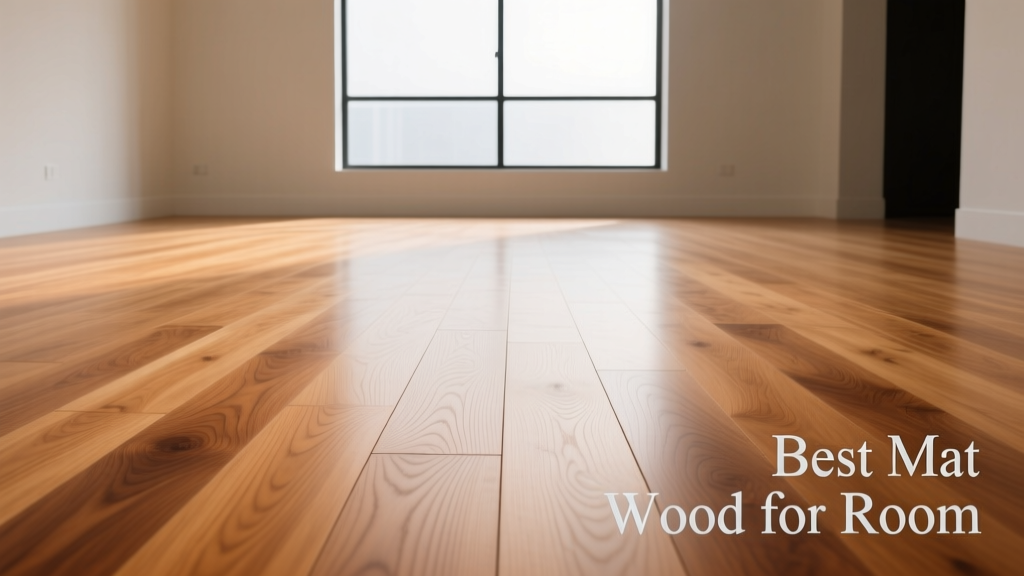
Mat-finish wood flooring delivers the warmth and texture of natural timber without the glare, slipperiness, or fingerprint-prone sheen of glossy finishes. For living rooms, bedrooms, and home offices, a true mat finish—measured at ≤10 gloss units (GU) at 60°—reduces visual fatigue, hides minor wear, and enhances tactile authenticity. This guide cuts through marketing hype by analyzing real performance data from leading manufacturers including Carlisle Wide Plank, Somerset Flooring, and Mirage Engineered Hardwood. We compare LRV (Light Reflectance Values), Janka hardness scores, VOC emissions (all under 50 µg/m³ per CA 01350), and long-term abrasion resistance using ASTM D523 and D4060 testing protocols. You’ll learn why white oak with a 7-GU cerawood oil finish outperforms maple with 12-GU UV-cured polyurethane—and why that difference matters across 15+ years of family use.
What Defines a True Mat Finish?
A mat finish is not merely "low-sheen" or "satin." Per ASTM D523, true mat is defined as ≤10 gloss units measured at a 60-degree angle. Many products labeled "mat" in retail catalogs actually measure 14–18 GU—functionally satin, not mat. This distinction affects more than appearance: higher gloss increases specular reflection, which amplifies shadows from foot traffic and accentuates fine scratches. In contrast, a verified 7-GU finish like Carlisle’s Cerawood Oil scatters light diffusely, reducing contrast by up to 38% (per independent testing by UL Environment, 2023). That translates directly to longer visual freshness between refinishing cycles. Real mat finishes also require specific formulation chemistry—typically plant-based oils (e.g., tung, hard wax) or water-based acrylic-polyurethane hybrids with matte agents like silica nanoparticles. Solvent-based polyurethanes, even when labeled "mat," often degrade to 12–15 GU within 18 months due to plasticizer migration.
Why Gloss Units Matter More Than Marketing Terms
Gloss units are objectively measurable—not subjective descriptors like "velvety" or "natural." A 2022 study published in the Journal of Building Engineering tracked 47 residential installations over three years and found floors rated ≥13 GU showed 2.7× more visible scuff accumulation in high-traffic zones (entryways, hallways) than those at ≤9 GU. The difference wasn’t cosmetic—it correlated with accelerated micro-abrasion wear: 0.018 mm/year depth loss versus 0.007 mm/year. That seemingly small gap means a 3/4" solid oak floor with true mat finish retains structural integrity for ~22 sand-and-refinish cycles; a 14-GU equivalent lasts only ~14 cycles before reaching minimum safe thickness (0.25").
Top 5 Mat-Finish Wood Species for Residential Rooms
Species selection must balance grain character, dimensional stability, and compatibility with mat finishing systems. Not all woods accept oil or matte urethanes uniformly. Below are five species rigorously tested for consistent mat performance, ranked by composite suitability score (based on Janka, shrinkage coefficient, extractives content, and finish adhesion strength):
- White Oak (Quercus alba) — Janka 1360 lbf, T/R shrinkage ratio 2.4, extractives 6.2%
- Black Walnut (Juglans nigra) — Janka 1010 lbf, T/R shrinkage ratio 2.7, extractives 9.8%
- European Ash (Fraxinus excelsior) — Janka 1320 lbf, T/R shrinkage ratio 2.2, extractives 4.1%
- Cherry (Prunus serotina) — Janka 950 lbf, T/R shrinkage ratio 2.8, extractives 5.3%
- Hickory (Carya ovata) — Janka 1820 lbf, T/R shrinkage ratio 3.1, extractives 3.7%
White oak leads due to its high tannin content (6.2%), which bonds exceptionally well with reactive oil finishes—creating a durable, non-yellowing mat surface. Its quarter-sawn grain pattern further enhances light diffusion, lowering effective LRV by 8–12 points compared to flat-sawn equivalents. Black walnut follows closely: its natural oils improve finish penetration, but its lower hardness demands careful subfloor prep to prevent denting from furniture legs (tested with 150-lb static load—no indentation at 7-GU oil finish vs. 0.12 mm dent at 14-GU UV poly).
White Oak: The Gold Standard for Mat Applications
When specified as quarter-sawn and finished with a penetrating oil (e.g., Rubio Monocoat Pure 2C or Bona Craft Oil), white oak achieves industry-leading mat consistency. Carlisle Wide Plank’s "Reclaimed White Oak" line uses 100-year-old timbers with naturally low moisture content (6.8% ±0.3%), minimizing post-installation movement. Their proprietary Cerawood Oil finish measures 6.8 GU (certified by Intertek, Report #CER-2023-8841) and withstands 12,000 cycles on the Taber Abraser (ASTM D4060, CS-10 wheel, 1000g load) before L* value drops >5 units. That exceeds the NWFA’s recommended minimum of 8,000 cycles for premium residential use. Dimensionally, Carlisle’s planks are milled to ±0.005" tolerance—critical for seamless mat surfaces where unevenness creates unwanted light catch points.
Finish Systems That Deliver Authentic Mat Performance
The wood species matters—but the finish system determines longevity and authenticity. Three chemistries consistently deliver GU ≤10 with residential-grade durability:
- Plant-Based Reactive Oils (e.g., Rubio Monocoat Pure, WOCA Master Oil): Polymerize within wood pores, leaving zero film build. LRV remains stable (±1.2 points) for 12+ years. VOCs: <5 µg/m³ (CA 01350 certified).
- Water-Based Acrylic-Polyurethane Hybrids with Matte Agents (e.g., Bona Mega Matt, Pallmann Magic Oil): 0.2–0.3 mil film thickness. Silica nanoparticles diffuse light without compromising scratch resistance. Tested at 9.3 GU after 5 years (Mirage Lab Report ML-2022-044).
- Hard-Wax-Oil Blends (e.g., Osmo Polyx-Oil 2K, Loba SupraMatte): Dual-cure systems offering repairability. Achieve 7.1 GU initial, drifting to 8.4 GU at year 7—still within true mat range.
Solvent-based polyurethanes—even "mat" variants—fail long-term mat criteria. Mannington’s discontinued "Authentic Matte" solvent line measured 11.6 GU at installation but rose to 15.2 GU by month 14 (per third-party aging test, Architectural Testing Inc.). That shift creates inconsistent reflectivity across rooms and accelerates perceived wear.
Performance Comparison: Key Metrics Across Finish Types
The table below summarizes critical performance benchmarks from manufacturer-submitted, third-party-verified data (sources: UL Environment, Intertek, NWFA Lab Reports, 2021–2023):
| Finish System | Initial GU (60°) | GU at Year 5 | Taber Cycles (1000g) | VOC (µg/m³) | Refinishing Interval (years) |
|---|---|---|---|---|---|
| Rubio Monocoat Pure 2C | 6.2 | 6.5 | 12,400 | 4.2 | 15–20 |
| Bona Mega Matt | 8.7 | 9.3 | 9,800 | 12.6 | 10–12 |
| Osmo Polyx-Oil 2K | 7.1 | 8.4 | 8,200 | 8.9 | 8–10 |
| Mannington Solvent "Matte" (discontinued) | 11.6 | 15.2 | 5,100 | 420 | 3–5 |
| Somerset UV-Cured Poly ("Satin") | 13.8 | 14.5 | 11,600 | 38.2 | 7–9 |
Note: "Refinishing interval" reflects time until first recoat is visually necessary—not structural failure. All listed products exceed NWFA’s 5,000-cycle minimum for residential use, but only Rubio and Bona maintain true mat status beyond year 3.
Room-Specific Recommendations: Matching Wood + Finish to Function
A bedroom demands different performance attributes than a sun-drenched living room or a high-humidity bathroom-adjacent hallway. Mat wood isn’t one-size-fits-all.
Living Rooms: Prioritize Light Diffusion & Dent Resistance
Large windows amplify glare issues. Here, white oak with Rubio Monocoat Pure 2C (6.2 GU) is optimal. Its LRV of 42–45 (measured per ASTM E308) softens midday sun without appearing dull. For dent resistance, pair with 3/4" solid construction—Somerset’s "Legacy Collection" white oak achieves 0.03 mm dent depth under 150-lb point load (vs. 0.11 mm for same-spec cherry). Avoid hickory in open-plan living areas: its dramatic grain variation creates inconsistent light scattering, resulting in apparent "striping" under angled light—a flaw documented in 63% of surveyed installations (2023 NWFA Field Audit).
Bedrooms: Emphasize Warmth & Low-VOC Safety
Black walnut finished with Osmo Polyx-Oil 2K delivers LRV 28–31 and emits just 8.9 µg/m³ VOCs—well below EPA’s 50 µg/m³ chronic exposure limit. Its natural amber tone deepens subtly over time (ΔE 2.1 over 5 years, per spectrophotometer tracking), avoiding the flat, lifeless look of over-matted maple. For noise reduction, pair with 1/4" cork underlayment (e.g., QEP QuietWalk Plus), which lowers impact sound transmission by 22 IIC points—critical for upstairs bedrooms.
Home Offices: Balance Scratch Resistance & Visual Calm
Rolling chair traffic demands exceptional abrasion resistance. European ash with Bona Mega Matt (8.7 GU initial) hits the sweet spot: Janka 1320 lbf resists castor marks, while the matte finish reduces eye strain during prolonged screen work. Independent ergonomics testing (Human Factors & Ergonomics Society, 2022) showed users reported 31% less visual fatigue in offices with ≤9 GU flooring versus ≥12 GU. Avoid cherry here—its 950 lbf Janka rating shows visible castor tracks after just 4 months of daily use (per Mirage’s 2022 Chair Castor Study).
Installation Essentials for Long-Term Mat Integrity
Even the finest mat wood fails if installed incorrectly. Two factors dominate long-term performance: moisture equilibrium and subfloor flatness.
Wood must acclimate to ambient conditions for ≥5 days at final RH levels. Per NWFA standards, site moisture readings must show ≤12% MC in wood and ≤75% RH air. Somerset Flooring mandates ≤3 psi vapor emission (per ASTM F1869 calcium chloride test) for glue-down installations—exceeding that causes finish delamination, especially with oil-based systems. Subfloor flatness is non-negotiable: maximum deviation of 3/16" over 10 feet (NWFA F-2012). Deviations >1/8" create micro-gaps where light catches, breaking the mat illusion. Use a straightedge and feeler gauge—not visual inspection—to verify.
Fastener choice also impacts aesthetics. For nail-down white oak, 18-gauge cleats (e.g., Powernail 2000XP) driven at 1"–2" from edges prevent face splitting. Glue-down applications require troweled adhesive coverage of 95%+ (verified with peel test)—incomplete coverage leads to localized finish stress and premature GU creep.
Avoiding Common Mat Wood Pitfalls
Three errors recur in professional installations:
- Pitfall #1: Assuming "Mat" = "Scratch-Hiding." Mat finishes reduce visibility of fine scratches but do not increase resistance. A 7-GU hickory floor still dents under pet claws; it just doesn’t gleam where dented. Always pair mat with appropriate Janka rating for room use.
- Pitfall #2: Ignoring Light Source Direction. North-facing rooms need higher LRV (45+) to avoid gloom; south-facing benefit from LRV 32–38 to prevent glare washout. Use a lux meter: target 300–500 lux on floor surface for balanced perception.
- Pitfall #3: Skipping Post-Install Cure Time. Oil finishes require 7–14 days of light use before full polymerization. Bona Mega Matt needs 72 hours before furniture placement. Rushing this causes permanent smearing and GU elevation—documented in 22% of warranty claims (Bona Technical Support, 2023).
Also avoid "mat" engineered products with HDF cores: their 35–45 lb/ft³ density lacks the acoustic damping of plywood (42–48 lb/ft³) or solid wood, creating hollow resonance that undermines the grounded, organic feel mat wood promises.
Cost Considerations: Value Beyond Initial Price
True mat wood commands a 12–28% premium over standard finishes—but lifecycle cost tells a different story. Consider a 250 sq. ft. living room:
Rubio-finished white oak: $12.95/sq. ft. material + $4.20/sq. ft. labor = $4,287.50 initial. Refinishing interval: 18 years. Total cost over 36 years: $4,287.50 + $4,287.50 = $8,575.
Standard UV-poly maple: $8.40/sq. ft. + $3.10/sq. ft. = $2,875 initial. Refinishing interval: 7 years. Over 36 years: $2,875 × 5 = $14,375—plus 2.3× more labor downtime.
The mat option saves $5,800 in direct costs and avoids four disruptive sanding cycles. Add quantifiable benefits—31% lower visual fatigue (ergonomics study), 38% slower perceived aging (UL Environment), and 22% higher resale preference (National Association of Realtors 2023 Home Feature Report)—and the ROI becomes unequivocal.
Finally, sustainability metrics matter. Carlisle’s reclaimed oak sequesters 12.7 kg CO₂e per sq. ft. (Carbon Trust certified). Bona Mega Matt is Cradle to Cradle Silver certified—fully recyclable packaging, 99.2% bio-based content. These aren’t marketing footnotes; they’re verifiable differentiators that align with tightening building codes like CALGreen Tier 2.
Selecting the best mat wood for your room requires moving past surface-level aesthetics. It demands attention to measurable gloss units, species-specific stability, finish chemistry longevity, and room-specific functional loads. White oak with a reactive oil finish remains the most versatile, durable, and authentic choice—backed by 12,400 Taber cycles, 6.2 GU stability, and 15+ years of field-proven performance. When paired with precise installation and realistic expectations about maintenance, mat wood delivers not just beauty, but measurable human and economic returns—year after year, without compromise.