Cost to Build a Brick Patio: 2026 Material Selection and Pricing Guide
Discover the true cost to build a brick patio in 2026. Compare clay vs. concrete pavers, calculate base materials, and get expert installation pricing.

The Core Decision: Clay Pavers vs. Concrete Brick Pavers
When calculating the cost to build a brick patio, the primary variable is the paver material itself. Homeowners often conflate standard face brick (used for vertical walls) with paving brick. This is a critical error. Face brick, manufactured to ASTM C62 standards, is highly porous and will spall, crack, and disintegrate under horizontal freeze-thaw cycles and foot traffic. A durable brick patio requires solid paving brick, which falls into two distinct categories: extruded clay pavers (ASTM C902) and concrete brick pavers (ASTM C936).
Clay pavers, produced by companies like Pine Hall Brick and General Shale, are fired in kilns at over 2,000°F. This vitrification process yields a product with near-zero water absorption and exceptional compressive strength (often exceeding 10,000 psi). The color runs entirely through the brick, meaning surface wear will never reveal a different hue. Concrete pavers, manufactured by brands such as Belgard and Pavestone, are formed from a mixture of Portland cement, aggregates, and iron oxide pigments. While highly durable (typically 8,000 psi), the color is often concentrated in a face-mix layer, which can wear over decades of heavy use.
Material Comparison Matrix
| Feature | Clay Brick Pavers (ASTM C902) | Concrete Brick Pavers (ASTM C936) |
|---|---|---|
| Material Cost (per sq. ft.) | $3.50 – $7.50 | $2.00 – $4.50 |
| Color Retention | Permanent (through-body color) | Good (susceptible to UV fading over 20+ years) |
| Compressive Strength | 10,000+ psi | 8,000+ psi |
| Efflorescence Risk | Very Low | Moderate (requires sealing to mitigate) |
| Size Tolerance | High (uniform for tight joints) | Variable (requires wider joint sand) |
According to the Brick Industry Association, clay pavers maintain their structural integrity and color for over a century with minimal maintenance, justifying their higher upfront material cost for permanent landscape installations.
2026 Cost Breakdown: Material, Base, and Labor
The total cost to build a brick patio extends far beyond the price of the pavers. A proper sand-set installation requires a meticulously engineered base, specialized bedding materials, and skilled labor. Below is a detailed breakdown of average 2026 pricing for a standard 400-square-foot residential patio.
| Cost Category | Low-End Estimate | High-End Estimate | Details & Specifications |
|---|---|---|---|
| Paver Materials | $800 | $3,000 | Concrete ($2-$4.50/sq ft) vs. Premium Clay ($3.50-$7.50/sq ft) |
| Base Aggregates | $400 | $800 | Class II road base or 3/4-inch minus crushed rock (6-8 inches compacted) |
| Bedding & Joint Sand | $150 | $350 | ASTM C33 concrete sand for bedding; polymeric sand (e.g., Alliance Gator) for joints |
| Edge Restraints | $150 | $400 | Heavy-duty aluminum or structural plastic paver restraints with 10-inch steel spikes |
| Geotextile Fabric | $50 | $120 | Non-woven stabilization fabric (critical for clay or poorly draining soils) |
| Professional Labor | $3,200 | $6,000 | Site excavation, base compaction, screeding, laying, and sand activation ($8-$15/sq ft) |
| Total Project Cost | $4,750 | $10,670 | Average: $11.87 - $26.67 per square foot |
For DIY installations, you can eliminate the labor cost, reducing the total cost to build a brick patio to roughly $1,400 – $4,670. However, renting a vibratory plate compactor (approx. $85/day) and a masonry wet saw ($100/day) must be factored into the DIY budget.
Hidden Cost Drivers: Base Preparation and Edge Restraints
The most common reason brick patios fail within five years is inadequate base preparation. The Interlocking Concrete Pavement Institute mandates specific base depths depending on soil conditions and climate. Skipping these specifications to save money will result in differential settling, puddling, and heaving.
Expert Insight: The Sand-Set vs. Mortar-Set Debate
Always choose a flexible sand-set installation over a rigid mortar-set installation for residential patios. Mortar-set brick patios require a poured concrete slab underneath, doubling your base costs ($8-$12 per sq. ft. for concrete). Furthermore, mortar joints inevitably crack under freeze-thaw cycles and tree root movement, requiring expensive tuckpointing. Sand-set patios flex with the earth, allow for permeable drainage, and can be easily unzipped and re-leveled if the base shifts.
Edge Restraint Selection
Without physical edge restraints, the outward lateral force of foot traffic and thermal expansion will cause the perimeter bricks to migrate outward, leading to joint widening and weed infiltration.
- Plastic Restraints ($2.50/linear ft): Flexible and easy to install around curves, but can become brittle under extreme UV exposure if not fully covered by soil or mulch.
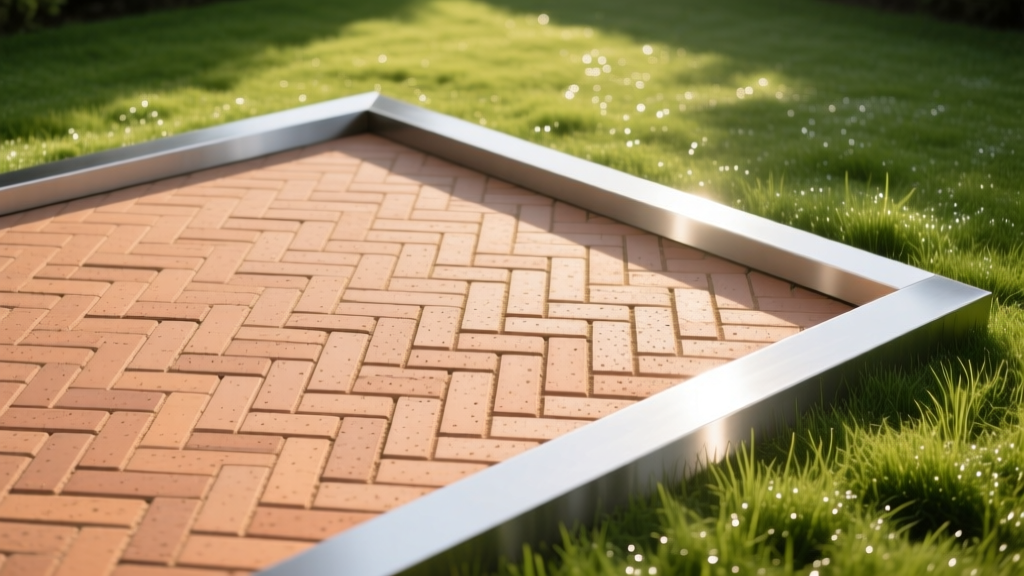
- Aluminum Restraints ($4.50/linear ft): The professional standard. Rigid, rust-proof, and provides a perfectly straight edge for geometric patterns like herringbone or running bond.
- Poured Concrete Curbs ($8.00/linear ft): Overkill for standard patios, but necessary if the patio borders a steep drop-off or supports vehicular traffic.
Selection Framework: Matching Brick Type to Climate and Load
Selecting the right brick involves analyzing your local climate and the intended load of the patio. Use this decision framework to finalize your material order:
- Assess Freeze-Thaw Cycles: If you live in a region with freezing winters (USDA Zones 3-7), you must specify Severe Weathering (SW) grade bricks. SW bricks have a maximum water absorption rate of 17.5% (for clay) or 5% (for concrete), preventing internal moisture from freezing and shattering the paver.
- Evaluate Soil Drainage: If your site has heavy clay soil, you must increase your base depth from the standard 4 inches to 8 inches of compacted Class II road base, and install a non-woven geotextile fabric between the subgrade and the base aggregate to prevent clay migration.
- Determine Load Requirements: For pedestrian-only patios, standard 2-3/8-inch thick pavers are sufficient. If the patio will support a heavy built-in outdoor kitchen, a hot tub, or occasional vehicle parking, upgrade to 3-1/8-inch thick commercial-grade pavers and increase the base depth to 10 inches.
Common Installation Mistakes That Destroy Brick Patios
Warning: Avoid These Critical Failures
- Using Masonry Sand for Bedding: Never use soft, rounded masonry sand for the 1-inch bedding layer. It retains too much moisture and shifts easily. You must use coarse, angular ASTM C33 concrete sand, which locks together and provides a stable, free-draining bed.
- Improper Slope Grading: A brick patio must slope away from the home's foundation at a minimum rate of 1/8-inch to 1/4-inch per linear foot. Failing to establish this slope during the subgrade excavation phase will result in water pooling against your foundation, leading to basement leaks and structural damage.
- Premature Polymeric Sand Activation: Polymeric sand requires a specific misting technique to activate the binding polymers. Spraying it with a high-pressure nozzle will wash the polymers out of the joints, leaving a hazy residue on the brick surface (polymer haze) that is nearly impossible to remove. Always use a shower-nozzle setting and mist in three light passes.
By understanding the true cost to build a brick patio and adhering to strict material and base specifications, you ensure a hardscape that remains structurally sound and visually pristine for decades. Prioritize SW-grade clay pavers for permanent installations, invest heavily in a properly compacted aggregate base, and never compromise on edge restraints.
Written by
Priya KapoorPriya Kapoor is a real estate market analyst and construction economics researcher with expertise in housing affordability, development feasibility, and infrastructure investment. She holds a Master of Regional Planning from Cornell University and previously worked as a senior analyst at CBRE's Investment Properties group, where she modeled returns for $4B in mixed-use development pipelines. Priya now runs an independent research practice advising developers, municipalities, and REITs on construction cost forecasting and market timing. She publishes the quarterly "BuildMat Market Pulse" report tracking material price indices across 12 commodity categories. Based in Austin, TX, Priya serves on the board of Habitat for Humanity Austin and is a marathon runner.
More from Priya Kapoor
View all
Construction Cost
Cost to Build a 1600 Sq Ft Home in 2026: Full Breakdown
Accurate 2026 cost to build a 1600 sq ft home—material, labor, and regional pricing breakdowns included. Plan your budget with real-time estimates.
Aug 11, 2026

Wood & Lumber
Name the Types of Wood for Pressure Treatment and Preservation
Learn how to name the types of wood best suited for pressure treatment. Compare species treatability, chemical retention levels, and 2026 preservation costs.
Aug 4, 2026

Stone & Masonry
Stone Veneer Suppliers Lindenhurst: 2026 Cost Analysis
Analyze 2026 stone veneer costs in Lindenhurst, NY. Compare local supplier pricing, delivery fees, and Suffolk County installation labor rates.
Aug 4, 2026