Brick and White Exteriors: Material Taxonomy and Selection Guide
Compare true white clay brick, limewash, and painted brick. Expert taxonomy and selection guide for durable brick and white exterior palettes.
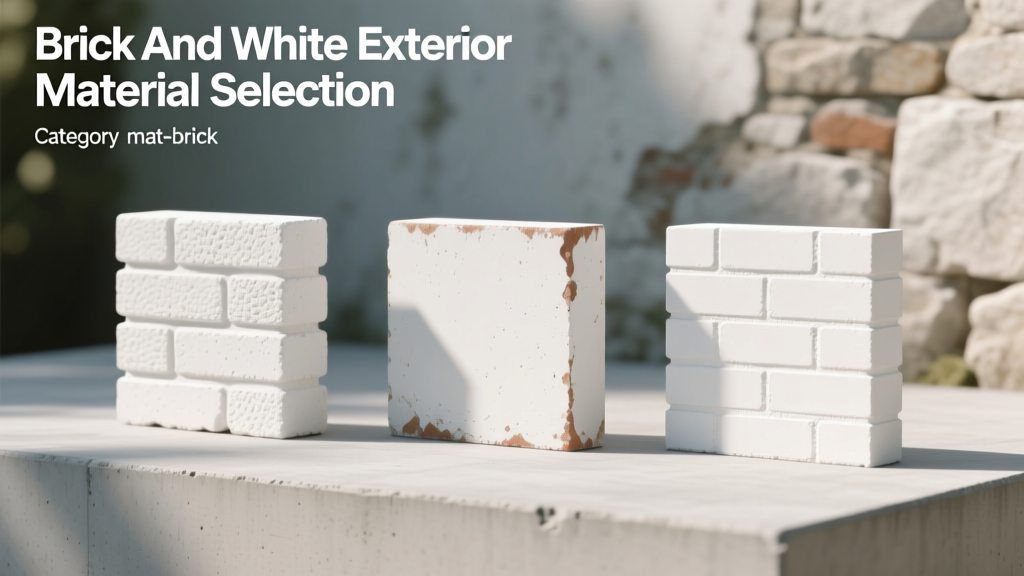
The Material Taxonomy of 'Brick and White' Exteriors
The 'brick and white' aesthetic remains a dominant force in both residential and commercial architecture. This design language relies on the high-contrast interplay between the heavy, textured thermal mass of clay masonry and the crisp, light-reflective properties of white finishes, trim, or secondary cladding. However, achieving this look requires precise material selection. Specifying the wrong white finish or pairing incompatible cladding systems can lead to moisture entrapment, spalling, and premature facade failure.
For architects, builders, and homeowners, navigating the 'brick and white' palette requires understanding the distinct material categories available. This guide breaks down the taxonomy of white brick materials, cladding pairings, and the critical mortar specifications required for long-term durability.
Category 1: True White Clay Brick
True white brick is not painted or coated; it is manufactured from specific clay deposits. Unlike standard red clay bricks that derive their color from iron oxide, white clay bricks are formulated using kaolin clay and ball clays with exceptionally low iron and carbon content. These bricks are fired at temperatures exceeding 2,000°F (1,093°C) to achieve full vitrification.
Selection Criteria and Cost
- Material Cost: Typically ranges from $950 to $1,400 per thousand units (as of 2026), making it a premium investment compared to standard red face brick ($600–$800).
- Durability: High-density extruded white bricks offer a compressive strength of 8,000+ psi and an initial rate of absorption (IRA) that requires careful mortar matching.
- Best Application: High-end commercial facades and modern residential builds where a permanent, maintenance-free white masonry surface is required.
Category 2: Limewashed Brick (Mineral Silicate Coatings)
When the design calls for the texture of traditional red brick softened by a white, mottled finish, limewash is the superior material choice. Unlike modern paints, limewash is a mineral coating made from slaked lime (calcium hydroxide). When applied to masonry, it undergoes a carbonation process, reacting with atmospheric CO2 to form calcium carbonate, effectively petrifying into a micro-layer of limestone.
The critical advantage of limewash (such as Romabio Classico Limewash) is its 100% vapor permeability. It allows trapped moisture within the brick wythe to evaporate freely. This prevents the hydrostatic pressure buildup that causes winter freeze-thaw spalling, a common failure mode in colder climates.
Category 3: Painted Brick (Acrylic and Elastomeric)
Painting brick solid white using acrylic or elastomeric masonry coatings (e.g., Sherwin-Williams Loxon) provides the most uniform, opaque white finish. However, this method fundamentally alters the hygrothermal behavior of the wall assembly. Standard acrylic paints form a plastic-like film that can trap moisture inside the masonry. If a brick wall absorbs water from the interior or through micro-cracks, an impermeable paint film will blister and peel as the moisture attempts to escape.
Specification Rule: If painting brick white, you must specify a siloxane-modified or highly breathable elastomeric coating with a water vapor transmission rate (WVTR) of at least 15 perms. Never use standard exterior house paint on raw masonry.
Cladding Pairings: Brick and White Siding
The most common interpretation of the 'brick and white' aesthetic is pairing a brick water-resistive base with white horizontal or vertical siding. White fiber cement siding (such as James Hardie Primelap or Artisan lap) is the industry standard for this pairing due to its dimensional stability and fire resistance.
Critical Transition Details
Where the brick masonry terminates and meets white fiber cement siding, moisture management is paramount. You must install a continuous Z-flashing with a 1/4-inch hemmed edge above the brick course. Weep holes must be maintained at 24-inch intervals along this transition to allow water draining down the back of the siding to exit the wall cavity. Failing to flash this transition will result in water wicking into the bottom edge of the fiber cement, causing swelling and delamination.
Material Selection Matrix
| Material Type | Est. Cost (per sq ft) | Vapor Permeability | Maintenance Cycle | Best Use Case |
|---|---|---|---|---|
| True White Clay Brick | $14.00 - $22.00 | High (Inherent) | None (Lifetime) | New construction, premium facades |
| Limewash over Red Brick | $1.50 - $3.00 | Very High | 5 - 10 Years | Historic renovations, textured aesthetics |
| Breathable Masonry Paint | $2.50 - $4.50 | Moderate to High | 7 - 12 Years | Uniform modern aesthetics, flip projects |
| Brick + White Fiber Cement | $18.00 - $28.00 | High (System dependent) | 15+ Years (Paint) | Transitional architecture, mixed textures |
Mortar Selection for White Brick Masonry
The mortar joint accounts for nearly 20% of a brick wall's visible surface area. When working with white brick or designing a stark 'brick and white' contrast, mortar selection is critical. Standard gray Portland cement will muddy the appearance of white brick and create a mottled, dirty look over time.
According to guidelines supported by the Brick Industry Association, you must specify White Masonry Cement (which utilizes white Portland cement and titanium dioxide pigments) conforming to ASTM C270. Furthermore, the aggregate must be a washed, light-colored silica sand. Avoid standard masonry sand, which often contains dark loam or iron impurities that will bleed into the white mortar joints during the curing process.
Common Failure Modes and Edge Cases
1. Efflorescence on Painted Brick
Efflorescence occurs when water-soluble salts migrate to the surface of the brick and crystallize. On unpainted red brick, this appears as a white, powdery residue. On white painted brick, however, the crystallization happens behind the paint film, creating immense hydrostatic pressure that pops the paint off the wall in large, brittle flakes. Fix: Always treat raw brick with a silane/siloxane penetrating water repellent and allow a 28-day curing period before applying any white opaque coating.
2. Thermal Shock on Dark-to-White Transitions
If an existing dark red or brown brick building is painted stark white, the wall's thermal dynamics change drastically. The wall will absorb significantly less solar radiation, reducing the thermal expansion of the brick wythe. While this sounds beneficial, it can alter the performance of existing, aged expansion joints. Ensure that existing vertical expansion joints are inspected and repointed with a high-modulus polyurethane sealant before painting.
Specification Checklist for Architects and Builders
Pre-Installation Verification
- Clay Verification: Confirm kaolin clay origin and iron-oxide test results for true white brick orders.
- Mortar Mockup: Require a 4x4 ft physical mockup of the white brick with the specified white silica sand mortar to verify color consistency under natural daylight.
- Moisture Testing: Test existing brick for internal moisture content (must be below 12%) before applying limewash or elastomeric white paint.
- Flashing Audit: Verify Z-flashing and weep hole placement at all masonry-to-white-siding transitions prior to siding installation.
- Sealant Compatibility: Ensure the polyurethane sealant used at masonry control joints is paintable and compatible with the specific white coating selected.
Selecting the right materials for a 'brick and white' exterior goes far beyond color matching. By understanding the hygrothermal properties of limewash, the structural permanence of kaolin clay, and the strict flashing requirements of mixed-cladding systems, builders can deliver facades that are as durable as they are visually striking.