Pound of Feathers or Pound of Bricks: Masonry Density and Grades
Explore the 'pound of feathers or pound of bricks' riddle through masonry density. Compare brick weights, ASTM grades, and structural load metrics.

The Physics of Masonry: Mass, Volume, and Bulk Density
The classic riddle—"What weighs more, a pound of feathers or a pound of bricks?"—tricks the brain into confusing mass with density. While a pound of mass is identical regardless of the material, the volume required to achieve that pound differs drastically. In structural masonry, this distinction between weight (mass) and bulk density (mass per unit volume) is not a parlor trick; it is the foundational metric that dictates structural integrity, thermal performance, acoustic dampening, and dead load calculations on foundation engineering.
When specifying masonry units in 2026, architects and structural engineers do not simply order "bricks." They specify units based on ASTM grading systems that dictate compressive strength, absorption rates, and density. Understanding the density spectrum—from ultra-dense engineering bricks to lightweight aerated units—is critical for optimizing both material costs and structural longevity.
ASTM Brick Classifications: Weathering and Density
The Brick Industry Association (BIA) and ASTM International categorize clay masonry units primarily by their resistance to environmental degradation and their physical cross-section. Density directly influences these grades.
Weathering Index Grades
- Severe Weathering (SW): High-density bricks designed for freeze-thaw cycles. They possess low porosity (typically under 17% absorption) and high compressive strength (minimum 3,000 psi). Their dense matrix prevents water ingress, which is the primary catalyst for spalling.
- Moderate Weathering (MW): Medium-density bricks used in exterior walls protected by overhangs or in interior applications. They allow higher absorption rates but offer better thermal insulation than SW bricks.
- Negligible Weathering (NW): Low-density, highly porous bricks strictly for interior, non-load-bearing partitions. They are lightweight and easy to cut but will rapidly deteriorate if exposed to moisture.
Solid vs. Hollow Cross-Sections
Under ASTM C62 (Solid Brick) and ASTM C652 (Hollow Brick), the distinction lies in the core area. Solid bricks must have a net cross-sectional area of at least 75% in every plane parallel to the bearing surface. Hollow bricks feature larger core voids, reducing the overall unit weight by up to 30% while maintaining the same nominal footprint. This reduction in mass lowers freight costs—a significant factor in 2026 supply chain economics—and reduces the dead load on the building's foundation without sacrificing the structural shell's dimensions.
High-density engineering bricks (140+ pcf) require careful mortar selection. Because dense bricks absorb very little water, they do not draw moisture out of the mortar bed quickly. Using a standard Type N mortar on a high-density, low-absorption brick can lead to delayed setting, unit slippage, and compromised bond strength. In these scenarios, a Type S mortar with specific water-retention additives is required to ensure a proper mechanical and chemical bond.
Real-World Weight Metrics: What Does a Brick Actually Weigh?
To ground the "pound of bricks" concept in reality, we must look at the specific metrics of modern masonry units. The table below contrasts standard modular units across different material densities.
| Brick / Unit Type | Nominal Size (W x H x L) | Average Unit Weight | Bulk Density (pcf) | Compressive Strength (psi) |
|---|---|---|---|---|
| Standard Modular Clay (SW) | 4" x 2 2/3" x 8" | 4.2 - 4.5 lbs | 120 - 130 pcf | 3,500 - 5,000 |
| Engineering Brick (Class A) | 4" x 2 2/3" x 8" | 5.2 - 5.8 lbs | 140 - 150 pcf | 8,000 - 12,000+ |
| Hollow Clay Brick (ASTM C652) | 4" x 4" x 12" | 6.0 - 7.5 lbs | 85 - 105 pcf | 3,000 - 4,000 |
| Autoclaved Aerated Concrete (AAC) | 8" x 8" x 16" | 18.0 - 22.0 lbs | 30 - 45 pcf | 300 - 600 |
| Lightweight CMU (Expanded Shale) | 8" x 8" x 16" | 28.0 - 32.0 lbs | 85 - 105 pcf | 2,000 - 3,000 |
The "Featherweight" Contenders: Lightweight and Aerated Masonry
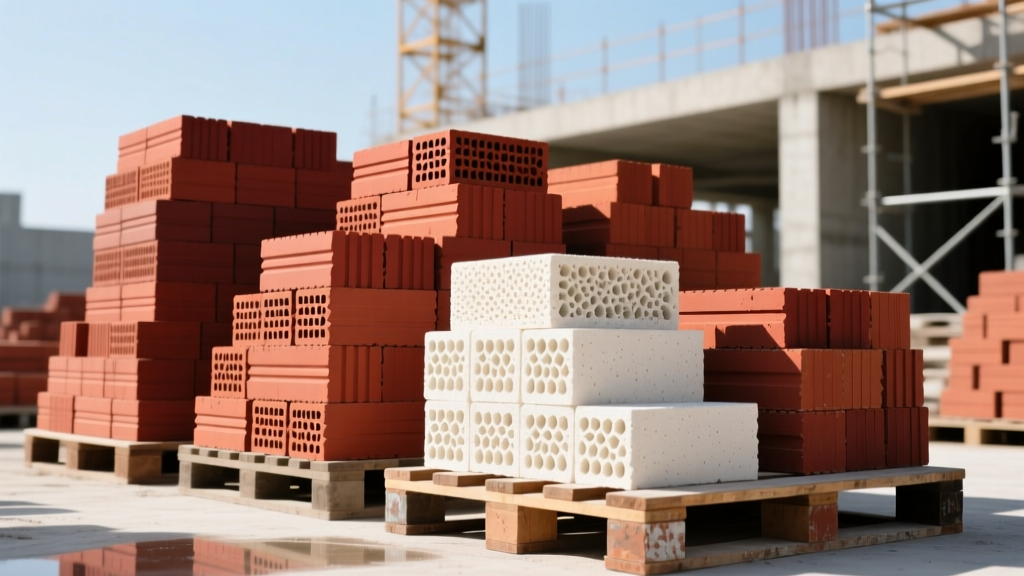
If standard clay bricks represent the traditional "pound of bricks," Autoclaved Aerated Concrete (AAC) and lightweight Concrete Masonry Units (CMU) represent the masonry equivalent of the "pound of feathers." They occupy massive volume for a fraction of the traditional weight.
AAC blocks are manufactured by introducing an expanding agent (like aluminum powder) into a cementitious slurry, creating millions of microscopic air voids. According to data from the National Concrete Masonry Association (NCMA), utilizing lightweight aggregates like expanded shale, clay, or slate in CMU production reduces unit weight by up to 40% compared to normal-weight stone aggregates. This reduction drastically improves the R-value (thermal resistance) of the wall assembly, often eliminating the need for continuous exterior rigid foam insulation in moderate climate zones.
Structural Implications of Brick Density
Choosing between high-density and low-density masonry is a structural trade-off that impacts three critical building systems:
1. Foundation Dead Loads
A standard masonry veneer wall exerts approximately 40 to 45 pounds per square foot (psf) of dead load on the foundation shelf. By switching to a hollow clay brick or lightweight CMU system, that load can drop to 25-30 psf. Over a three-story commercial build, this reduction can save tens of thousands of dollars in foundation concrete and steel reinforcement by allowing engineers to design narrower footings and smaller grade beams.
2. Thermal Mass vs. Insulation
High-density bricks possess exceptional thermal mass. They absorb solar radiation during the day and release it slowly at night, a passive design strategy highly effective in arid, high-diurnal-swing climates. However, their actual R-value is remarkably low (typically R-0.2 per inch). Conversely, lightweight "featherweight" masonry offers lower thermal mass but significantly higher intrinsic R-values (up to R-1.25 per inch for AAC), making it superior for continuous insulation requirements in colder, northern climates.
3. Acoustic Transmission Class (STC)
Mass blocks sound. The Masonry Society notes that the Sound Transmission Class (STC) rating of a masonry wall is directly proportional to its mass per unit area. A solid, high-density brick wall will easily achieve an STC of 50+, effectively blocking loud speech and street noise. Lightweight aerated units require additional acoustic treatments, such as resilient channels and dense gypsum board laminations, to achieve equivalent acoustic privacy.
"In masonry design, you cannot cheat physics. If you reduce the density of the wall to save on structural loads, you must compensate with added insulation for thermal code compliance and added mass layers for acoustic separation." — Structural Engineering Principles in Modern Masonry
Selection Framework: Matching Density to Project Requirements
Use the following decision matrix to specify the correct masonry density for your next project:
- Specify High-Density (Engineering / Solid SW Clay) When: You are designing retaining walls, below-grade foundation walls, paving bricks, or structures exposed to severe freeze-thaw cycles and high mechanical impact (e.g., industrial loading docks).
- Specify Medium-Density (Standard Modular / Hollow Clay) When: You are constructing standard residential or commercial veneer walls, cavity walls, and architectural facades where traditional aesthetics, moderate thermal mass, and standard load-bearing capacities are required.
- Specify Low-Density (AAC / Lightweight CMU) When: You are building multi-story structures where minimizing dead load on steel/concrete frames is paramount, or when designing exterior walls in strict energy-code jurisdictions that demand high intrinsic R-values without adding thick exterior foam profiles.
Ultimately, the riddle of the feathers and the bricks is resolved not by the scale, but by the blueprint. A pound of mass remains constant, but the architectural application of that mass determines whether a structure will stand efficiently for a century or fail under its own mismanaged weight.
Written by
Elena RodriguezElena Rodriguez is a civil engineer and technical writer specializing in concrete technology, masonry systems, and ASTM/ACI compliance. She earned her B.S. in Civil Engineering from Texas A&M University and spent a decade at a materials testing laboratory, performing over 2,000 concrete compressive strength tests and masonry prism evaluations. Elena is an ACI-certified Field Testing Technician (Grade I) and a member of ASTM Committee C12 on Natural Building Stone. She currently consults on forensic engineering cases involving concrete failures and moisture intrusion. Based in San Antonio, TX, Elena is a proud member of the Society of Women Engineers (SWE) and coaches her daughter's FIRST Robotics team.
More from Elena Rodriguez
View all
Walls & Panels
Cost Analysis: Light Gauge Steel Framing Advantages and Disadvantages
Evaluate light gauge steel framing advantages and disadvantages through a strict cost analysis lens, comparing material, labor, and lifecycle expenses.
Aug 4, 2026

Walls & Panels
Gypsum Board Types: Exact Specifications, Thickness & Dimensions
Compare standard, Type X, and moisture-resistant gypsum board types. Get exact specifications, thicknesses, dimensions, and ASTM standards for your project.
Aug 4, 2026

Fire Resistance
Best Fire-Resistant Outdoor Decking Materials: 2026 Buyer Guide
Discover the best fire-resistant outdoor decking materials for 2026. Compare Class A PVC, aluminum, and hardwood options for WUI compliance and safety.
Aug 4, 2026