Pavers or Bricks: A Complete Hardscape Material Guide
Deciding between pavers or bricks for your patio or driveway? Compare costs, durability, ASTM standards, and installation methods in our complete guide.

The Core Distinction: Face Brick, Paving Brick, and Concrete Pavers
When homeowners and contractors debate whether to use pavers or bricks for hardscape projects, the conversation is often clouded by a fundamental misunderstanding of material classifications. Laying standard face brick flat on the ground is a common DIY error that leads to rapid spalling, cracking, and frost heave. To make an informed decision, you must differentiate between three distinct manufactured units:
- Face Brick (ASTM C216): Designed for vertical, structural, or veneer applications. It has lower compressive strength and higher porosity. Never use this for horizontal paving.
- Clay Paving Brick (ASTM C902): Extruded or molded clay fired at extreme temperatures (up to 2,000°F) specifically engineered for horizontal pedestrian and light vehicular traffic.
- Concrete Pavers (ASTM C936): Manufactured from a zero-slump concrete mixture, vibratory-pressed into molds, and cured. They rely on interlocking geometric shapes for structural integrity.
The choice between pavers or bricks ultimately comes down to comparing ASTM C902 clay pavers against ASTM C936 concrete pavers. Both are exceptional materials, but their physical properties dictate entirely different installation methods, maintenance profiles, and ideal use cases.
Material Composition and ASTM Performance Standards
The manufacturing process directly impacts the compressive strength, absorption rate, and freeze-thaw durability of the paving units. According to the Brick Industry Association (BIA) Technical Notes, material selection must align with local climate and load-bearing requirements.
Clay Paving Brick (ASTM C902)
High-quality clay pavers are classified into three types based on traffic: Type I (pedestrian), Type II (vehicular up to 8,000 lbs), and Type III (heavy vehicular). For residential driveways, Type II is the minimum standard. These bricks boast a minimum compressive strength of 8,000 psi and a maximum water absorption rate of 7% (for severe weathering regions). The color runs entirely through the unit because it is derived from the natural shale and clay composition, meaning surface wear will not reveal a different color beneath.
Solid Concrete Interlocking Pavers (ASTM C936)
Concrete pavers are manufactured to a minimum compressive strength of 8,000 psi, but modern vibratory-pressing techniques often yield units exceeding 9,500 psi. The National Concrete Masonry Association (NCMA) notes that concrete pavers are highly resistant to de-icing salts when properly air-entrained during manufacturing. However, their color is typically applied as a 1/8-inch wear layer over a gray concrete core. Over decades of traffic, this wear layer can erode, exposing the aggregate base.
Performance Matrix: Pavers or Bricks by Application
Selecting the right material requires matching its physical properties to the specific environmental and structural demands of the project site.
| Application | Clay Paving Brick (ASTM C902) | Concrete Paver (ASTM C936) | Optimal Choice |
|---|---|---|---|
| Residential Driveways | High compressive strength, but rectangular shapes lack shear interlock. Requires strict edge restraints to prevent spreading under turning tires. | Interlocking geometric shapes distribute vehicular shear loads laterally. Highly resistant to tire scuffing and turning forces. | Concrete Pavers |
| Pool Decks | Naturally cooler to the touch due to thermal mass and color. High slip resistance when wet. Resists chlorine and saltwater degradation. | Can become uncomfortably hot in direct summer sun. Lighter colors mitigate heat but show staining from pool chemicals and algae. | Clay Brick |
| Patios & Walkways | Offers timeless, traditional aesthetics. Color never fades. Requires wider joints (3/8" to 1/2") due to slight dimensional variations. | Available in endless shapes, textures, and sizes. Precision manufacturing allows for tight 1/8" joints and complex laying patterns. | Tie (Aesthetic) |
| Permeable Systems | Permeable clay brick exists but is niche, expensive, and requires specialized open-graded aggregate jointing. | Permeable Interlocking Concrete Pavers (PICP) are an industry standard, heavily tested for stormwater management and LEED credits. | Concrete Pavers |
Installation Realities: Base Prep, Bedding, and Edge Restraints
The most common cause of hardscape failure is not the material itself, but improper base preparation. Both clay bricks and concrete pavers utilize flexible pavement design, meaning the structural integrity relies entirely on the underlying aggregate base and lateral confinement.
Step 1: The Aggregate Base
Do not use gravel or rounded river rock. You must use crushed, angular aggregate (typically Class II road base or 3/4-inch minus crushed limestone). The angular faces lock together when compacted. For pedestrian patios, a 4-inch compacted base is sufficient. For driveways, you need a minimum of 6 to 8 inches of compacted base, laid in 2-inch lifts (layers) to achieve 95% Proctor density.
Step 2: Bedding Sand Selection
The bedding layer must be 1 inch of coarse, washed concrete sand meeting ASTM C33 specifications. Never use mason sand, play sand, or stone dust. These materials contain fine particles (silt and clay) that trap water, leading to frost heave in freezing climates and efflorescence migration in warm climates. The sand should be screeded perfectly level; do not compact the bedding sand before laying the units.
Step 3: Edge Restraints
Without lateral confinement, pavers and bricks will creep outward under load, opening the joints and allowing the bedding sand to wash out. You have two viable options:
- Poured Concrete Curb: The gold standard. A 6-inch wide by 6-inch deep poured concrete beam troweled against the perimeter. It will never shift, bend, or degrade.
- Plastic/Composite Snap-Edge: Secured with 10-inch galvanized or stainless steel landscaping spikes driven every 12 inches. This is faster and cheaper but can warp over decades of freeze-thaw cycles if the base beneath the edge restraint is not fully compacted.
Cost Breakdown: 2026 Material and Labor Estimates
When budgeting for pavers or bricks, material costs are only a fraction of the total expense. Base preparation and labor dominate the final invoice. Below are the average national costs for 2026.
| Cost Category | Clay Paving Brick | Concrete Pavers |
|---|---|---|
| Material (Per Sq. Ft.) | $5.50 - $9.00 | $3.50 - $6.50 |
| Base & Bedding Materials | $2.50 - $4.00 | $2.50 - $4.00 |
| Polymeric Jointing Sand | $0.75 - $1.25 | $0.50 - $0.90 |
| Professional Installation Labor | $8.00 - $14.00 | $6.00 - $12.00 |
| Total Installed Cost | $16.75 - $28.25 | $12.50 - $23.40 |
Note: Complex patterns (like herringbone), severe grading requirements, or retaining wall integration will push labor costs to the higher end of these ranges.
Maintenance, Weathering, and Efflorescence
The long-term maintenance profiles of clay and concrete differ significantly, primarily due to how they handle moisture and UV exposure.
Expert Insight on Efflorescence: Efflorescence is the white, powdery residue that appears on masonry surfaces. It is caused by water-soluble salts migrating to the surface and evaporating. While both materials can experience it, concrete pavers are vastly more prone to primary efflorescence due to the free lime present in Portland cement. Clay bricks, having been fired at 2,000°F, have already calcified most of their soluble salts.
Joint Stabilization: Polymeric vs. Regular Sand
For both materials, jointing sand is critical. Standard silica sand allows weed growth and ant infestations. Polymeric sand contains water-activated polymers that bind the sand grains together, creating a flexible, impermeable joint. When using polymeric sand with clay brick, ensure the brick surface is completely dry and swept perfectly clean before activation; otherwise, the polymers will bond to the clay's porous surface, leaving a hazy, permanent film that requires specialized chemical strippers to remove.
UV Fading and Color Retention
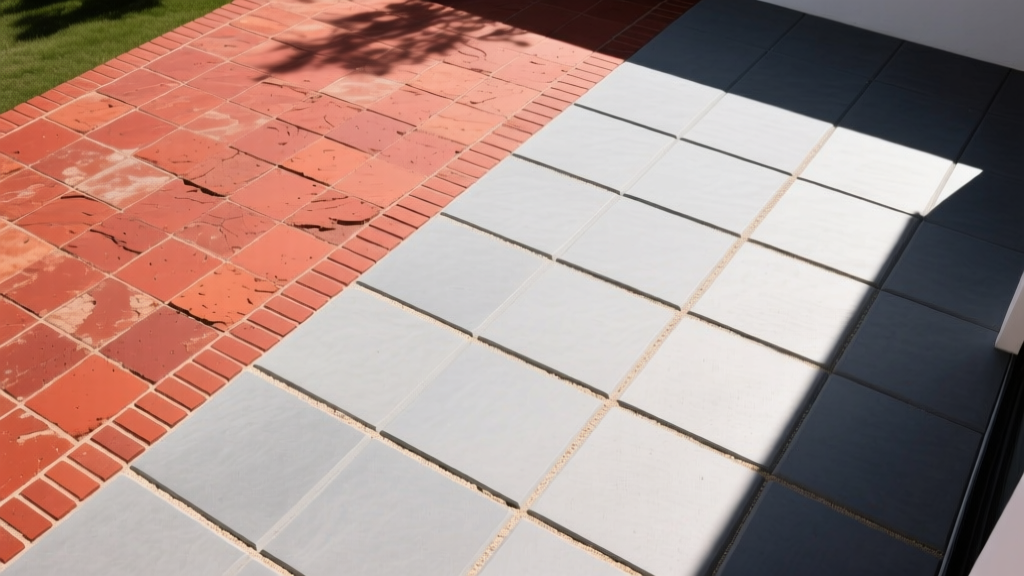
Clay pavers are virtually immune to UV fading. A red clay brick will remain red for a century. Concrete pavers utilize iron-oxide pigments that can degrade under intense, prolonged UV exposure, leading to a washed-out appearance after 15 to 20 years. Applying a high-quality, breathable siloxane sealer can mitigate UV fading on concrete, but it must be reapplied every 3 to 5 years.
The Final Decision Framework
Use this practical framework to finalize your material selection based on your specific project parameters:
- Choose Clay Paving Brick if: You are building a pool deck, a traditional-style patio, or a project in a historic district where architectural review boards mandate natural materials. You want a zero-maintenance surface regarding color fading and are willing to pay a 20-30% premium for material longevity.
- Choose Concrete Pavers if: You are paving a residential driveway (the interlocking shapes handle vehicular shear forces better), you require a permeable pavement system for stormwater management, or you are working with a strict budget and need access to a wide variety of modern, large-format slab styles.
By matching the material's ASTM specifications to the structural and environmental demands of your site, you ensure a hardscape that performs flawlessly for decades, regardless of whether you ultimately choose pavers or bricks.
Written by
Sarah WhitfieldSarah Whitfield is a chartered quantity surveyor (MRICS) and construction cost analyst with 15 years of experience in material pricing, procurement strategy, and project budgeting. She earned her degree in Construction Management from the University of Reading (UK) and has worked on projects ranging from $2M custom homes to $180M mixed-use developments across North America and Europe. Sarah currently leads cost estimating for BuildMat Insight, maintaining a proprietary database of 4,000+ material price points updated quarterly. She is a frequent contributor to RSMeans cost data panels and has presented at the International Cost Engineering Council (ICEC) congress. Based in Denver, CO, Sarah is an avid trail runner and volunteer mentor for Women in Construction.
More from Sarah Whitfield
View all
Wood & Lumber
What Are the Different Types of Wood? A Builder's Guide
Compare structural softwoods, finish hardwoods, and engineered lumber. Analyze Janka ratings, MOE values, and 2026 pricing for construction.
Aug 4, 2026

Walls & Panels
Steel Framing vs Wood Framing: Corrosion and Moisture Defense
Compare steel framing vs wood framing for moisture resistance. Learn about galvanized coatings, condensation risks, and corrosion protection strategies.
Jul 21, 2026

Stone & Masonry
How to Cut Stone Veneer: Wet Saw vs Grinder Comparison
Compare the best tools for cutting stone veneer. We review wet saws, angle grinders, and chop saws to help you achieve clean, chip-free cuts.
Jul 21, 2026