Masonry Paint Durability: Lifespan Analysis and Failure Modes
Discover the true lifespan of masonry paint on brick. Analyze durability, common failure modes, and top mineral vs. acrylic coatings for lasting results.
The Reality of Brick Masonry Paint Lifespans
Unpainted, properly detailed clay brick can endure for over a century with virtually zero maintenance. However, applying a coating fundamentally alters the thermodynamic and hygroscopic behavior of the masonry wall system. When evaluating masonry paint durability, the primary metric is not just how long the color remains vibrant, but how long the coating can withstand the continuous outward vapor drive of moisture migrating through the brick without causing catastrophic substrate damage.
Baseline Lifespan Expectations
- Standard Acrylic Latex: 5 to 8 years before peeling or chalking requires full remediation.
- Elastomeric Acrylics: 8 to 12 years, but carries a high risk of moisture entrapment.
- Mineral Silicate (Potassium Silicate): 15 to 20+ years via chemical petrification.
- Traditional Limewash: 5 to 7 years, but fails gracefully without substrate damage.
According to the Brick Industry Association (BIA) Technical Notes, painting brick is generally discouraged unless the masonry was originally intended to be painted, or the brick is of poor quality and requires protection. Once the decision to paint is made, selecting the correct chemistry is the single most critical factor in determining the lifecycle cost of the facade.
Acrylic vs. Mineral Silicate: A Durability Matrix
The fundamental difference in masonry paint longevity lies in the binder chemistry. Organic binders (acrylics) sit on the surface as a continuous film, while inorganic binders (silicates) penetrate the capillary pores and react chemically with the silica in the brick and mortar.
| Performance Metric | 100% Acrylic Masonry Paint | Mineral Silicate Paint | Traditional Limewash |
|---|---|---|---|
| Bonding Mechanism | Mechanical adhesion (surface film) | Petrification (chemical bond) | Carbonation (calcium carbonate) |
| Vapor Permeability (Perms) | 1.0 - 5.0 (Restrictive) | > 15.0 (Highly Breathable) | > 20.0 (Fully Breathable) |
| UV Resistance | Moderate (binders degrade) | Excellent (inorganic pigments) | Excellent |
| Alkali Resistance (High pH) | Poor (prone to saponification) | Excellent (alkali-activated) | Excellent (inherently alkaline) |
| Material Cost (per gallon) | $55 - $80 | $90 - $130 | $80 - $120 |
The Top 3 Failure Modes of Painted Brick
Understanding why masonry paint fails is essential for specifying the right product. The National Park Service Preservation Briefs frequently document the destructive nature of trapped moisture in historic masonry, a principle that applies equally to modern brick veneer and solid mass walls.
1. Moisture Entrapment and Freeze-Thaw Spalling
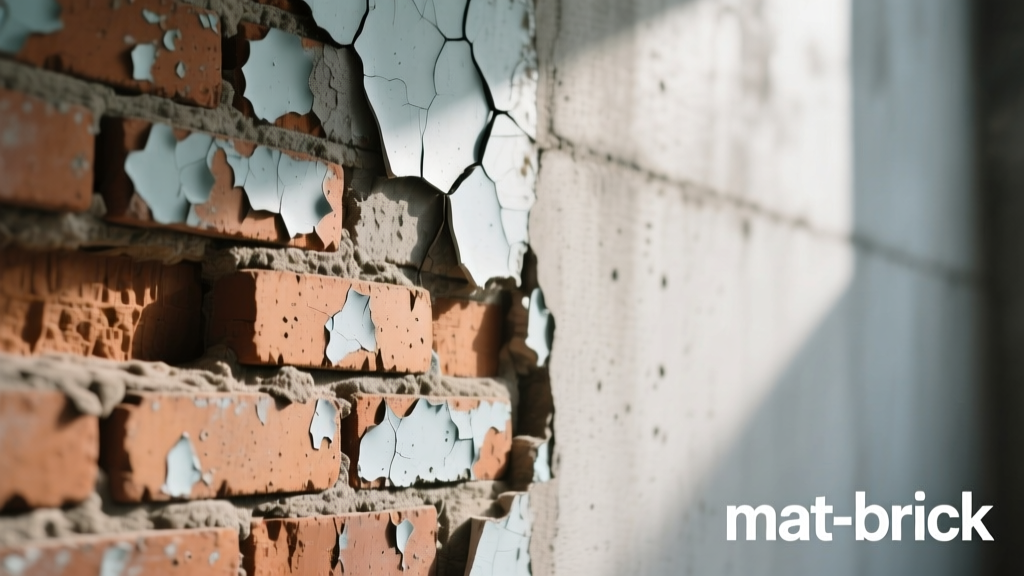
Brick is a porous sponge. Moisture enters the wall system through micro-cracks in the mortar joints, coping failures, or interior humidity. In an unpainted wall, this moisture evaporates freely through the brick face. When a low-perm acrylic masonry paint is applied, it acts as a vapor barrier on the exterior. Water becomes trapped behind the paint film. In freezing climates, this trapped water expands by 9% upon freezing, generating internal hydraulic pressures exceeding the tensile strength of the clay. The result is spalling: the face of the brick literally pops off, taking the paint with it. This failure mode is irreversible and requires brick replacement.
2. Alkali Burn (Saponification)
Fresh masonry mortar and concrete block have a pH level of 12 to 13. Acrylic paints contain esters. When moisture is present, the high alkalinity of the masonry breaks down the ester bonds in the acrylic binder, a chemical reaction known as saponification. This literally turns the paint binder into soap. The coating loses adhesion, turns yellow or brown, and washes away. To prevent this, masonry must cure for at least 28 days, and the surface pH must be tested to ensure it has dropped below 10 before any organic coating is applied.
3. Efflorescence Blistering
Efflorescence consists of water-soluble salts (primarily sodium and potassium sulfates) naturally present in clay brick and Portland cement. If these salts are not completely removed prior to painting, moisture moving through the wall dissolves them and carries them to the surface. When the water hits the impermeable paint film and evaporates, the salts crystallize behind the paint. The osmotic pressure of crystallizing salts can exceed 3,000 psi, easily blistering and delaminating even the thickest elastomeric masonry coatings.
Real-World Product Performance & Costs
For a standard 2,000 square foot brick facade, material requirements average 7 to 8 gallons (assuming 250-300 sq ft coverage per gallon on rough masonry). Here is how top-tier commercial products perform in the field:
- Sherwin-Williams Loxon Concrete & Masonry Coating (Acrylic): Priced around $65/gallon. This is a high-build, alkali-resistant acrylic. While it offers excellent flexibility and water resistance, its perm rating is relatively low. Best suited for above-grade, dry climates where interior vapor drive is minimal. Expected lifespan: 8-10 years. Total material cost for 2,000 sq ft: ~$520.
- KEIM Soldalit (Mineral Silicate): Priced around $110/gallon. This sol-silicate paint uses colloidal silica to bond chemically with the brick substrate. It is entirely vapor-permeable and UV-stable. Because it petrifies into the brick, it will never peel or blister, though it may slowly fade after 15+ years. Expected lifespan: 15-25 years. Total material cost for 2,000 sq ft: ~$880.
- Romabio Classico Limewash (Calcium Hydroxide): Priced around $115/gallon. Unlike paint, limewash calcifies into the brick pores. It is highly breathable and naturally biocidal (resists mold). It will slowly wear away over 5-7 years, requiring a maintenance coat, but it will never peel or trap moisture. Total material cost for 2,000 sq ft: ~$920.
Maximizing Longevity: The 20-Year Prep Protocol
The most expensive mineral silicate paint will fail in two years if applied over a compromised substrate. Achieving a 20-year lifecycle requires rigorous, uncompromising preparation.
- Moisture Verification: Tape a 2-foot square of clear 4-mil polyethylene sheeting tightly to the brick in multiple locations (especially on the shaded, north-facing elevation). Leave for 24 hours. If condensation forms under the plastic, the wall contains too much moisture to paint. Identify and repair the source of water intrusion first.
- pH Testing: Use distilled water and digital pH strips or a calibrated pH meter. Wet the masonry and test the runoff. If the pH reads above 10, the wall is too alkaline for acrylics. Either wait for further carbonation (curing) or switch to a mineral silicate system which requires high pH to activate.
- Efflorescence Eradication: Dry-brush all white salt deposits with a stiff natural-bristle brush (never wire, which leaves rust-prone steel particles). Wash the wall with a commercial masonry cleaner or a diluted solution of muriatic acid (1 part acid to 10 parts water), followed by a thorough low-pressure rinse. Allow 48 hours to dry.
- Biocide Treatment: Apply a sodium hypochlorite or quaternary ammonium-based biocide to kill any latent mold or algae spores deep within the brick pores. Rinse thoroughly.
- Primer Selection: For acrylic topcoats on marginal masonry, apply an alkali-resisting sealer/primer (such as Sherwin-Williams Loxon Block Surfacing Primer). For mineral silicates, use a silicate-based mineral primer to consolidate friable surfaces without blocking vapor transmission.
Critical Warning on Elastomeric Coatings
Never apply thick-film elastomeric masonry paint to solid mass brick walls or historic masonry. While they bridge cracks exceptionally well, their near-zero vapor permeability guarantees moisture entrapment. Restrict elastomeric coatings exclusively to modern concrete masonry units (CMU) with interior vapor barriers and weep-hole drainage planes.
Expert Verdict: Lifecycle Cost vs. Initial Investment
When analyzing the true cost of masonry paint, the initial material price is secondary to the labor cost of future remediation. Repainting a two-story brick facade with scaffolding and power washing can easily exceed $4,000 in labor alone. Spending an extra $400 on mineral silicate paint (like KEIM) during the initial application eliminates the risk of peeling, reduces the vapor-trapping risks associated with acrylics, and pushes the next maintenance cycle out by a decade or more. For any architect, builder, or homeowner prioritizing structural integrity and long-term durability, inorganic mineral coatings represent the only technically sound choice for exterior brick masonry.