Siding or Brick: A Lifecycle Durability and Cost Analysis
Evaluating siding or brick for your exterior? Compare 50-year lifecycle durability, maintenance costs, failure modes, and climate performance.

Material Degradation Vectors: How Each Cladding Fails
When deciding between siding or brick, the conversation often defaults to upfront installation costs. However, a true durability analysis requires examining the specific degradation vectors that compromise each material over a 50-year lifecycle. Brick masonry and modern siding systems fail through entirely different mechanical and chemical processes.
Brick Masonry and Veneer Failure Modes
Brick is a fired clay product, making it inherently resistant to UV degradation and rot. Its primary vulnerability is moisture intrusion combined with freeze-thaw cycles. According to Brick Industry Association (BIA) Technical Notes, spalling—the flaking or peeling of the brick face—occurs when water trapped inside the clay matrix expands upon freezing. This is strictly governed by the brick's absorption rate. ASTM C216 classifies facing brick into Grade SW (Severe Weathering) and Grade MW (Moderate Weathering). Grade SW mandates a maximum water absorption of 12.5%. Installing Grade MW brick in a northern climate guarantees premature spalling.
Secondary failure points include efflorescence (soluble salts migrating to the surface) and mortar joint erosion. Type N mortar, commonly used in residential veneer, has a compressive strength of 750 psi and will typically require tuckpointing after 25 to 30 years of weather exposure.
Siding Failure Modes: Fiber Cement and Vinyl
Siding materials face a different threat matrix. Fiber cement siding, such as the James Hardie Artisan Collection, is immune to rot and insect damage but is susceptible to impact fracturing and moisture wicking at unsealed cut edges. If installers fail to leave a 1/8-inch gap at butt joints or neglect to prime field cuts, the cementitious matrix will absorb water, leading to edge swelling and delamination.
Vinyl siding (PVC) suffers primarily from UV degradation and thermal movement. While modern co-extruded vinyl includes a capstock layer of titanium dioxide to reflect UV rays, prolonged exposure inevitably leads to chalking and color fading. Furthermore, vinyl expands and contracts significantly; a 10-foot panel can expand up to 5/8 of an inch across a 100°F temperature swing. Nailing it too tightly restricts this movement, causing the panels to buckle and warp.
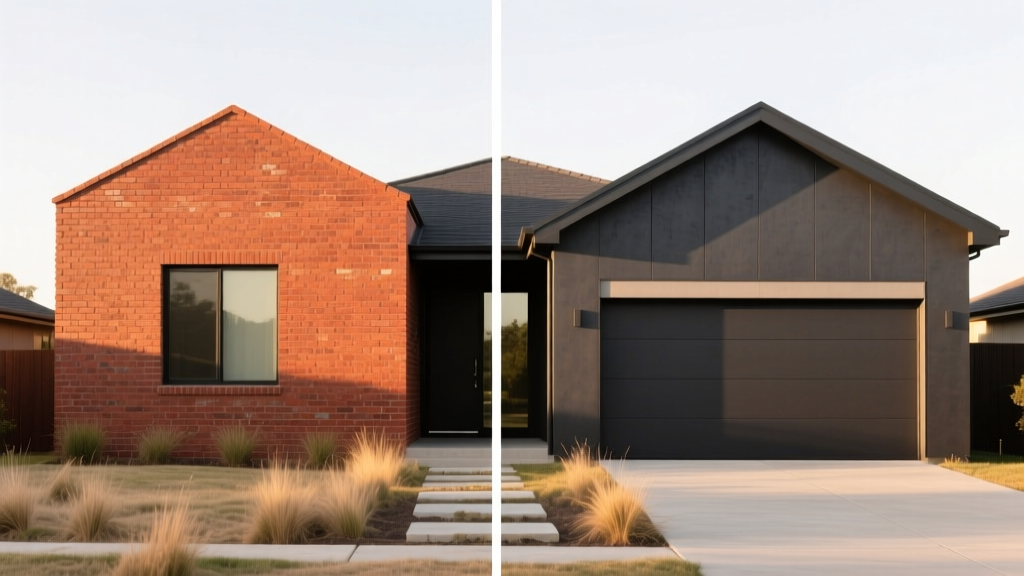
The 50-Year Lifecycle Durability Matrix
The following matrix compares the long-term performance metrics of the most common exterior cladding options evaluated in the siding or brick debate.
| Material | Expected Lifespan | Primary Failure Point | Maintenance Interval | Impact Resistance (Hail) |
|---|---|---|---|---|
| Clay Brick Veneer (Grade SW) | 100+ Years | Mortar joint erosion | Tuckpointing at 25-30 yrs | Exceptional (No damage) |
| Fiber Cement Lap Siding | 50 Years | Edge swelling / Paint failure | Repaint every 10-15 yrs | High (UL 2218 Class 4) |
| Premium Vinyl Siding | 30-40 Years | UV fading / Thermal buckling | Washing / Panel replacement | Moderate (Cracks in cold) |
| Engineered Wood Siding | 30-50 Years | Moisture intrusion at seams | Repaint every 5-10 yrs | Low to Moderate |
Environmental Stress Testing: Regional Performance
The optimal choice between siding or brick shifts dramatically based on your specific microclimate. Material longevity is not absolute; it is highly contextual.
Maintenance Cadence and Hidden Lifecycle Costs
Upfront installation costs only tell half the story. As of 2026, the installed cost of brick veneer ranges from $14 to $22 per square foot, while fiber cement ranges from $9 to $14, and vinyl sits at $5 to $8. However, factoring in a 50-year maintenance cadence alters the financial calculus.
Brick Maintenance Realities
- Tuckpointing: Required every 25 to 30 years. Cost: $8 to $12 per square foot. For a 2,000 sq ft facade, expect a $16,000 to $24,000 invoice.
- Flashing and Weep Hole Clearing: Weep holes must be kept clear of debris and mortar droppings to allow the cavity to drain. This is a zero-cost but high-vigilance requirement.
- Cleaning: Avoid power washing brick. High PSI forces water through the porous clay and compromises the mortar. Use a low-pressure garden hose and a specialized masonry cleaner like Prosoco Sure Klean.
Siding Maintenance Realities
- Painting (Fiber Cement): Factory-applied acrylic finishes last 15 years. Subsequent repaints cost $3 to $5 per square foot and must be repeated every 10 years.
- Caulking: All siding requires annual inspection of perimeter caulking (where siding meets trim, windows, and corners). Polyurethane sealants like OSI QUAD Max must be replaced every 7 to 10 years to prevent bulk water intrusion.
Impact Resistance and Structural Integrity
When evaluating extreme weather resilience, the siding or brick decision impacts insurance premiums and structural survivability. FEMA Building Science guidelines highlight masonry as a premier impact-resistant cladding. A 2x4 wooden stud fired at 34 mph (simulating tornado debris) will shatter vinyl, dent fiber cement, and bounce off a brick wythe.
However, brick veneer is not structural; it is a cladding system tied to wood or steel framing. In high-wind zones (130+ mph), the veneer must be anchored with 22-gauge corrugated galvanized steel ties spaced no more than 16 inches on center vertically and 24 inches horizontally. If these ties are improperly installed, the brick facade can peel away from the structure during a hurricane, despite the bricks themselves being indestructible.
'The durability of a brick wall is rarely limited by the brick itself; it is limited by the mortar, the flashing, and the ties. A $20,000 brick facade will fail in 10 years if the $500 flashing system is installed incorrectly.' — Masonry Forensic Engineering Report
The Verdict: A Practical Decision Framework
Selecting between siding or brick should be dictated by your holding period, climate, and maintenance tolerance. Use this framework to finalize your specification:
Choose Brick Veneer If:
- Generational Holding Period: You plan to own the property for 30+ years, allowing the higher upfront cost to amortize against zero repainting and superior longevity.
- Severe Weather Exposure: Your region is prone to severe hail (UL 2218 Class 4) or high-wind debris impacts.
- Acoustic and Thermal Mass Needs: You require the sound-dampening properties of a 4-inch masonry wythe and the thermal mass benefits in passive solar designs.
Choose Fiber Cement Siding If:
- Seismic or Expansive Soil Zones: Brick veneer is highly vulnerable to differential settlement and seismic shear. Fiber cement siding, being lighter and more flexible at the joints, accommodates minor structural movement without cracking.
- Budget Constraints with High Aesthetics: You require the deep shadow lines and premium look of masonry (using thick-profile fiber cement like Hardie Artisan) but need to keep initial capital expenditures under $12 per square foot.
- Complex Architectural Geometry: Homes with numerous radius walls, steep gables, and intricate trim details are vastly more cost-effective and structurally sound when clad in siding rather than attempting complex brick corbeling and cutting.
Ultimately, both materials offer exceptional durability when specified correctly. The failures almost always originate at the detailing stage—flashing, weep holes, and expansion joints—rather than the cladding material itself. For comprehensive installation standards, always cross-reference the James Hardie Product Catalog for siding clearances and the BIA Technical Notes for masonry cavity drainage requirements.
Written by
Priya KapoorPriya Kapoor is a real estate market analyst and construction economics researcher with expertise in housing affordability, development feasibility, and infrastructure investment. She holds a Master of Regional Planning from Cornell University and previously worked as a senior analyst at CBRE's Investment Properties group, where she modeled returns for $4B in mixed-use development pipelines. Priya now runs an independent research practice advising developers, municipalities, and REITs on construction cost forecasting and market timing. She publishes the quarterly "BuildMat Market Pulse" report tracking material price indices across 12 commodity categories. Based in Austin, TX, Priya serves on the board of Habitat for Humanity Austin and is a marathon runner.
More from Priya Kapoor
View all
Construction Cost
Cost to Build a 1600 Sq Ft Home in 2026: Full Breakdown
Accurate 2026 cost to build a 1600 sq ft home—material, labor, and regional pricing breakdowns included. Plan your budget with real-time estimates.
Aug 11, 2026

Wood & Lumber
Name the Types of Wood for Pressure Treatment and Preservation
Learn how to name the types of wood best suited for pressure treatment. Compare species treatability, chemical retention levels, and 2026 preservation costs.
Aug 4, 2026

Stone & Masonry
Stone Veneer Suppliers Lindenhurst: 2026 Cost Analysis
Analyze 2026 stone veneer costs in Lindenhurst, NY. Compare local supplier pricing, delivery fees, and Suffolk County installation labor rates.
Aug 4, 2026