Is a Pound of Bricks or Feathers Heavier? Physics of Masonry Density
Explore the physics behind 'is a pound of bricks or feathers heavier' and how material density dictates masonry construction methods and structural loads.

The Riddle Resolved: Mass, Weight, and Air Buoyancy
The classic riddle—is a pound of bricks or feathers heavier?—is designed to trick the listener into confusing mass with volume. The standard punchline is that they both weigh exactly one pound. However, from a strict physics and structural engineering perspective, the answer is far more nuanced and directly applicable to how we calculate material behavior in construction.
In the US customary system, a 'pound' can refer to pound-mass (lbm) or pound-force (lbf). If you place a pound of bricks and a pound of feathers on a calibrated scale in a standard atmospheric environment, the scale measures the downward force (weight) minus the upward buoyant force of the displaced air. Because feathers are significantly less dense, a pound of feathers occupies a vastly larger volume, displacing more air and experiencing greater upward buoyancy. Therefore, to register exactly one pound of downward force on the scale, the feathers must actually possess slightly more mass than the bricks.
While this physics trivia is a fun parlor trick, the underlying principles of density, volume, and buoyant forces are foundational to modern masonry construction methods. When structural engineers and masonry contractors evaluate building materials, they are not just looking at total weight; they are analyzing density (mass per unit volume), dead loads, and how those factors dictate foundation sizing, seismic performance, and job site logistics.
Translating Density to Masonry Construction Methods
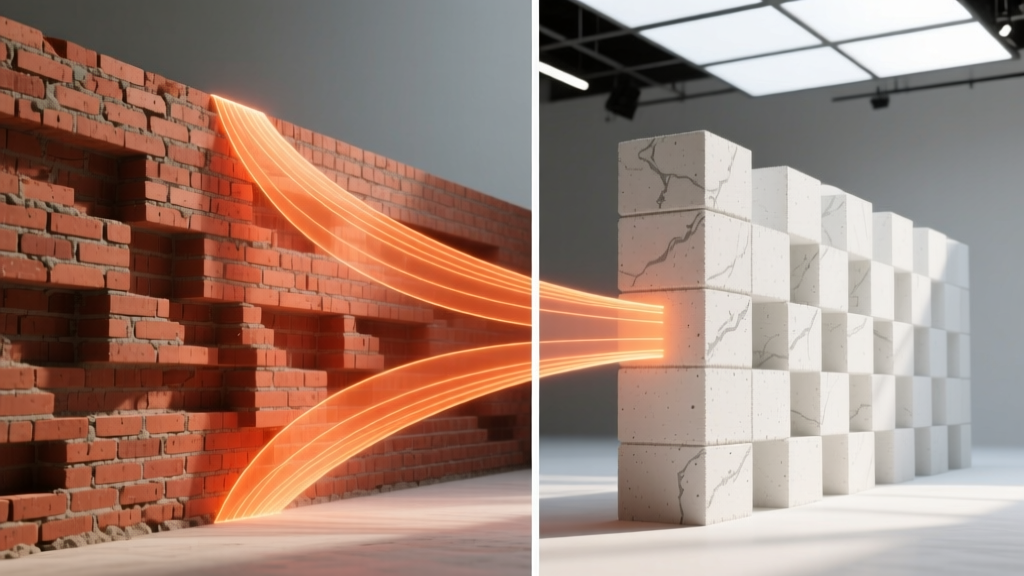
In masonry construction, the 'feathers vs. bricks' paradigm translates to the choice between normal-weight masonry units and lightweight alternatives. Standard clay bricks and normal-weight concrete masonry units (CMUs) are the 'bricks' of the equation—highly dense, offering excellent thermal mass, acoustic insulation, and compressive strength. Lightweight masonry units, manufactured using expanded shale, clay, or slate aggregates (compliant with Brick Industry Association (BIA) standards and ASTM C331), represent the 'feathers'—providing volume and structural enclosure with a fraction of the density.
Understanding the exact density of your chosen masonry unit is critical for calculating the dead load of the structure. Dead load is the permanent, static weight of the building components. Overestimating or underestimating the density of a brick wythe can lead to over-engineered, wastefully expensive foundations, or worse, structural deflection and failure.
Material Density and Dead Load Matrix
The following matrix compares standard masonry materials, illustrating how volume and density interact to create structural loads. Data aligns with standard metrics from The Engineering Toolbox and masonry engineering manuals.
| Material Type | Density (pcf) | Weight per 100 sq ft (4-in Wythe) | Thermal Resistance (R-Value) | Primary Construction Use |
|---|---|---|---|---|
| Standard Clay Brick (ASTM C216) | 120 - 130 lbs | 400 - 433 lbs | 0.20 per inch | Load-bearing walls, high thermal mass facades |
| Normal Weight CMU | 125 - 140 lbs | 415 - 465 lbs | 0.25 per inch | Commercial foundations, retaining walls |
| Lightweight CMU (ASTM C331) | 85 - 105 lbs | 285 - 350 lbs | 0.45 per inch | Multi-story shear walls, seismic retrofits |
| Autoclaved Aerated Concrete (AAC) | 25 - 50 lbs | 85 - 165 lbs | 1.25 per inch | Insulating infill, low-rise residential |
Structural Implications: Foundation Sizing and Seismic Forces
The choice between high-density and low-density masonry extends far beyond the cost of the units themselves; it fundamentally alters the structural skeleton of the building.
Foundation Economics
A standard 4-inch nominal brick veneer adds roughly 40 pounds per square foot (psf) of wall area to the dead load. For a 10,000 square foot commercial building with extensive masonry facades, this translates to hundreds of thousands of pounds of additional static load. This requires wider continuous footings, deeper pile caps, or higher-strength concrete mixes. By substituting standard brick with lightweight masonry veneers or AAC blocks, structural engineers can reduce the dead load by 30% to 60%, allowing for narrower footings and significant savings in concrete and rebar.
Seismic Lateral Forces
In earthquake-prone regions (Seismic Design Categories D, E, and F), the 'feathers' win decisively. Seismic lateral force is calculated using the equation $F = ma$ (Force = mass × acceleration). The heavier the building (the greater the mass), the larger the seismic forces it attracts during a ground acceleration event. High-density clay brick structures require extensive horizontal and vertical reinforcing steel, grout-filled cells, and robust shear walls to resist these amplified forces. Utilizing lightweight masonry units reduces the seismic mass, directly lowering the base shear calculations and allowing for more efficient, less congested reinforcement detailing.
Job Site Logistics: The Ergonomics of Masonry Weight
The 'pound of bricks' also impacts the human element of construction methods. Masonry is inherently labor-intensive, and the physical toll of laying dense materials is a major factor in project scheduling and safety.
According to OSHA ergonomic guidelines for masonry, repetitive lifting of heavy units leads to high rates of musculoskeletal disorders (MSDs). A standard modular clay brick weighs approximately 4.5 lbs. While manageable, a mason lays between 300 and 500 bricks a day, lifting over 2,000 lbs daily. When transitioning to larger masonry units (like 8x8x16 CMUs), a normal-weight block can weigh up to 38 lbs, often requiring two-person lifts or mechanical hoists, which slows the construction schedule.
Lightweight masonry units (weighing 22 to 26 lbs for the same 8x8x16 dimension) allow for single-person handling, drastically improving crew productivity, reducing fatigue-related errors in mortar joint tooling, and lowering the risk of job site injuries.
⚠️ Warning: Mortar Compatibility with Lightweight Units
When utilizing lightweight masonry (the 'feathers' of the masonry world), you cannot use standard high-strength mortar. Lightweight units have high initial rates of absorption (IRA) and lower compressive strengths. Using a rigid, high-Portland cement mortar (like Type S or M) will cause the mortar to shrink and crack the masonry units. Always specify Type N or Type O mortar, or utilize specialized polymer-modified mortars designed specifically for lightweight and AAC masonry systems to ensure proper bond and accommodate thermal expansion.
Decision Framework: Selecting Masonry Units by Structural Need
To move beyond the theoretical riddle and apply these physics to your next project, use this practical decision framework to determine whether your construction method requires the dense 'bricks' or the lightweight 'feathers'.
- Choose High-Density Brick/CMU When: The project requires high thermal mass for passive solar heating/cooling (e.g., desert climates with high diurnal temperature swings); the design calls for high-impact resistance (e.g., prison facilities, retaining walls, or flood zones where buoyancy and water resistance are critical); or the architectural specification demands the authentic acoustic dampening and aesthetic profile of traditional fired clay.
- Choose Lightweight Masonry/AAC When: The building is located in a high seismic zone where reducing lateral mass is paramount; the soil bearing capacity is poor (e.g., expansive clays or peat) and foundation dead loads must be minimized; the project is a multi-story retrofit where adding heavy masonry would exceed the existing structural frame's load capacity; or crew ergonomics and speed of enclosure are the primary scheduling drivers.
Summary: The Gravity of Material Selection
So, is a pound of bricks or feathers heavier? In a vacuum, they are identical. In the atmosphere, buoyancy gives the edge to the feathers. But on the construction site, the true weight of a material is measured by its impact on the foundation, its behavior under seismic stress, and its toll on the masons laying it. By understanding the physics of material density, contractors and engineers can manipulate the 'weight' of their structures, optimizing masonry construction methods for safety, cost-efficiency, and long-term structural resilience.
Written by
Priya KapoorPriya Kapoor is a real estate market analyst and construction economics researcher with expertise in housing affordability, development feasibility, and infrastructure investment. She holds a Master of Regional Planning from Cornell University and previously worked as a senior analyst at CBRE's Investment Properties group, where she modeled returns for $4B in mixed-use development pipelines. Priya now runs an independent research practice advising developers, municipalities, and REITs on construction cost forecasting and market timing. She publishes the quarterly "BuildMat Market Pulse" report tracking material price indices across 12 commodity categories. Based in Austin, TX, Priya serves on the board of Habitat for Humanity Austin and is a marathon runner.
More from Priya Kapoor
View all
Construction Cost
Cost to Build a 1600 Sq Ft Home in 2026: Full Breakdown
Accurate 2026 cost to build a 1600 sq ft home—material, labor, and regional pricing breakdowns included. Plan your budget with real-time estimates.
Aug 11, 2026

Wood & Lumber
Name the Types of Wood for Pressure Treatment and Preservation
Learn how to name the types of wood best suited for pressure treatment. Compare species treatability, chemical retention levels, and 2026 preservation costs.
Aug 4, 2026

Stone & Masonry
Stone Veneer Suppliers Lindenhurst: 2026 Cost Analysis
Analyze 2026 stone veneer costs in Lindenhurst, NY. Compare local supplier pricing, delivery fees, and Suffolk County installation labor rates.
Aug 4, 2026