How to Clean, Seal, and Maintain Grey Stacked Stone Veneer
Learn expert techniques to clean, seal, and maintain grey stacked stone veneer. Discover pH-neutral cleaners, sealing schedules, and stain removal tips.

The Unique Maintenance Profile of Grey Stacked Stone
Grey stacked stone veneer offers a striking, contemporary aesthetic for both interior feature walls and exterior facades. However, the specific mineral composition and visual characteristics of grey stone—often derived from slate, basalt, quartzite, or dyed limestone—introduce distinct maintenance challenges. Unlike warmer tan or brown tones, grey surfaces act as a high-contrast backdrop for white efflorescence, hard water mineral deposits, and dust accumulation. Furthermore, the deep crevices inherent in stacked ledger panels trap particulate matter that standard dusting cannot reach.
Maintaining this material requires moving beyond generic masonry advice. You must account for the porosity of the specific stone type, the chemical sensitivity of grey pigments, and the structural integrity of the mortar joints (if applicable) or the adhesive bed (for mortarless applications). This guide provides a precise, actionable framework for cleaning, sealing, and preserving grey stacked stone veneer.
Understanding Porosity and Chemical Sensitivity
Before applying any liquid to your veneer, you must identify the stone's geological category. Grey slate and quartzite are relatively dense, with water absorption rates typically below 1%. Conversely, grey limestone or sandstone can exhibit absorption rates exceeding 5%, making them highly susceptible to staining and water infiltration.
Never use vinegar, lemon juice, or commercial bathroom cleaners containing hydrochloric or phosphoric acid on grey stone veneer. Many grey stones contain calcium carbonate. Acidic solutions will chemically react with the stone, causing 'etching'—a permanent dulling and pitting of the surface that manifests as light grey or white scarring.
According to the Natural Stone Institute, all natural stone should be cleaned with pH-neutral solutions (pH 7.0 to 8.5) to preserve the surface tension and prevent micro-fissures from expanding during freeze-thaw cycles.
Routine Cleaning Protocol for Grey Tones
Because grey stone highlights dust and light-colored debris, a strict routine cleaning schedule is necessary to maintain visual depth. Follow this three-step protocol for interior and sheltered exterior applications.
Step 1: Dry Agitation and Extraction
Do not start with water. Wetting dust in the deep joints of stacked stone creates mud that smears across the stone faces. Use a vacuum cleaner with a soft brush attachment, or a dry microfiber duster, to pull loose particulate matter out of the horizontal ledges. For exterior applications, a leaf blower on a low setting effectively clears organic debris from the crevices.
Step 2: pH-Neutral Washing
Mix a pH-neutral stone cleaner (such as StoneTech Revitalizer or Simple Green Oxy Solve Stone & Tile) at a ratio of 1 ounce per gallon of warm water. Apply using a pump sprayer to ensure even coverage without over-saturating the joints. Allow a dwell time of 3 to 5 minutes to emulsify oils and grime.
Step 3: Gentle Mechanical Action
Agitate the surface using a soft-bristled nylon brush. Never use wire brushes or stiff synthetic bristles. Wire brushes will leave behind microscopic iron particles that oxidize and create permanent orange rust stains on the grey stone, while stiff bristles can scratch softer stones like slate.
Tackling Stubborn Stains and Efflorescence
When routine cleaning fails, targeted chemical interventions are required. The table below outlines specific treatments for the most common issues affecting grey stacked stone veneer.
| Stain / Issue | Primary Cause | Recommended Treatment | Dwell Time & Action |
|---|---|---|---|
| Efflorescence (White Powder) | Water-soluble salts migrating to the surface and crystallizing. | Dry stiff nylon brush, followed by a dedicated efflorescence remover (e.g., Aqua Mix Eff-Ex). | Brush dry first. Apply remover for 5 mins, scrub, and rinse thoroughly. Do not use water until dry-brushing removes the bulk. |
| Hard Water / Mineral Scale | Calcium and magnesium deposits from sprinkler systems or humidity. | pH-neutral hard water stain remover or a poultice made of diatomaceous earth and distilled water. | Apply poultice 1/4-inch thick, cover with plastic wrap for 24 hours. Allow to dry and scrape off. |
| Organic Growth (Mildew/Algae) | Shade and moisture accumulation on exterior veneer. | Hydrogen peroxide-based cleaner (3% to 6% solution). Avoid chlorine bleach, which can leave salt residues. | Spray directly, allow 10 minutes dwell time, scrub with nylon brush, and power rinse at low PSI. |
| Oil and Grease | Cooking splatter (kitchens) or handling oils. | Acetone or mineral spirits applied to a clean white cloth, followed by a baking soda poultice. | Blot (do not rub) with solvent. If stain persists, apply baking soda poultice for 48 hours to draw oil from pores. |
For extensive exterior efflorescence, the National Concrete Masonry Association (NCMA) emphasizes that identifying and stopping the source of moisture intrusion is mandatory before chemical treatment, otherwise, the salt deposits will continuously return.
Sealing: Does Grey Stacked Stone Need It?
Sealing is not always mandatory for dense stones like quartzite, but it is highly recommended for exterior applications, kitchen backsplashes, and high-traffic interior walls. The choice of sealer dramatically alters the visual impact of grey stone.
Penetrating vs. Enhancing Sealers
- Matte Penetrating Sealers (e.g., Aqua Mix Sealer's Choice Gold, Miracle Sealants 511 Impregnator): These sealers absorb into the pores and block moisture without changing the stone's appearance. This is the preferred choice if you want to maintain the natural, dry, light-grey aesthetic of the stone.
- Color-Enhancing Sealers (e.g., StoneTech Enhancer Pro): These sealers darken the stone and highlight its natural veining, giving it a permanent 'wet' look. On grey stone, enhancers will shift the color from light ash to deep charcoal or slate blue. Always test an enhancer in an inconspicuous area first, as the color shift on grey tones is often much more dramatic than on beige or brown stones.
Application Specifications
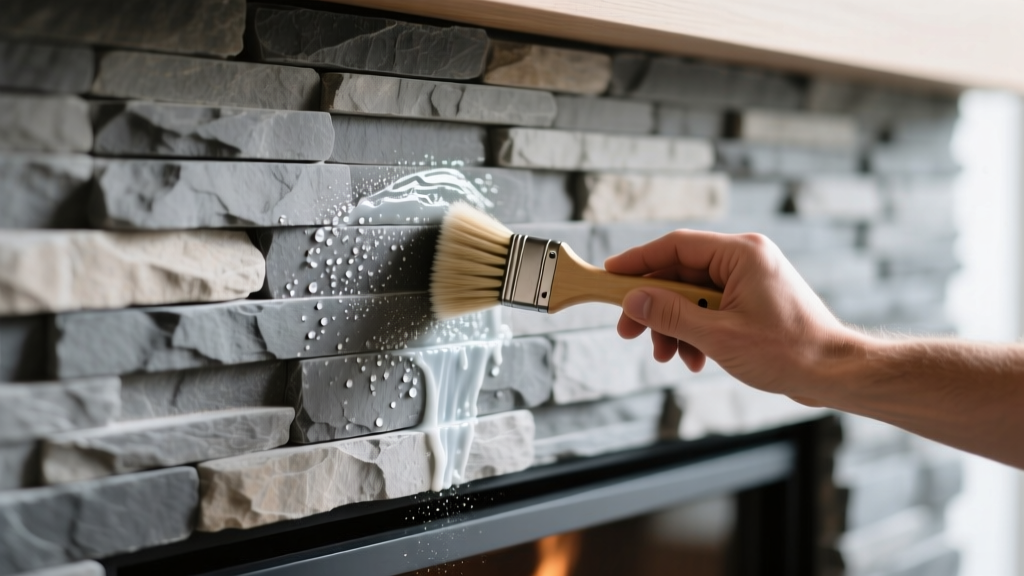
Apply sealer using a low-pressure pump sprayer or a dense foam roller. For stacked ledger panels, a sprayer is essential to force the sealer into the deep mortar joints and shadow lines. Expect a coverage rate of 300 to 500 square feet per gallon, depending on stone porosity. Wipe away any excess sealer that pools on the stone faces within 5 minutes; allowing enhancer sealer to dry on the surface will leave a sticky, glossy residue that requires chemical stripping to remove.
Repairing Mortar Joints in Grey Veneer
If your stacked stone veneer utilizes visible mortar joints (such as a grouted ledgestone profile), maintaining the mortar is just as critical as maintaining the stone. Over time, mortar can crack or crumble due to structural settling or freeze-thaw expansion.
When repairing joints, match the mortar type to the original installation. Exterior veneers typically require Type N or Type S mortar. To match the grey color, do not rely on standard grey Portland cement, which cures to a light, cool-toned grey. Instead, use integral liquid pigments (like Solomon Colors or Davis Colors in 'Charcoal' or 'Slate') mixed directly into the mortar batch. According to guidelines from The Masonry Society, repointing should only be done when ambient temperatures are between 40°F and 90°F to ensure proper hydration and curing of the cementitious materials.
Critical Mistakes That Ruin Grey Veneer
Avoid these common maintenance errors that cause irreversible damage to grey stacked stone:
- High-Pressure Washing: Never use a pressure washer exceeding 1,500 PSI on stacked stone. High pressure will erode the mortar joints, blast away the natural cleft surface of softer stones like slate, and force water behind the veneer, leading to substrate rot or adhesive failure.
- Using Generic Grout Haze Removers: Many commercial haze removers contain sulfamic or hydrochloric acid. If applied to grey limestone or marble veneer, these acids will instantly etch the surface, leaving permanent rough, whitish patches.
- Ignoring Horizontal Ledges: Stacked stone creates microscopic horizontal shelves. If exterior sealants fail, water pools on these ledges, accelerating freeze-thaw spalling. Inspect and reseal horizontal planes annually.
By adhering to pH-neutral cleaning, selecting the correct sealer for your desired aesthetic, and addressing efflorescence at its moisture source, your grey stacked stone veneer will retain its architectural depth and structural integrity for decades.
Written by
James ThorntonJames Thornton is a construction industry veteran with 25 years of hands-on experience in wood framing, lumber grading, and residential building codes. He started as a framing carpenter in rural Oregon, earned his ICC Residential Building Inspector certification, and eventually became a senior plan reviewer for the City of Portland Bureau of Development Services. James holds a B.S. in Wood Science & Technology from Oregon State University and is a certified lumber grader through the West Coast Lumber Inspection Bureau (WCLIB). He has inspected over 3,000 residential construction sites and authored the city's internal guide on advanced framing techniques (2x6 at 24" O.C.). James lives in Bend, OR, where he builds custom timber-frame cabins and competes in lumberjack sports.
More from James Thornton
View all
Insulation
Best Home Insulation Materials: Complete 2026 Guide
Compare top home insulation materials for 2026. Find R-values, installed costs per square foot, and best uses for fiberglass, spray foam, and mineral wool.
Aug 4, 2026

Sustainable Building
Certify Your Green Building Material for LEED and WELL
Step-by-step guide to certifying a green building material for LEED v5 and WELL v2. Master EPDs, HPDs, and VOC limits for 2026 project specifications.
Aug 4, 2026

Stone & Masonry
Veneer Stacked Stone Panels: Interior Design & Style Showcase
Discover how veneer stacked stone panels transform interiors. Explore modern design profiles, material pairings, and technical installation specs.
Aug 4, 2026