Technical Guide to Faux Stone Veneer Panels for Exterior Walls
Compare technical specs of polyurethane, EPS, and fiber cement faux stone veneer panels for exterior walls, including fire ratings and R-values.

Material Composition and Core Polymers
When specifying faux stone veneer panels for exterior applications, understanding the base polymer or composite matrix is critical for predicting long-term weatherability and impact resistance. Unlike traditional manufactured stone veneer (MSV), which utilizes a Portland cement base and weighs up to 15 lbs per square foot, modern faux panels rely on synthetic matrices to achieve weights between 1.0 and 2.5 lbs per square foot. The market is currently dominated by three primary material classes:
- High-Density Polyurethane (PUR): The premium standard for exterior faux stone. PUR panels (such as those manufactured by GenStone or Novik) are cast in molds taken from real stone, yielding a closed-cell structure with high compressive strength (typically 30-40 psi) and superior impact resistance. The closed-cell nature inherently resists water absorption rates of less than 1% by volume.
- Expanded Polystyrene (EPS): A lower-cost alternative often reinforced with a fiberglass mesh and a polymer-modified cementitious coating. While lightweight, EPS is vulnerable to localized impact damage and requires a more robust protective coating to prevent UV degradation and moisture ingress at the coating micro-cracks.
- Fiber Cement Composites: Heavier than PUR or EPS (approx. 4-6 lbs/sq ft) but offering superior fire resistance and dimensional stability. These are less common in interlocking panel formats but are used in large-format architectural cladding.
Thermal Performance and Moisture Permeability
Exterior faux stone panels alter the thermal and hygric dynamics of a wall assembly. Because polyurethane and EPS are rigid foam insulators, they add continuous insulation (ci) to the exterior envelope. High-density PUR typically provides an R-value of R3.5 to R4.0 per inch of thickness. Given that most exterior faux stone profiles range from 1.0 to 1.5 inches in thickness, they contribute an R4 to R6 thermal break. This helps mitigate thermal bridging through wood or steel studs, aligning with modern energy code requirements for continuous insulation.
However, adding exterior foam introduces vapor permeability considerations. Polyurethane acts as a Class II vapor retarder (0.1 to 1.0 perms). According to building science principles outlined by Building Science Corporation, placing a Class II retarder on the exterior of a wall assembly in cold climates can trap interior moisture within the stud cavity if the interior side is also sealed with polyethylene. In mixed or hot-humid climates, the exterior foam can cause the exterior sheathing to drop below the dew point during cooling seasons, leading to condensation on the back of the OSB or plywood.
The Rainscreen Requirement
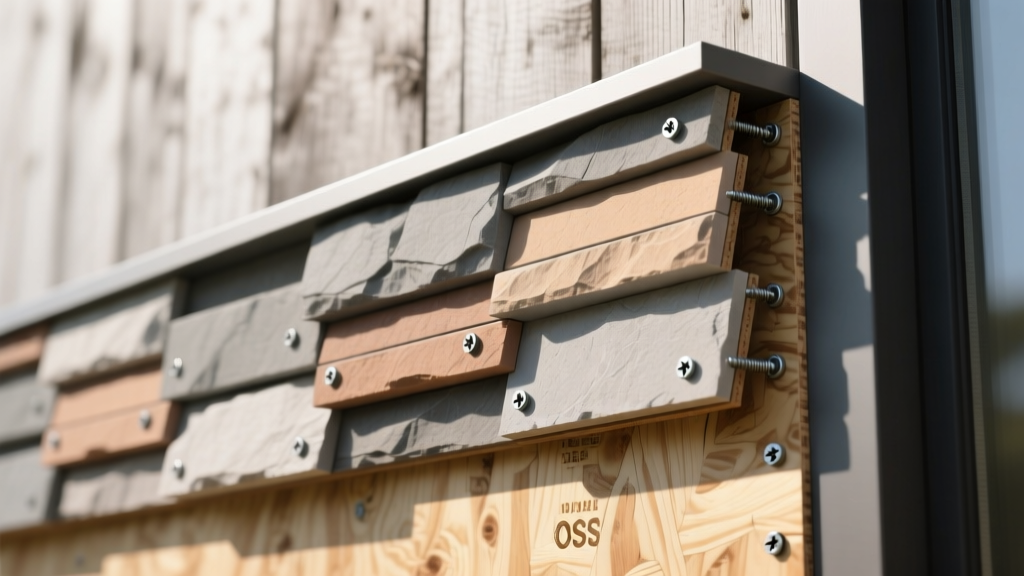
To mitigate moisture risks, faux stone veneer panels for exterior walls must never be adhered directly to the weather-resistive barrier (WRB). They must be installed over a ventilated rainscreen gap. This is achieved by fastening 1x3 or 1x4 pressure-treated or composite furring strips vertically at 16 inches on center (O.C.) over the WRB, and then attaching the panels to the furring. This 0.75-inch air cavity allows hydrostatic pressure to equalize and provides a drainage plane for any bulk water that penetrates the panel joints.
Fire Resistance and Structural Load Ratings
Exterior cladding materials must meet stringent fire safety standards, particularly in Wildland-Urban Interface (WUI) zones. High-quality PUR faux stone panels are tested to ASTM E84 (Standard Test Method for Surface Burning Characteristics of Building Materials). To achieve a Class A fire rating, the material must demonstrate a Flame Spread Index (FSI) of 25 or less and a Smoke-Developed Index (SDI) of 450 or less. Specifiers should verify that the specific product line carries an active ICC-ES Evaluation Report (typically under AC386 criteria for polyurethane exterior veneers) confirming these ratings, as unmodified raw polyurethane is highly combustible.
Structurally, the extreme lightness of faux panels (1.2 lbs/sq ft average) eliminates the need for masonry ledges, foundation thickening, or heavy-duty steel lintels above windows and doors. The APA - The Engineered Wood Association notes that reducing cladding dead loads allows for optimized framing and foundation designs, yielding significant cost savings in multi-story residential and light commercial construction compared to natural stone or traditional MSV.
Comparative Specification Matrix
| Specification | High-Density PUR Panels | Coated EPS Panels | Traditional MSV (Cement) | Natural Ledge Stone |
|---|---|---|---|---|
| Weight (lbs/sq ft) | 1.0 - 1.5 | 1.5 - 2.5 | 10.0 - 15.0 | 15.0 - 25.0 |
| Added R-Value | R4.0 - R6.0 | R4.5 - R6.5 | R0.1 - R0.2 | R0.08 |
| Water Absorption | < 1% (Closed Cell) | 2% - 4% (Core) | 8% - 12% | 1% - 5% |
| ASTM E84 Fire Rating | Class A (with FR additives) | Class A (cementitious coat) | Non-Combustible | Non-Combustible |
| Thermal Expansion | High (Requires gaps) | Moderate | Low | Very Low |
Fastening Schedules and Installation Tolerances
Proper mechanical fastening is the primary defense against wind uplift and panel delamination. Adhesives should only be used as a secondary sealant at joints and corners, never as the primary structural attachment for exterior faux panels.
- Type: #8 or #9 exterior-grade wood screws with a minimum 1.5-inch to 2.5-inch length, depending on furring thickness and sheathing.
- Coating: Ceramic-coated, zinc-flake, or 304/316 stainless steel to prevent rust staining on the faux stone finish.
- Head Style: Flat head or pan head with a neoprene washer to seal the penetration through the polyurethane face.
- Schedule: Minimum of 4 fasteners per 2' x 4' panel, placed no more than 12 inches O.C. along the furring strips. In high-wind zones (HVHZ), reduce spacing to 8 inches O.C. and utilize 6 fasteners per panel.
Fasteners must penetrate through the faux panel, through the furring strip, and embed at least 1 inch into the structural wood framing or metal studs. Relying solely on OSB or plywood sheathing for pull-out strength is a critical failure point; the U.S. Department of Energy emphasizes that exterior cladding loads must be transferred directly to the primary structural framing members to withstand cyclical wind loads.
Polyurethane has a coefficient of thermal expansion (CTE) of approximately 3 x 10^-5 in/in/°F. On a 100-foot long exterior wall experiencing a 100°F seasonal temperature swing, the cumulative linear expansion can exceed 1.5 inches. Installers must leave a 1/8-inch expansion gap at all end joints and a 1/4-inch gap at inside and outside corners. These gaps must be sealed with a high-quality, paintable polyurethane or silicone elastomeric sealant, never with rigid caulk or mortar, which will crack and fail within the first freeze-thaw cycle.
2026 Procurement and Cost Analysis
The financial calculus for faux stone veneer panels for exterior walls extends beyond raw material costs. While premium PUR panels command a higher upfront material cost than EPS or vinyl siding, the reduction in specialized labor and structural preparation shifts the ROI.
- Material Costs (2026): High-density PUR panels range from $8.50 to $14.00 per square foot. EPS alternatives range from $5.50 to $8.00 per square foot. Traditional MSV materials range from $6.00 to $10.00 per square foot.
- Labor and Installation: PUR faux panels install at a rate of 40 to 60 square feet per man-hour using basic carpentry tools (circular saw, drill, level). Traditional MSV requires skilled masons, mortar mixing, and lath installation, averaging 10 to 15 square feet per man-hour. At prevailing masonry labor rates of $65-$95/hour, the labor savings on a 1,000 sq ft exterior elevation typically offsets the premium material cost of PUR entirely.
- Structural Savings: Eliminating the need for masonry ties, brick ledges on the foundation, and reinforced lintels saves an average of $1.50 to $2.50 per square foot of cladding area in new construction framing and concrete budgets.
When specifying faux stone veneer panels, project managers must prioritize products with integrated UV-inhibitors molded directly into the polyurethane resin, rather than relying on surface-applied paints which will chalk and fade within 5 to 7 years of direct solar exposure. Verify the manufacturer's warranty explicitly covers color fading and impact cracking for a minimum of 25 years to ensure long-term facade integrity.
Written by
James ThorntonJames Thornton is a construction industry veteran with 25 years of hands-on experience in wood framing, lumber grading, and residential building codes. He started as a framing carpenter in rural Oregon, earned his ICC Residential Building Inspector certification, and eventually became a senior plan reviewer for the City of Portland Bureau of Development Services. James holds a B.S. in Wood Science & Technology from Oregon State University and is a certified lumber grader through the West Coast Lumber Inspection Bureau (WCLIB). He has inspected over 3,000 residential construction sites and authored the city's internal guide on advanced framing techniques (2x6 at 24" O.C.). James lives in Bend, OR, where he builds custom timber-frame cabins and competes in lumberjack sports.
More from James Thornton
View all
Insulation
Best Home Insulation Materials: Complete 2026 Guide
Compare top home insulation materials for 2026. Find R-values, installed costs per square foot, and best uses for fiberglass, spray foam, and mineral wool.
Aug 4, 2026

Sustainable Building
Certify Your Green Building Material for LEED and WELL
Step-by-step guide to certifying a green building material for LEED v5 and WELL v2. Master EPDs, HPDs, and VOC limits for 2026 project specifications.
Aug 4, 2026

Stone & Masonry
Veneer Stacked Stone Panels: Interior Design & Style Showcase
Discover how veneer stacked stone panels transform interiors. Explore modern design profiles, material pairings, and technical installation specs.
Aug 4, 2026