Granite Stone Veneer: The Ultimate Buyer's Selection Guide
Discover how to select the best granite stone veneer for your project. Compare costs, thicknesses, installation methods, and top brands in our buyer's guide.

Natural vs. Manufactured Granite Veneer: Core Material Differences
When specifying granite stone veneer for architectural facades, interior accent walls, or landscape features, the primary decision hinges on selecting between natural quarried granite and manufactured concrete alternatives. Natural granite is an igneous rock composed primarily of quartz, feldspar, and mica, offering unparalleled compressive strength (typically exceeding 20,000 psi per ASTM C170) and a Mohs hardness scale rating of 6 to 7. This geological density makes natural granite highly resistant to scratching, etching, and UV degradation.
Manufactured granite veneer, conversely, is cast from Portland cement, lightweight aggregates, and iron oxide pigments in molds taken from real stone. While modern manufacturing techniques yield highly realistic color variations, manufactured veneer lacks the crystalline structure of natural stone. According to the Natural Stone Institute, natural granite's absorption rate is generally below 0.4% (ASTM C97), whereas manufactured concrete veneers can exhibit absorption rates between 8% and 15%, necessitating different sealing and waterproofing strategies depending on the climate zone.
Performance Metrics at a Glance
| Metric | Natural Thin Granite Veneer | Manufactured Granite Veneer |
|---|---|---|
| Compressive Strength | 19,000 - 28,000 psi | 4,500 - 8,000 psi |
| Water Absorption | < 0.4% | 8% - 15% |
| Freeze-Thaw Durability | Exceptional (if properly sealed) | Moderate (requires strict sealing) |
| UV Fade Resistance | 100% (Mineral pigments) | High (Synthetic oxides may fade over 20+ years) |
2026 Cost Breakdown: Material and Installation Pricing
Budgeting for granite stone veneer requires analyzing both the raw material cost and the specialized masonry labor required for installation. Natural granite commands a premium due to quarrying, diamond-wire cutting, and splitting processes. Manufactured options reduce material costs but often require similar labor investments for mortared applications.
| Category | Material Cost (per sq. ft.) | Labor Cost (per sq. ft.) | Total Installed Cost |
|---|---|---|---|
| Natural Thin Granite (3/4" - 1.5") | $14.00 - $24.00 | $14.00 - $20.00 | $28.00 - $44.00 |
| Natural Full-Bed Granite (3" - 5") | $18.00 - $32.00 | $22.00 - $35.00 | $40.00 - $67.00 |
| Manufactured Thin Veneer | $8.50 - $13.50 | $12.00 - $18.00 | $20.50 - $31.50 |
| Interlocking Mortarless Panels | $11.00 - $16.00 | $6.00 - $10.00 | $17.00 - $26.00 |
Structural Load Limits and Thickness Specifications
The structural capacity of your substrate dictates whether you can use full-bed granite or must restrict your selection to thin veneer. Standard 2x4 or 2x6 wood-framed walls with 1/2-inch OSB or plywood sheathing are generally rated to support a maximum dead load of 15 pounds per square foot (psf) for exterior cladding without additional structural reinforcement.
Natural thin granite veneer typically weighs between 10 and 14 psf, placing it safely within the limits of standard wood framing when anchored with corrosion-resistant metal lath and masonry ties. Full-bed granite, weighing 35 to 45 psf, requires a concrete masonry unit (CMU) backup wall, a structural steel frame, or a reinforced concrete foundation shelf. The Masonry Society's TMS 402 Building Code mandates specific anchor spacing and wythe thicknesses for anchored masonry veneers exceeding these weight thresholds, particularly in high-wind or seismic design categories.
Profile Selection: Matching Aesthetics to Architecture
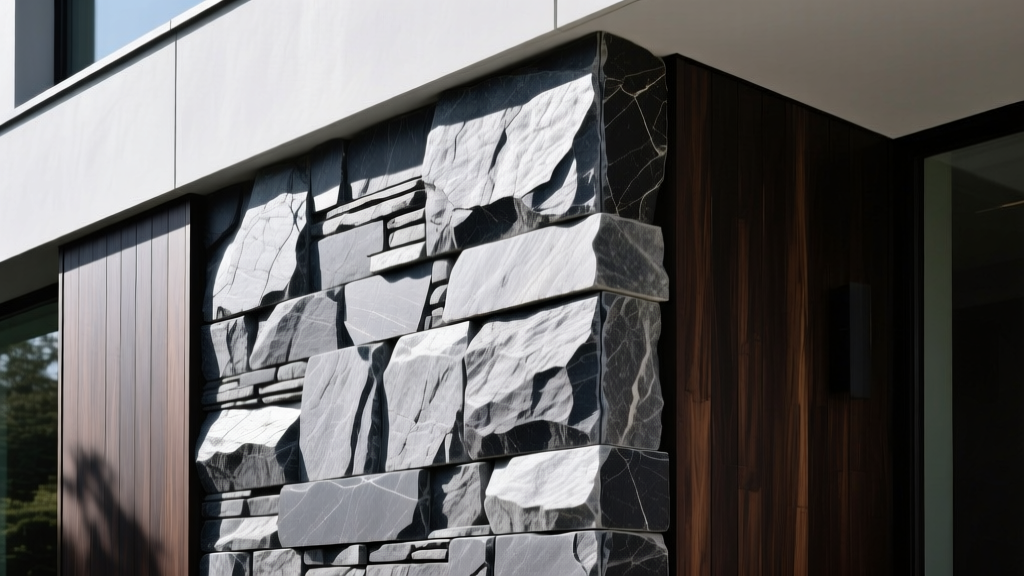
Granite stone veneer is processed into distinct profiles that dramatically alter the visual weight and shadow lines of the installation. Selecting the correct profile is critical for architectural cohesion.
- Ashlar Pattern: Rectangular, squared stones of varying heights and lengths. Provides a formal, structured appearance ideal for contemporary commercial facades and traditional colonial residences. Requires precise leveling during installation.
- Ledgestone / Ledge Rock: Long, horizontal, linear strips (typically 2 to 6 inches high and 12 to 24 inches long). Emphasizes horizontal sightlines, making it highly effective for modern fireplaces, retaining wall caps, and mid-century modern exteriors.
- Fieldstone / Mosaic: Irregular, rounded, or organic shapes fitted together like a puzzle. Yields a rustic, old-world aesthetic. Installation is labor-intensive due to the lack of uniform edges, driving up masonry costs.
- Sawn Thin Veneer Panels: Large-format, precision-cut panels (e.g., 12x24 inches) with a split-face or thermal finish. Used extensively in high-end commercial lobbies and elevator cores where a monolithic stone appearance is required.
Installation Systems: Mortar Chemistry and Substrate Prep
The longevity of a granite veneer installation relies entirely on the mortar chemistry and substrate preparation. For exterior natural granite thin veneer, specify ASTM C270 Type N mortar. Type N offers a balanced compressive strength (approx. 750 psi) and high flexural bond strength, allowing it to absorb thermal expansion and contraction without cracking the stone or breaking the bond.
For interior applications, particularly over cement backer board in wet areas or drywall in living spaces, a polymer-modified thinset mortar (ANSI A118.4 or A118.15) is required. Thinset provides superior adhesion to non-porous substrates and reduces the overall weight of the installation.
Common Failure Modes and Climate Considerations
Understanding how granite veneer fails allows buyers to specify preventative measures during the design phase. The three most common failure modes in stone veneer systems are efflorescence, spalling, and delamination.
Efflorescence and Moisture Management
Efflorescence appears as a white, powdery residue on the stone surface, caused by water-soluble salts migrating from the mortar or substrate to the surface. While natural granite itself contains very few soluble salts, the Portland cement in the mortar does. To prevent this, specify a low-alkali mortar and ensure the wall assembly includes a continuous weather-resistive barrier (WRB) and a weep screed at the base to evacuate trapped moisture.
Spalling in Freeze-Thaw Climates
Spalling occurs when water penetrates the stone or mortar, freezes, expands, and pops the face off the veneer. While natural granite is highly resistant to this, manufactured veneer is vulnerable if left unsealed. If sealing is required, strictly use a breathable silane/siloxane penetrating sealer. Film-forming acrylic sealers trap moisture inside the wall assembly, accelerating freeze-thaw damage and voiding manufacturer warranties.
Delamination from Thermal Shock
Dark-colored granites (such as Absolute Black or Impala Black) absorb significant solar radiation. On south-facing exterior walls, surface temperatures can exceed 140°F (60°C) in summer, while the substrate remains cool. This thermal gradient creates shear stress at the mortar bond line. For dark granites in high-sun exposures, increase the mortar scratch coat thickness and use mechanical wall ties spaced at 16 inches on center, rather than relying solely on adhesive bond strength.
Written by
Priya KapoorPriya Kapoor is a real estate market analyst and construction economics researcher with expertise in housing affordability, development feasibility, and infrastructure investment. She holds a Master of Regional Planning from Cornell University and previously worked as a senior analyst at CBRE's Investment Properties group, where she modeled returns for $4B in mixed-use development pipelines. Priya now runs an independent research practice advising developers, municipalities, and REITs on construction cost forecasting and market timing. She publishes the quarterly "BuildMat Market Pulse" report tracking material price indices across 12 commodity categories. Based in Austin, TX, Priya serves on the board of Habitat for Humanity Austin and is a marathon runner.
More from Priya Kapoor
View all
Construction Cost
Cost to Build a 1600 Sq Ft Home in 2026: Full Breakdown
Accurate 2026 cost to build a 1600 sq ft home—material, labor, and regional pricing breakdowns included. Plan your budget with real-time estimates.
Aug 11, 2026

Wood & Lumber
Name the Types of Wood for Pressure Treatment and Preservation
Learn how to name the types of wood best suited for pressure treatment. Compare species treatability, chemical retention levels, and 2026 preservation costs.
Aug 4, 2026

Stone & Masonry
Stone Veneer Suppliers Lindenhurst: 2026 Cost Analysis
Analyze 2026 stone veneer costs in Lindenhurst, NY. Compare local supplier pricing, delivery fees, and Suffolk County installation labor rates.
Aug 4, 2026