Marble Rock Specifications: Performance Ratings and ASTM Data
Explore detailed marble rock performance ratings, ASTM specifications, and mechanical data for structural and architectural applications.
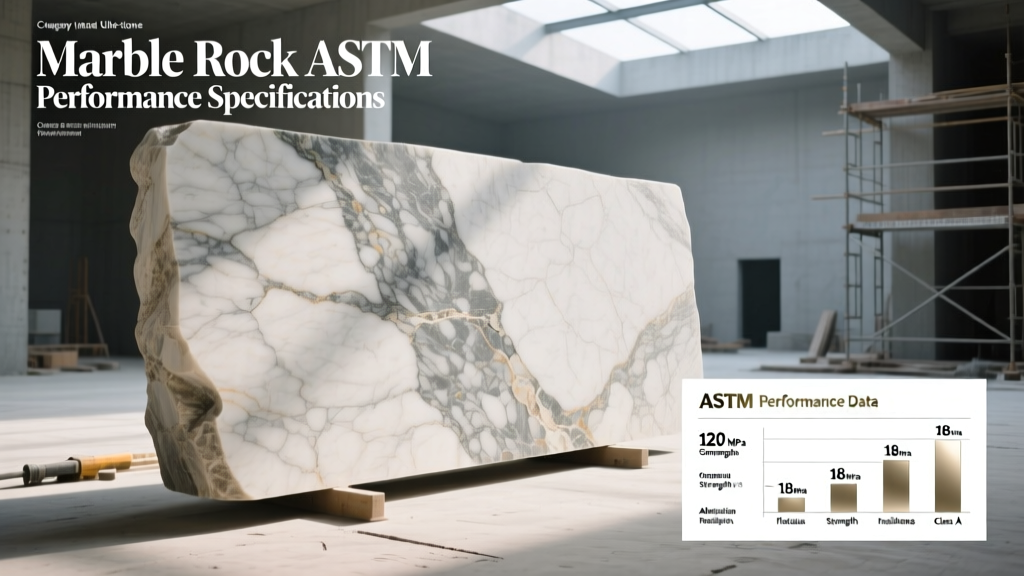
Geological Composition and Structural Baseline
When specifying natural stone for architectural and structural applications, understanding the baseline geological composition of marble rock is critical for predicting long-term performance. Geologically, marble is a metamorphic rock formed from the recrystallization of carbonate minerals, primarily calcite or dolomite. This recrystallization process dictates the stone's porosity, compressive strength, and chemical reactivity.
Not all marble rock performs identically. Calcite marble (calcium carbonate) is highly susceptible to acidic etching and has a Mohs hardness of 3. Dolomite marble (calcium magnesium carbonate) features a Mohs hardness of 4 and exhibits significantly higher resistance to weak acids, making it the superior specification for high-traffic commercial flooring and kitchen surfaces.
According to the U.S. Geological Survey (USGS), dimension stone production requires stringent grading to ensure the marble rock is free of structural voids, clay seams, and micro-fractures that could compromise load-bearing capacity. For structural cladding and heavy-duty flooring, the stone must meet the rigorous testing protocols established by ASTM International.
Core Mechanical Performance Ratings
The mechanical viability of marble rock for construction is governed by ASTM Committee C18 on Dimension Stone. These standards establish the minimum thresholds for safety and durability. Below is a comprehensive breakdown of the standard ASTM specifications and the typical performance ranges observed in high-grade architectural marble rock.
| ASTM Standard | Test Method | Minimum Spec (ASTM C50) | Typical Marble Rock Range |
|---|---|---|---|
| C170 / C170M | Compressive Strength | 7,500 psi (52 MPa) | 12,000 – 19,000 psi |
| C99 / C99M | Modulus of Rupture (Flexural) | 1,000 psi (7 MPa) | 1,500 – 2,800 psi |
| C97 / C97M | Absorption by Weight | 0.20% Max | 0.05% – 0.15% |
| C241 / C1353 | Abrasion Resistance | 10 Ha (C241) | 15 – 28 Ha |
| C97 / C97M | Bulk Specific Gravity | N/A | 2.60 – 2.85 |
Data sourced from testing protocols overseen by ASTM Committee C18 indicates that while marble rock easily exceeds minimum compressive strength requirements, its flexural strength (modulus of rupture) is the limiting factor in unsupported span applications. Engineers must account for this lower flexural threshold when designing ventilated facade anchoring systems.
Environmental Durability and Chemical Thresholds
Specifying marble rock for exterior or wet environments requires a strict analysis of its environmental durability. The stone's performance is heavily dictated by its porosity and mineralogical makeup.
Freeze-Thaw and Porosity Limits
Marble rock exhibits exceptionally low water absorption (typically under 0.15%). However, when subjected to ASTM C666 freeze-thaw cycling, the presence of micro-fissures can trap moisture. If the stone is not properly sealed with a penetrating silane/siloxane sealer, trapped water expanding during freezing can cause spalling. For exterior cladding in climate zones with more than 40 annual freeze-thaw cycles, specifications must mandate a maximum absorption rate of 0.10% and require factory-applied breathable impregnators.
Standard calcite marble rock will etch when exposed to substances with a pH below 6.5 (e.g., citrus, vinegar, harsh cleaning agents). For commercial food service areas or exterior applications exposed to acid rain (pH 4.5–5.5), specify dolomitic marble rock or mandate a permanent anti-etch nano-coating that maintains the stone's vapor permeability.
Thermal Expansion and Structural Loading
When designing structural supports or expansion joints for large-format marble rock panels, thermal movement must be calculated. The coefficient of thermal expansion for marble rock averages 3.5 x 10⁻⁶ in/in/°F. While lower than many metals and synthetic composites, a 120-inch exterior panel can expand by nearly 1/16th of an inch across a 100°F temperature swing. Open-drainage ventilated rainscreen systems must incorporate neoprene or EPDM isolation pads at anchor points to prevent stress fracturing.
Application-Specific Selection Matrix
Not all marble rock grades are suitable for every architectural application. The following matrix provides a decision framework for architects and structural engineers based on performance data.
| Application | Minimum Thickness | Required Anchoring / Substrate | Critical Performance Note |
|---|---|---|---|
| Interior Flooring (Commercial) | 3/4" (20mm) | Full-bed mortar, ANSI A118.15 EPT | Specify Ha > 20 (ASTM C241) for high-traffic lobbies. |
| Exterior Ventilated Cladding | 1 1/4" (30mm) | Type 316 SS kerf anchors, aluminum grid | Flexural strength dictates span; max span 24" without intermediate support. |
| Wet Areas / Shower Pans | 3/8" (10mm) mosaic | Epoxy adhesive (ANSI A118.3), sloped mud bed | Must be sealed; avoid iron-rich veins to prevent rust staining. |
| Countertops / Vanities | 1 1/4" (30mm) | Plywood substrate, silicone adhesive | Dolomite marble rock highly recommended to resist etching. |
Dimensional Tolerances and Fabrication Specifications
The precision of fabricated marble rock directly impacts installation speed and structural integrity. According to guidelines published by the Natural Stone Institute, dimension stone must adhere to strict calibration tolerances.
- Thickness Calibration: Standard tolerance is ±1/32" (±1mm) for interior tiles, and ±1/16" (±1.5mm) for exterior cladding panels.
- Length and Width: Tolerance of ±1/32" for gauged tiles; ±1/16" for large-format architectural panels.
- Squareness: Maximum out-of-square deviation of 1/64" per 12 inches of edge length.
- Surface Flatness: Variation in plane must not exceed 1/32" over a 24-inch straight edge to prevent lippage in large-format flooring installations.
"When specifying marble rock for exterior curtain walls, never rely solely on adhesive bonding. The stone's density and the dynamic wind loads require mechanical anchoring. Always specify undercut or kerf anchors manufactured from Type 316 stainless steel to prevent galvanic corrosion and subsequent stone spalling at the anchor points."
Testing and Certification Protocols
To ensure the marble rock delivered to the job site matches the laboratory specifications, project documents should mandate batch testing. For projects exceeding 5,000 square feet of dimension stone, require the supplier to provide independent laboratory test reports for ASTM C97 (Absorption), C99 (Flexural Strength), and C170 (Compressive Strength) from the specific quarry block being harvested.
Furthermore, for exterior applications, request a petrographic analysis (ASTM C295) to identify the presence of reactive minerals, such as pyrite or iron sulfides, which can oxidize and cause unsightly rust staining on the facade over time. By rigorously enforcing these performance ratings and specifications, architects and builders can leverage the timeless aesthetic of marble rock while ensuring structural longevity and minimizing lifecycle maintenance costs.