Stone Veneer Installation Cost: 2026 Pricing & Material Breakdown
Discover the true stone veneer installation cost for 2026. Get detailed pricing for natural vs. manufactured stone, labor rates, and hidden expenses.

The True Economics of Stone Veneer in 2026
Calculating the exact stone veneer installation cost requires moving beyond basic square-footage averages. While national averages often cite a broad range of $14 to $32 per square foot, actual project costs are dictated by substrate preparation requirements, material weight constraints, and specialized labor rates. This guide deconstructs the 2026 pricing landscape for natural, manufactured, and high-density polyurethane veneers, providing the precise data needed to budget accurately and avoid catastrophic moisture management failures.
2026 Stone Veneer Cost Matrix: Material vs. Labor
The ratio of material to labor shifts dramatically depending on the veneer type selected. Natural stone demands higher structural support and slower installation times, while interlocking polyurethane panels drastically reduce labor hours at the expense of material authenticity.
| Material Type | Material Cost (per sq. ft.) | Labor Cost (per sq. ft.) | Total Installed | Weight (lbs/sq. ft.) |
|---|---|---|---|---|
| Natural Fieldstone (Ledge) | $11.00 - $18.00 | $14.00 - $22.00 | $25.00 - $40.00 | 15 - 22 lbs |
| Manufactured Stone (e.g., Cultured Stone) | $6.50 - $10.50 | $10.00 - $16.00 | $16.50 - $26.50 | 8 - 12 lbs |
| Interlocking Faux Panels (Polyurethane) | $8.00 - $13.00 | $3.50 - $7.00 | $11.50 - $20.00 | 1 - 2 lbs |
| Sliced Thin Brick / Real Stone Slices | $7.00 - $12.00 | $12.00 - $18.00 | $19.00 - $30.00 | 5 - 8 lbs |
Labor Breakdown: Where the Budget is Actually Spent
Labor accounts for 55% to 70% of the total stone veneer installation cost for traditional masonry applications. Journeyman masons in 2026 are billing between $75 and $110 per hour, while specialized masonry contractors charge by the square foot based on the complexity of the profile.
Phase 1: Substrate Preparation and Lath (25% of Labor)
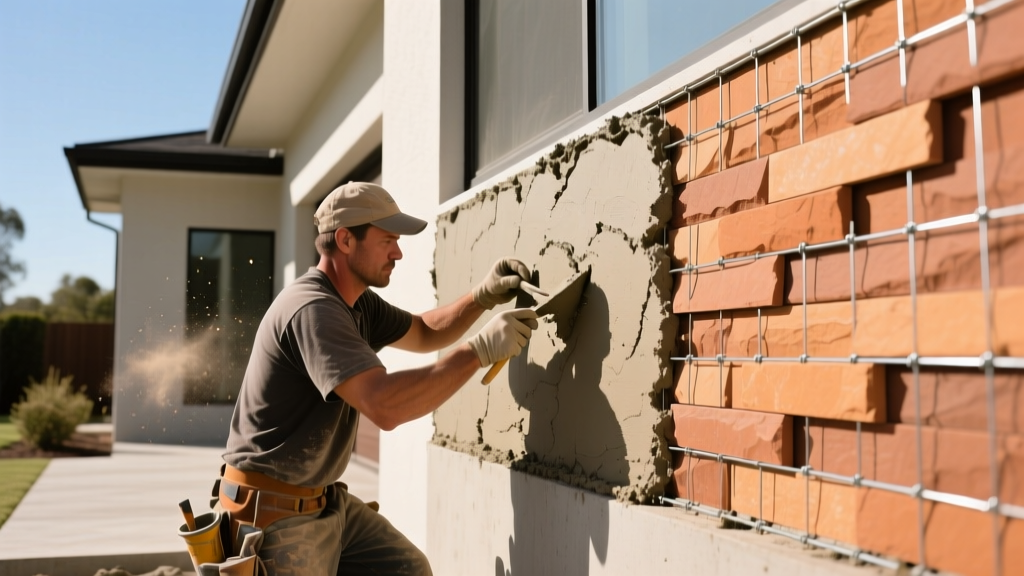
Veneer cannot be adhered directly to painted concrete block, drywall, or raw plywood. The substrate requires a weather-resistive barrier (WRB) followed by self-furring, galvanized expanded metal lath (minimum 2.5 lbs per square yard). The lath must be mechanically fastened to the wall studs or masonry backup using corrosion-resistant nails or screws every 6 inches on center. This phase is non-negotiable; skipping the scratch coat or using inadequate lath is the primary cause of delamination.
Phase 2: The Scratch Coat and Setting (50% of Labor)
A 1/2-inch Type S mortar scratch coat must be applied and scored horizontally to provide a mechanical key for the setting bed. Masons then back-butter each stone piece with a polymer-modified Type S or Type N mortar before pressing it into the setting bed. According to technical guidelines published by the National Concrete Masonry Association (NCMA), maintaining consistent 1/2-inch to 1-inch joints and ensuring complete mortar coverage on the back of each unit is critical for passing freeze-thaw cycle testing in northern climates.
Phase 3: Grouting, Pointing, and Cleanup (25% of Labor)
Pointing the joints with a grout bag and striking them with a jointing tool is highly labor-intensive. Acid washing or dry-brushing the final surface to remove mortar haze adds the final hours to the project timeline.
Hidden Costs and Edge Cases That Destroy Margins
When estimating your stone veneer installation cost, contractors often omit peripheral expenses that are mandatory for code compliance and structural integrity.
- Weep Screed Installation: Building codes mandate a weep screed at the base of all exterior adhered masonry veneer. The screed must be positioned a minimum of 4 inches above grade or 2 inches above paved surfaces. Adding this metal flashing and integrating it with the WRB adds $1.50 to $2.50 per linear foot to the project.
- Scaffolding and Equipment Rentals: For two-story installations, pump jacks or rented frame scaffolding will add $800 to $2,200 to the overall project cost. Mortar mixers and material hoists add another $300 to $500 in daily rental fees.
- Structural Reinforcement: Natural stone weighing over 15 lbs per square foot may require structural review. If the existing foundation or wall framing cannot support the dead load, installing additional concrete footings or steel angle iron shelf supports can add $3,000 to $8,000 to the prep phase.
- Waste Factor: Manufactured stone requires a 10% waste factor for cutting and fitting. Natural fieldstone, due to its irregular shaping, demands a 15% to 20% waste factor. Failing to order adequate overage results in stalled projects and mismatched dye-lot shipments.
Moisture Management: The Cost of Failure
Critical Warning: The most expensive stone veneer installation cost is the one you pay twice. Trapped moisture behind adhered masonry veneer causes wood framing rot and interior mold. Never rely solely on standard house wrap. Best practices dictate using two layers of Grade D building paper or a specialized dimpled drainage mat over the WRB to create a capillary break, allowing incidental moisture to drain down and out through the weep screed. Consult Fine Homebuilding's masonry guides for detailed drainage plane schematics.
Material Deep Dive: ASTM Standards and Brand Realities
Not all manufactured stone is created equal. When evaluating material costs, verify that the product meets ASTM C1670 (Standard Specification for Adhered Manufactured Stone Masonry Veneer). This standard ensures the product has been tested for compressive strength, water absorption, and freeze-thaw durability.
Premium Manufactured Brands (Eldorado, Cultured Stone)
These brands utilize high-quality molds taken directly from real stone, resulting in deep textures and varied color palettes. They require traditional mortar installation. Expect to pay $8.50 to $11.00 per square foot for the materials. They offer the highest return on investment for curb appeal and appraisals.
High-Density Polyurethane Panels (GenStone, AirStone)
Priced between $8.00 and $13.00 per square foot, these panels interlock and can be screwed directly into OSB, plywood, or concrete block using structural screws, bypassing the need for lath, mortar, and masons. While the material cost is comparable to mid-tier manufactured stone, the labor plummets. However, they lack the thermal mass and acoustic density of real masonry, and close-up inspection reveals repetitive patterns.
Expert Decision Framework: Allocating Your Budget
Use this framework to determine which material and installation method aligns with your financial and structural parameters.
Scenario A: Budget Under $14/sq. ft.
Recommendation: High-Density Polyurethane Panels (DIY or Handyman install).
Why: Eliminates the $10+ per sq. ft. masonry labor cost. Ideal for interior accent walls, basement remodels, or exterior wainscoting where structural load limits prohibit real masonry.
Scenario B: Budget $16 - $24/sq. ft.
Recommendation: Manufactured Stone Veneer (Professional Mason install).
Why: The optimal balance of authentic aesthetics, structural safety (lighter than natural stone), and ROI. Best choice for full exterior facade renovations and high-visibility architectural features.
Scenario C: Budget Over $28/sq. ft.
Recommendation: Natural Thin Veneer or Full-Bed Ledge Stone.
Why: Reserved for luxury custom builds where unique, non-repeating geological profiles are demanded. Requires a dedicated structural engineer to verify load-bearing capacity and specialized masons skilled in dry-stack or wide-grout techniques.
Accurately forecasting your stone veneer installation cost requires separating the romance of natural materials from the physics of building envelopes. By budgeting for mandatory moisture management systems, calculating corner pieces by the linear foot, and selecting materials that meet ASTM C1670 standards, you ensure the installation remains structurally sound and visually impeccable for decades.
Written by
James ThorntonJames Thornton is a construction industry veteran with 25 years of hands-on experience in wood framing, lumber grading, and residential building codes. He started as a framing carpenter in rural Oregon, earned his ICC Residential Building Inspector certification, and eventually became a senior plan reviewer for the City of Portland Bureau of Development Services. James holds a B.S. in Wood Science & Technology from Oregon State University and is a certified lumber grader through the West Coast Lumber Inspection Bureau (WCLIB). He has inspected over 3,000 residential construction sites and authored the city's internal guide on advanced framing techniques (2x6 at 24" O.C.). James lives in Bend, OR, where he builds custom timber-frame cabins and competes in lumberjack sports.
More from James Thornton
View all
Insulation
Best Home Insulation Materials: Complete 2026 Guide
Compare top home insulation materials for 2026. Find R-values, installed costs per square foot, and best uses for fiberglass, spray foam, and mineral wool.
Aug 4, 2026

Sustainable Building
Certify Your Green Building Material for LEED and WELL
Step-by-step guide to certifying a green building material for LEED v5 and WELL v2. Master EPDs, HPDs, and VOC limits for 2026 project specifications.
Aug 4, 2026

Stone & Masonry
Veneer Stacked Stone Panels: Interior Design & Style Showcase
Discover how veneer stacked stone panels transform interiors. Explore modern design profiles, material pairings, and technical installation specs.
Aug 4, 2026