The Ultimate Slate Roof Maintenance and Cleaning Playbook
Protect your investment with our expert slate roof maintenance and cleaning playbook. Learn safe washing techniques, inspection protocols, and repair costs.
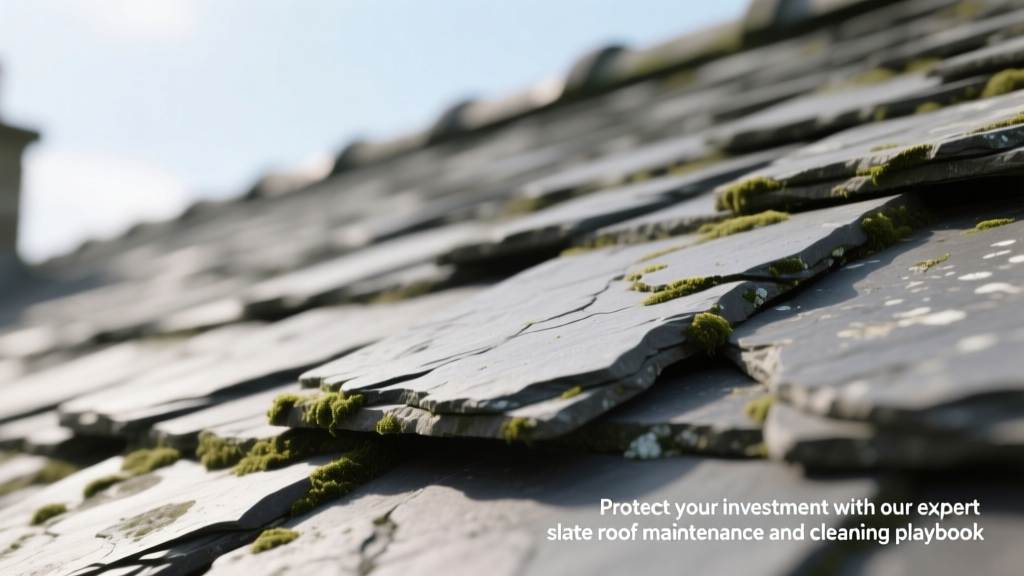
The Anatomy of Slate Degradation: Hard vs. Soft Stone
Slate is a metamorphic rock formed from shale under intense heat and pressure, resulting in a roofing material that can easily outlast the structure it covers. However, a slate roof is a system, not just a collection of stones. While the slate itself may endure for a century or more, the ancillary components—flashing, fasteners, and underlayment—dictate the actual lifespan of the assembly. Before executing any maintenance playbook, you must identify whether your roof utilizes hard or soft slate, as this fundamentally alters your cleaning and repair approach.
Hard Slate (Pennsylvania, Buckingham, Monson)
Hard slate features an absorption rate of less than 0.25% and a modulus of rupture exceeding 9,000 psi. Sourced primarily from Pennsylvania and Virginia quarries, these tiles routinely last 125 to 200 years. Hard slate is highly resistant to delamination and can withstand careful, low-pressure cleaning without surface spalling.
Soft Slate (Vermont, New York, Newfoundland)
Soft slate has a higher absorption rate (up to 0.45%) and a lifespan of 60 to 90 years. It is more susceptible to "gypsum leaching," a process where calcium sulfate within the stone dissolves, leaving microscopic voids that trap moisture and accelerate freeze-thaw delamination. Soft slate requires gentler cleaning protocols and more frequent inspections for edge flaking.
Never use a standard high-pressure washer (above 500 PSI) on a slate roof. High-pressure streams will blast away the protective mineral crust, force water upward under the headlaps (bypassing the gravity-shedding design), and fracture the cleavage planes of soft slate. According to the Slate Roofing Contractors Association, pressure washing is the leading cause of premature failure in otherwise healthy historic slate roofs.
The Bi-Annual Visual Inspection Protocol
Walking on a slate roof to inspect it causes more damage than it prevents. The point load of a human foot can easily snap aging slates or compromise the copper nails holding them. Modern maintenance relies on ground-level optics and aerial technology.
- Drone Thermography: Use a drone equipped with an infrared camera to scan the roof after a rainstorm. Wet underlayment or trapped moisture beneath slipped slates will retain heat differently than dry slate, highlighting hidden leak paths without physical contact.
- Binocular Sweep (Ground Level): Scan for "slipped slates" (tiles that have slid out of alignment, exposing the nail head of the course above), missing tiles, and localized moss accumulation.
- Gutter Sediment Analysis: Check the gutters for excessive granular grit. While some surface dust is normal, an accumulation of slate flakes or a gritty, sandy residue indicates advanced delamination and gypsum leaching from soft slate.
- Acoustic Testing (Contractor Only): If a specialized roofer must access the roof using proper hook ladders and knee pads, they will use a slate hammer to tap the tiles. A sharp, metallic ring indicates a secure, healthy slate; a dull thud signals a broken nail or internal delamination.
Biological Growth Removal: The D/2 Method
Algae, lichen, and moss retain moisture against the slate surface, accelerating the freeze-thaw cycle and promoting delamination. While zinc or copper ridge strips can prevent future growth, existing biological matter must be chemically eradicated rather than mechanically scraped.
The industry standard for stone and slate cleaning is D/2 Biological Solution, a quaternary ammonium-based biocide that is non-acidic, non-caustic, and safe for copper flashing and surrounding landscaping. Below is the professional application playbook:
- Preparation: Saturate surrounding landscaping and metal flashing with plain water to prevent localized chemical concentration.
- Application: Apply D/2 using a low-pressure garden pump sprayer at a rate of 1 gallon per 150–250 square feet. Ensure complete coverage of the biological growth.
- Dwell Time: Do not rinse. Allow the solution to dwell on the surface. The biological matter will turn white or orange within 24 hours and will naturally wash away with subsequent rainfall over 2 to 4 weeks.
- Follow-Up: For heavy lichen buildup, a second application may be required after 30 days. Never attempt to scrub the dead lichen off, as the mechanical friction will damage the slate surface.
"Slate is a water-shedding system, not a water-blocking membrane. The headlap (the overlap between courses) is what keeps water out. Any cleaning method that forces water upward under that lap will compromise the roof's integrity."
— Guidelines adapted from the National Roofing Contractors Association (NRCA)
Flashing and Fastener Diagnostics
The most common point of failure on a 75-year-old slate roof is not the stone; it is the metal holding it together. Slate outlasts almost all standard flashing materials, meaning a "slate roof replacement" is often just a flashing replacement disguised as a full tear-off.
Flashing Metallurgy
Inspect all valley, step, and chimney flashings. Original 16 oz or 20 oz copper flashing typically lasts 70 to 90 years before pinholing occurs. If your roof features terne metal (a lead-tin alloy), it requires repainting with a specialized metal roof coating every 10 to 15 years to prevent oxidation. Galvanized steel flashing is a hallmark of poor historical repairs and will rust through in 20 to 30 years, requiring immediate replacement with copper or stainless steel.
Nail Sickness and Rust Jacking
Authentic slate roofs are fastened with copper or stainless steel nails. If a previous contractor used standard cut steel nails, "rust jacking" will occur. As the steel nail corrodes, the expanding rust creates immense outward pressure, cracking the slate around the nail hole. If you see a high concentration of cracked slates specifically around the nail line, the fasteners have failed, and the roof will require a complete re-nailing or replacement.
Snow Guard and Gutter Maintenance
Slate is exceptionally slick. In snow-heavy climates, snow guards are mandatory to prevent sudden avalanches of snow and ice that can rip gutters from the fascia and destroy landscaping. Inspect the copper straps securing the snow guards; these straps endure immense shear stress and can fatigue or tear over decades. Ensure gutters are cleared bi-annually. Ice damming at the eaves forces meltwater backward under the slate headlaps, rotting the wooden roof deck and causing interior ceiling stains that are often misdiagnosed as mid-roof slate failures.
2026 Slate Roof Maintenance Cost Matrix
Budgeting for slate upkeep requires understanding the premium associated with specialized labor. General roofing contractors often lack the specific tooling (slate rippers, bib hangers, slate hammers) and knowledge required for proper repairs. Always hire a certified specialist.
| Service / Repair | Frequency | Estimated Cost Range |
|---|---|---|
| Drone & Visual Inspection | Every 2-3 Years | $350 – $650 |
| D/2 Biocidal Cleaning (per sq ft) | As Needed (10-15 yrs) | $0.75 – $1.50 / sq ft |
| Individual Slate Replacement | As Needed | $250 – $450 per tile |
| Copper Valley Flashing Replacement | Every 70-90 Years | $45 – $85 per linear ft |
| Full Square Replacement (100 sq ft) | End of Life | $1,800 – $3,200+ |
For comprehensive historical preservation standards and detailed architectural guidelines on maintaining heritage stone assemblies, consult the National Park Service Preservation Briefs. Proper stewardship of a slate roof transforms it from a recurring expense into a generational asset, preserving both the structural integrity and the architectural heritage of the building.