Top Granite Colors 2026: Premium Brand Slabs & Design Guide
Explore 2026's top granite colors through premium brand lines like MSI and Antolini. Compare pricing, mineral durability, and fabrication specs.
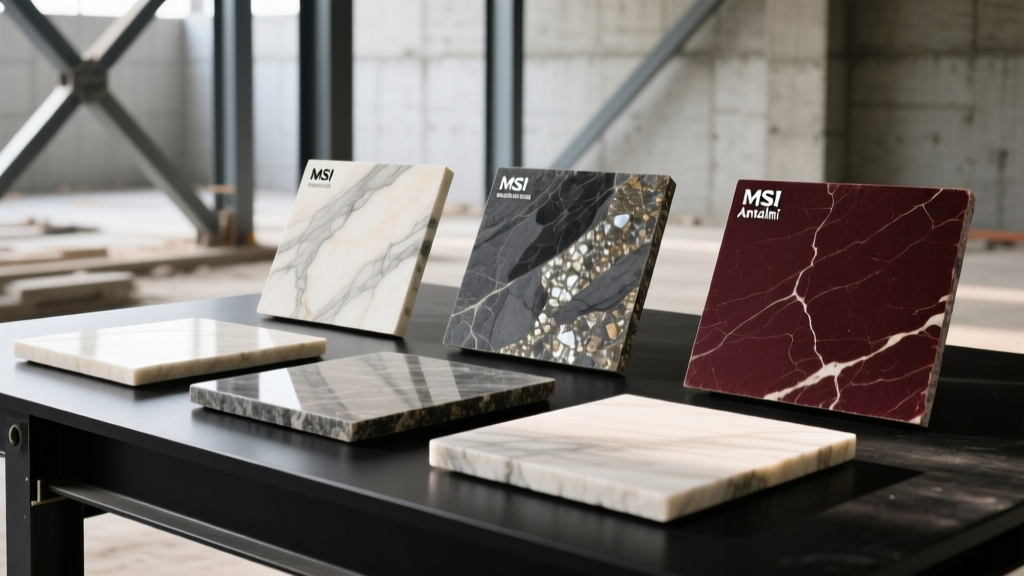
The Shift in Granite Color Trends: Beyond Uba Tuba
The natural stone market has decisively moved past the mottled greens and browns of the early 2000s. In 2026, architects and homeowners specify granite colors that offer high contrast, dramatic veining, and monochromatic depth. However, selecting a color is only the first step; understanding the brand-specific processing, mineralogical composition, and fabrication requirements of specific product lines is what separates a successful installation from a costly failure.
This deep-dive analyzes the current landscape of granite colors through the lens of industry-leading brands, contrasting commercial workhorses with high-end exotic collections, while providing the technical data required for proper specification and fabrication.
Brand Deep-Dive: MSI’s Commercial & Premium Granite Lines
MSI Surfaces remains a dominant force in the North American market, bridging the gap between high-volume commercial projects and premium residential builds. Their inventory is categorized by color consistency and origin, with two specific color families dominating their 2026 shipments.
Alaska White & Steel Grey: The High-Volume Workhorses
Alaska White (sourced primarily from Brazil) and Steel Grey (sourced from India) represent the backbone of MSI’s premium commercial line. These colors are favored for their dramatic movement and relative fabrication ease.
- Alaska White: Features a stark white and grey background with deep burgundy and black garnet deposits. Because of the varying mineral density, fabricators must use continuous-rim diamond blades to prevent chipping the softer feldspar pockets.
- Steel Grey: A monochromatic, large-crystal granite that mimics the look of concrete but offers superior scratch resistance. It is highly forgiving during CNC routing for complex edge profiles like the double-ogee or waterfall miter.
Both slabs are typically treated at the quarry with polyester resin to fill micro-fissures. While adequate for indoor vertical and horizontal applications, polyester resin is UV-sensitive. If specifying these colors for exterior cladding or outdoor kitchens, verify with the distributor that the specific batch was treated with UV-stable epoxy resin.
Antolini’s Exotic Collection: When Granite Colors Defy Convention
For luxury specifications where budget is secondary to visual impact, Antolini sets the global standard. Their exotic granite lines feature colors that challenge conventional geological expectations, often requiring specialized handling.
Sodalite Blue and Titanium
Antolini’s Sodalite Blue is arguably the most sought-after blue stone on the market. Geologically, it is not a true granite but a sodalite-rich syenite. Its deep, electric blue veins are interspersed with white nepheline and grey inclusions. Titanium, another Antolini staple, features a chaotic, metallic-looking blend of black, gold, and white minerals that resemble a starry night sky.
Fabricator Warning: Exotic Blue Sensitivity
Stones marketed as 'Blue Granite' (such as Sodalite Blue or Azul Bahia) contain high concentrations of sodalite or nepheline. Unlike quartz, these minerals are highly sensitive to acidic cleaners and can etch or dull over time. Always specify a penetrating, fluoropolymer-based impregnating sealer rather than a topical coating, and educate the client on strict pH-neutral maintenance.
To protect these high-value slabs, Antolini utilizes proprietary backing technologies, including fiberglass mesh reinforcement and hydrophobic treatments, which stabilize the stone during the intense vibration of bridge saw cutting.
Color vs. Mineralogy: How Composition Dictates Durability
A common misconception in the stone industry is that all 'granite colors' share the same physical properties. In reality, the commercial term 'granite' encompasses a wide variety of igneous rocks. The color of the stone is a direct indicator of its mineral composition, which dictates its hardness, porosity, and chemical resistance.
| Color Family | Primary Minerals | Mohs Hardness | Acid Sensitivity |
|---|---|---|---|
| Black (e.g., Black Pearl) | Plagioclase, Pyroxene | 6.0 - 6.5 | None |
| White (e.g., Alaska White) | Feldspar, Quartz | 6.0 - 7.0 | None |
| Blue (e.g., Sodalite Blue) | Sodalite, Nepheline | 5.5 - 6.0 | High (Etching Risk) |
| Red (e.g., New Imperial) | K-Feldspar, Quartz | 6.5 - 7.0 | None |
As highlighted by the Natural Stone Institute, understanding these geological distinctions is critical for setting client expectations, particularly regarding maintenance and longevity in high-traffic culinary environments.
Sourcing and Pricing Matrix: What You Will Actually Pay in 2026
Pricing for granite colors varies wildly based on quarry scarcity, block size, and the level of factory processing. The following matrix reflects average market rates for material and professional installation in major North American metropolitan areas.
| Tier | Brand Example | Slab Color | Material Cost (per sq. ft.) | Installed Cost (per sq. ft.) |
|---|---|---|---|---|
| Commercial | MSI, Bedrosians | Steel Grey, Black Pearl | $35 - $55 | $65 - $95 |
| Premium | MSI, Surfaces Group | Alaska White, Viscount White | $60 - $90 | $100 - $140 |
| Exotic | Antolini, Marmi Bruno Zullo | Sodalite Blue, Cosmic Black | $150 - $300+ | $220 - $450+ |
Expert Selection Framework: Matching Color to Application
Selecting the right granite color requires matching the stone's inherent properties to the environmental demands of the space. Use this decision framework to avoid costly specification errors.
1. Exterior Cladding and Paving
Recommended Colors: True blacks, deep reds, and uniform greys (e.g., Absolute Black, New Imperial Red).
The Gotcha: Beware of dyed black granites. Some overseas quarries treat lower-grade grey stones with dark resins or dyes to achieve an 'Absolute Black' appearance. When exposed to direct UV sunlight, these dyes will fade, resulting in a patchy, greyish appearance. Always perform the acetone test: rub a white cloth soaked in pure acetone firmly on the slab. If the cloth turns black or dark grey, the stone is dyed and unsuitable for exterior use.
2. High-Use Culinary Islands
Recommended Colors: High-quartz whites and complex movement patterns (e.g., Alaska White, Steel Grey).
The Gotcha: Avoid solid, monochromatic light colors if the client is a heavy cook. While granite is highly stain-resistant when properly sealed, oil and acidic spills will eventually break down topical sealers. Stones with heavy visual movement and contrasting veins naturally camouflage micro-stains and water spots far better than solid white or solid black slabs.
3. Luxury Bathrooms and Vanity Tops
Recommended Colors: Exotic blues, titanium, and rare greens (e.g., Sodalite Blue, Fusion).
The Gotcha: Bathroom environments expose stone to harsh chemical cleaners, hairsprays, and acidic cosmetics. If specifying an exotic blue or green stone with calcite or sodalite veins, you must explicitly write a pH-neutral cleaning protocol into the client's handover documentation, as standard bathroom cleaners will permanently etch the softer mineral veins.