Fieldstone Foundation Repair Cost Guide: 2026 Pricing & Factors
Analyze 2026 fieldstone foundation repair costs. Compare repointing, rebuilding, and waterproofing pricing, plus mortar diagnostics for historic homes.

The Economics of Rubble Stone Restoration
Fieldstone foundations, often referred to as rubble stone or rubble trench foundations, are a hallmark of pre-1920s residential and agricultural construction. Unlike modern poured concrete or uniform Concrete Masonry Units (CMUs), fieldstone relies on a complex matrix of irregular, uncut stones bedded in mortar. Because the stones lack flat bedding planes, the structural load distribution depends almost entirely on the integrity of the mortar joints. When that mortar degrades, the foundation's ability to transfer loads to the earth is compromised.
Estimating the fieldstone foundation repair cost requires moving beyond standard per-square-foot concrete patching metrics. Historic masonry restoration demands specialized materials, meticulous hand-labor, and an understanding of building physics that modern waterproofing contractors often lack. In 2026, the national average for comprehensive fieldstone foundation repair ranges from $6,500 to $22,000, though severe structural failures requiring exterior excavation and sectional rebuilding can easily exceed $45,000. The final price is dictated by the failure mode, accessibility, and the strict material science required to preserve historic stone.
2026 Cost Matrix: Repair Methods and Pricing
The intervention required for a failing fieldstone wall varies wildly based on the symptom. Below is a detailed breakdown of current market rates for specialized masonry restoration.
| Repair Method | 2026 Cost Range | Best Application | Expected Lifespan |
|---|---|---|---|
| Interior Repointing (Tuckpointing) | $18 - $35 per sq. ft. | Minor mortar washout, efflorescence, non-structural voids | 50 - 80 years |
| Exterior Repointing (with excavation) | $55 - $95 per sq. ft. | Exterior mortar degradation, minor water infiltration | 75 - 100+ years |
| Sectional Rebuild (Re-laying collapsed stones) | $75 - $140 per sq. ft. | Localized bulging, racking, or collapsed rubble sections | 100+ years |
| Perimeter French Drain & Grading | $65 - $120 per linear ft. | Hydrostatic pressure management, surface water diversion | 30 - 50 years |
| Interior Steel I-Beam Bracing | $900 - $1,600 per beam | Severe inward bowing where exterior excavation is impossible | Permanent |
| Whole-Foundation Rebuilding | $150 - $250+ per sq. ft. | Total structural failure, severe settling, or extreme racking | 100+ years |
Diagnostic Framework: Matching Symptoms to Interventions
Accurate cost estimation begins with precise diagnosis. Misidentifying the failure mode leads to ineffective repairs and wasted capital. Use this diagnostic matrix to identify your foundation's specific pathology.
Symptom: White, Powdery Residue (Efflorescence)
- Cause: Moisture is migrating through the porous stone and mortar, dissolving natural salts and depositing them on the interior surface as the water evaporates.
- Intervention: Exterior grading correction and interior repointing. Do not apply interior sealants, which will trap moisture and accelerate spalling.
- Cost Impact: Low to Moderate. Primarily requires repointing ($18-$35/sq. ft.) and exterior landscaping adjustments.
Symptom: Crumbling Mortar and Loose Stones
- Cause: Original lime mortar has reached the end of its service life (often 100-150 years), or chronic water infiltration has caused 'mortar washout,' leaving voids in the rubble core.
- Intervention: Hand-raking of deteriorated joints to a depth of 2 to 2.5 times the joint width, followed by repacking with Natural Hydraulic Lime (NHL) mortar.
- Cost Impact: Moderate. Labor-intensive hand-raking drives the cost toward the higher end of the repointing spectrum.
Symptom: Bulging, Bowing, or Inward Leaning
- Cause: Lateral hydrostatic pressure from saturated exterior soils, frost heave, or loss of the mortar matrix causing the rubble core to shift outward under the structural load.
- Intervention: If the deflection exceeds 2 inches, exterior excavation and sectional rebuilding are required. If exterior access is blocked by property lines or additions, interior steel I-beam bracing anchored to the floor joists and slab is the alternative.
- Cost Impact: High to Severe. Excavation and shoring of the structure above add significant overhead.
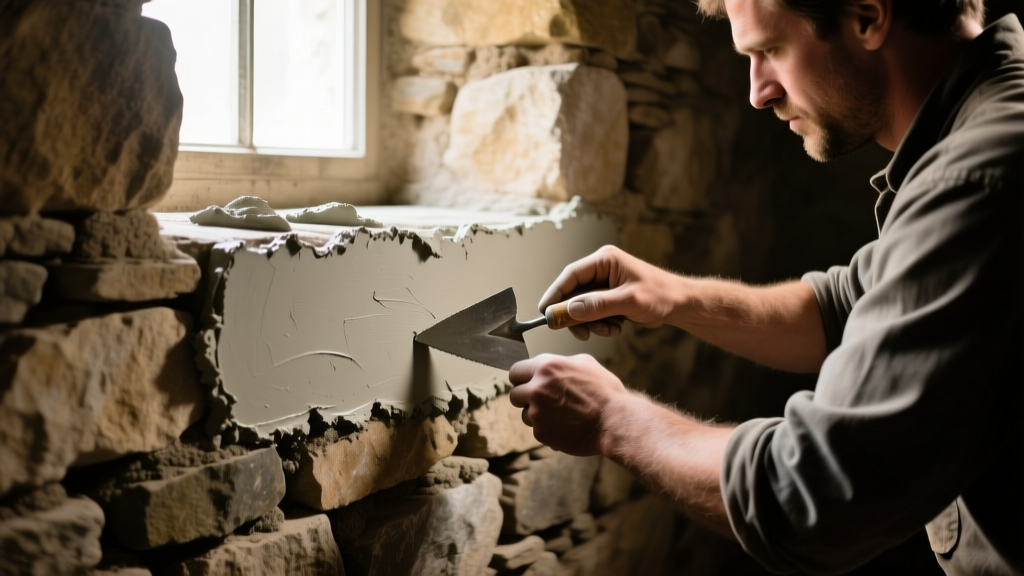
The Mortar Mandate: Why Chemistry Dictates Cost and Survival
The single most critical factor in fieldstone repair is mortar selection. According to the National Park Service Preservation Brief #2, using modern, high-strength Portland cement on historic masonry is a primary cause of accelerated deterioration.
Modern Portland cement (Type N, S, or M) possesses a compressive strength of 2,500 to 3,500 PSI and very low vapor permeability. Fieldstone is relatively soft and moves with seasonal temperature and moisture fluctuations. When rigid Portland mortar is used, the stone becomes the weakest element in the wall. Moisture gets trapped behind the impermeable mortar, and during freeze-thaw cycles, the face of the historic stone will spall (pop off), causing irreversible damage to the foundation.
The Correct Materials for 2026 Repairs
For pre-1900 fieldstone foundations, restorers must use Natural Hydraulic Lime (NHL 3.5 or NHL 5), such as those produced by Saint-Astier or Transmineral. NHL cures through carbonation and hydrolysis, resulting in a compressive strength of 700 to 1,500 PSI. It is highly vapor-permeable, allowing the wall to 'breathe,' and possesses autogenous healing properties, where micro-cracks naturally re-calcify over time when exposed to moisture.
If NHL is unavailable, a custom Type O mortar mix (1 part Portland cement, 2 parts hydrated lime, 9 parts well-graded masonry sand) is the absolute maximum allowable hardness. Because these specialized materials require custom batching and slower curing times (often requiring wet burlap curing for 7 to 14 days), labor costs for proper lime repointing are 20% to 30% higher than standard cement tuckpointing.
Excavation, Shoring, and the Exterior Premium
Exterior fieldstone repair costs exponentially more than interior work. Accessing the exterior face of a rubble foundation requires excavating a trench down to the footing. This introduces three major cost multipliers:
- Hand-Digging Requirements: Heavy machinery like mini-excavators can easily collapse a historic rubble trench or undermine the shallow, unreinforced footings typical of 19th-century construction. Most exterior fieldstone repairs require manual hand-digging in 4-foot sections, significantly increasing labor hours.
- Structural Shoring: Before excavating beneath the frost line, contractors must install temporary screw jacks and shoring beams to support the floor joists above. Shoring a standard 40-foot wall can add $2,500 to $4,500 to the project baseline.
- Debris Management: Excavating century-old soil mixed with collapsed stone, coal ash, and organic debris generates massive weight. Haul-away fees for heavy masonry rubble frequently exceed $1,500 per truckload.
Furthermore, as noted in guidelines regarding historic masonry maintenance, exterior stone should never be aggressively power-washed or sandblasted to prepare for repointing, as this destroys the protective patina and opens the stone's pores to rapid water ingress. Gentle hand-brushing and low-pressure water rinsing are mandatory, adding to the time-on-site.
Hidden Variables and Contingency Budgeting
When budgeting for a fieldstone foundation repair, homeowners and property managers must allocate a minimum 20% contingency fund. Rubble foundations are inherently unpredictable; the true condition of the mortar matrix is often hidden behind decades of interior parging (a thin coat of cement applied over the stone) or exterior stucco.
Removing failing interior parging is a common hidden cost. While stripping the parging reveals the beautiful historic stone, it also exposes massive voids and deteriorated joints that were previously hidden, instantly converting a $3,000 cosmetic patching job into a $12,000 comprehensive repointing project. Additionally, if the foundation lacks a proper concrete footing—a common scenario in pre-1880 farmhouses where stones were laid directly on compacted earth or a rubble trench—stabilizing the base requires pouring a modern reinforced concrete grade beam inside the basement, adding $150 to $250 per linear foot to the final invoice.
Written by
James ThorntonJames Thornton is a construction industry veteran with 25 years of hands-on experience in wood framing, lumber grading, and residential building codes. He started as a framing carpenter in rural Oregon, earned his ICC Residential Building Inspector certification, and eventually became a senior plan reviewer for the City of Portland Bureau of Development Services. James holds a B.S. in Wood Science & Technology from Oregon State University and is a certified lumber grader through the West Coast Lumber Inspection Bureau (WCLIB). He has inspected over 3,000 residential construction sites and authored the city's internal guide on advanced framing techniques (2x6 at 24" O.C.). James lives in Bend, OR, where he builds custom timber-frame cabins and competes in lumberjack sports.
More from James Thornton
View all
Insulation
Best Home Insulation Materials: Complete 2026 Guide
Compare top home insulation materials for 2026. Find R-values, installed costs per square foot, and best uses for fiberglass, spray foam, and mineral wool.
Aug 4, 2026

Sustainable Building
Certify Your Green Building Material for LEED and WELL
Step-by-step guide to certifying a green building material for LEED v5 and WELL v2. Master EPDs, HPDs, and VOC limits for 2026 project specifications.
Aug 4, 2026

Stone & Masonry
Veneer Stacked Stone Panels: Interior Design & Style Showcase
Discover how veneer stacked stone panels transform interiors. Explore modern design profiles, material pairings, and technical installation specs.
Aug 4, 2026