Stone Masonry Veneer Cost Breakdown & 2026 Installation Pricing
Analyze stone masonry veneer costs for 2026. Get detailed pricing for materials, labor, and prep work to budget your natural or manufactured stone project.

The True Cost of Stone Masonry Veneer: Beyond the Square Foot
Budgeting for stone masonry veneer requires looking past the advertised per-square-foot material prices. While a brochure might list manufactured stone at $8 per square foot, the final installed cost involves substrate preparation, specialized mortars, linear corner pieces, and skilled masonry labor. In 2026, supply chain stabilization has normalized material freight costs, but a persistent shortage of skilled masons continues to drive labor rates upward. Understanding the complete cost architecture is the only way to prevent mid-project budget overruns.
2026 Quick Cost Snapshot (Per Square Foot of Wall Area)
- Manufactured Stone Veneer (MSV): $24.00 – $42.00 installed
- Natural Stone Veneer: $38.00 – $75.00+ installed
- Material Only (MSV): $6.50 – $14.00
- Material Only (Natural): $15.00 – $35.00+
- Labor & Prep: $16.00 – $38.00
Material Costs: Natural vs. Manufactured Stone Masonry Veneer
The choice between natural and manufactured stone masonry veneer dictates your baseline material budget. Manufactured stone (often referred to as architectural stone veneer) is cast from Portland cement, lightweight aggregates, and iron oxide pigments. Natural stone is quarried and sliced into veneer thicknesses (typically 0.75 to 1.5 inches).
| Feature | Manufactured Stone Veneer (MSV) | Natural Stone Veneer |
|---|---|---|
| Average Material Cost | $6.50 – $14.00 / sq. ft. | $15.00 – $35.00 / sq. ft. |
| Weight | 10 – 12 lbs / sq. ft. | 15 – 25+ lbs / sq. ft. |
| Leading Brands / Types | Cultured Stone, Eldorado, Coronado | Limestone, Fieldstone, Slate, Granite |
| Waste Factor | 5% – 10% | 10% – 15% (due to irregular shapes) |
According to the National Concrete Masonry Association (NCMA), manufactured veneer must meet ASTM C1670 standards for dimensional stability and freeze-thaw durability. When purchasing MSV, verify the manufacturer's compliance with this standard to avoid premature spalling in cold climates.
The Corner Piece Trap: Linear vs. Square Foot Pricing
The most common budgeting error in stone masonry veneer projects is miscalculating corner pieces. Flat veneer is sold by the square foot, but corner pieces are sold by the linear foot. Because corners require specialized molds and more intricate manufacturing, they are disproportionately expensive.
Calculation Framework: Measure all external corners, window/door jambs, and pillar wraps in linear feet. Add a 10% waste factor for cuts and breaks. Deduct the linear footage of corners from your total square footage calculation so you do not over-order flat pieces.
Labor, Substrate, and Preparation Costs
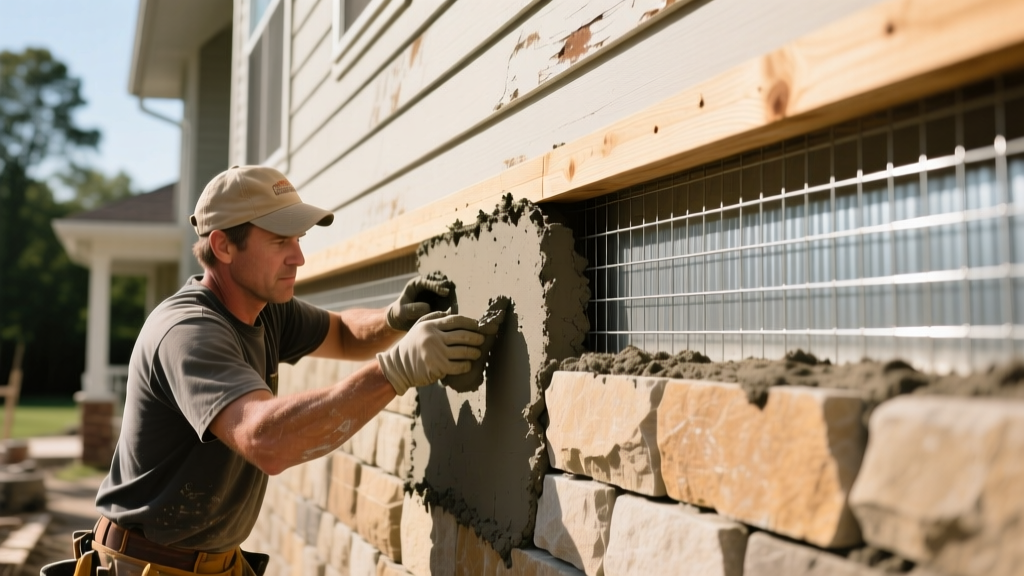
Stone masonry veneer is an adhered system. It cannot be applied directly to drywall, painted surfaces, or bare plywood. The substrate preparation is non-negotiable and heavily impacts the final labor invoice.
The Adhered Veneer Assembly
- Weather-Resistant Barrier (WRB): Two layers of Grade D paper or a high-performance house wrap (e.g., Tyvek CommercialWrap). Cost: $0.50 – $1.00 / sq. ft.
- Weep Screed: A corrosion-resistant metal or PVC screed installed at the base to allow moisture to escape. Must be installed a minimum of 4 inches above grade or 2 inches above paved surfaces per International Building Code (IBC) requirements. Cost: $2.00 – $4.00 / linear ft.
- Metal Lath: Self-furring, galvanized steel lath (minimum 2.5 lbs per square yard) attached with corrosion-resistant fasteners. Cost: $1.50 – $3.00 / sq. ft.
- Scratch Coat: A 0.5-inch layer of Type S mortar applied to the lath and horizontally scored. Must cure for 24 to 48 hours before stone application. Cost: $1.00 – $2.00 / sq. ft.
- Setting Mortar & Stone Application: Masons apply Type S or Type N mortar (or a polymer-modified veneer mortar) to the back of each stone (back-buttering) and press it into the scratch coat. Cost: $14.00 – $30.00 / sq. ft. for skilled labor.
Why Type S Mortar is Mandatory
Do not allow contractors to substitute Type N mortar or standard tile thin-set for the scratch coat and setting bed unless specifically approved by the stone manufacturer. Type S mortar contains a higher ratio of Portland cement to lime, providing the necessary tensile strength and bond adhesion required to support the sheer weight of masonry veneer on vertical surfaces.
Regional Labor Modifiers and Site-Specific Factors
Masonry labor rates vary drastically by region, driven by local union prevalence, cost of living, and the density of skilled tradespeople. The National Association of Home Builders (NAHB) regularly tracks regional construction labor shortages, which directly correlate to veneer installation premiums.
| Region | Average Masonry Labor Rate (per sq. ft.) | Market Dynamics (2026) |
|---|---|---|
| Northeast (NY, MA, CT) | $28.00 – $40.00 | High union density; strict scaffolding codes increase setup costs. |
| Southeast (FL, GA, NC) | $16.00 – $24.00 | Highly competitive; abundant non-union labor, but high demand for hurricane-rated assemblies. |
| Midwest (IL, OH, MI) | $22.00 – $32.00 | Moderate rates; seasonal weather constraints limit winter exterior installations. |
| West Coast (CA, WA, OR) | $30.00 – $45.00 | Highest labor costs; stringent seismic anchoring requirements for heavier natural stones. |
Hidden Costs and Failure Prevention
When evaluating bids, scrutinize the line items for moisture management. The leading cause of stone masonry veneer failure is not the stone itself, but trapped moisture causing efflorescence, mold, or structural rot behind the assembly.
- Flashing Integration: Proper integration of the WRB with window and door flashing (using kick-out diverters at roof-to-wall intersections) adds $300 to $800 to a typical residential project but prevents tens of thousands in water damage repairs.
- Scaffolding and Staging: For second-story applications or steep-grade properties, scaffolding rental and setup can add $1,500 to $4,000 to the project total. Ensure this is explicitly included or excluded in the contractor's bid.
- Sealing and Anti-Efflorescence Treatments: While most modern manufactured stones do not require sealing, natural stones like limestone or sandstone may benefit from a breathable, silane-siloxane penetrating sealer to prevent water intrusion and mineral leaching. Budget $1.50 to $3.00 per square foot for professional sealing.
ROI and Value Retention
Stone masonry veneer remains one of the highest-performing exterior upgrades in terms of value retention. Data from the Remodeling Magazine Cost vs. Value Report consistently shows that manufactured stone veneer replacements recoup between 90% and 95% of their project cost at the time of home resale. This outperforms nearly all other exterior cladding options, including fiber-cement siding and vinyl, making the premium upfront investment highly justifiable for homeowners planning to sell within a 5-to-10-year horizon.
Ultimately, securing an accurate budget for stone masonry veneer requires separating flat square footage from linear corner footage, mandating ASTM-compliant substrate preparations, and adjusting labor expectations based on your specific regional market. Demand itemized bids that separate material, prep, and masonry labor to ensure no critical moisture-management steps are being skipped to artificially lower the bottom line.
Written by
James ThorntonJames Thornton is a construction industry veteran with 25 years of hands-on experience in wood framing, lumber grading, and residential building codes. He started as a framing carpenter in rural Oregon, earned his ICC Residential Building Inspector certification, and eventually became a senior plan reviewer for the City of Portland Bureau of Development Services. James holds a B.S. in Wood Science & Technology from Oregon State University and is a certified lumber grader through the West Coast Lumber Inspection Bureau (WCLIB). He has inspected over 3,000 residential construction sites and authored the city's internal guide on advanced framing techniques (2x6 at 24" O.C.). James lives in Bend, OR, where he builds custom timber-frame cabins and competes in lumberjack sports.
More from James Thornton
View all
Insulation
Best Home Insulation Materials: Complete 2026 Guide
Compare top home insulation materials for 2026. Find R-values, installed costs per square foot, and best uses for fiberglass, spray foam, and mineral wool.
Aug 4, 2026

Sustainable Building
Certify Your Green Building Material for LEED and WELL
Step-by-step guide to certifying a green building material for LEED v5 and WELL v2. Master EPDs, HPDs, and VOC limits for 2026 project specifications.
Aug 4, 2026

Stone & Masonry
Veneer Stacked Stone Panels: Interior Design & Style Showcase
Discover how veneer stacked stone panels transform interiors. Explore modern design profiles, material pairings, and technical installation specs.
Aug 4, 2026