Quality Stone Veneer Inc. Maintenance: Expert Care & Cleaning Guide
Learn the exact maintenance, cleaning, and repointing protocols for Quality Stone Veneer Inc. manufactured stone to prevent efflorescence and fading.
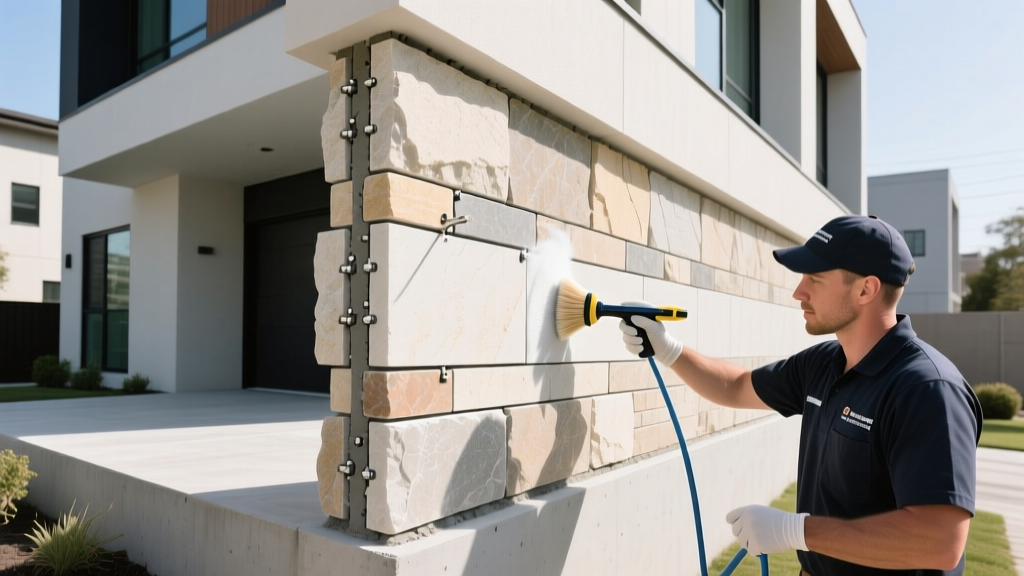
The Material Science of Quality Stone Veneer Inc. Products
Maintaining manufactured stone veneer (MSV) requires a fundamentally different approach than caring for natural quarried stone. Quality Stone Veneer Inc. products are engineered using a high-density Portland cement matrix, lightweight aggregates, and integrated iron oxide pigments. Because the color is not a surface coating but an integral component of the cementitious paste, the primary goal of maintenance is to protect this paste from chemical erosion and mechanical abrasion. When the cement paste degrades, the raw, uncolored aggregate beneath is exposed, leading to irreversible fading and a mottled appearance.
Never use muriatic acid, hydrochloric acid, or unbuffered acidic masonry cleaners on Quality Stone Veneer Inc. products. Acid etches the Portland cement binder, instantly stripping the iron oxide pigments and permanently scarring the veneer. According to the Masonry Veneer Manufacturers Association (MVMA), acid washing is the leading cause of premature color failure in MSV installations.
Annual Inspection Checklist: Identifying Early Failure Modes
Before initiating any cleaning protocol, conduct a systematic inspection of the veneer facade. Catching micro-failures early prevents moisture intrusion into the underlying weather-resistive barrier (WRB).
- Mortar Joint Integrity: Look for 'craze cracking' (a network of fine, shallow cracks) or separations between the mortar and the stone edge. Joints should be solid and flush or slightly recessed.
- Efflorescence Blooms: Identify white, powdery calcium carbonate deposits. While primarily cosmetic, heavy efflorescence indicates excessive moisture migration through the wall assembly.
- Biological Growth: Check north-facing elevations and areas near sprinkler heads for algae, moss, or lichen, which secrete mild acids that can slowly degrade the mortar joints.
- Weep Screed Clearance: Verify that the bottom edge of the veneer maintains a minimum 4-inch clearance from soil and 2-inch clearance from paved surfaces to prevent capillary water uptake.
Step-by-Step Cleaning Protocols for Manufactured Veneer
Routine cleaning should be performed annually or bi-annually to remove atmospheric pollutants, dirt, and organic matter. The mechanical force applied to the surface must be strictly controlled.
1. Pre-Wetting and Dry Brushing
Always pre-wet the stone surface with clean water before applying any cleaning solution. This prevents the dry, porous cement matrix from rapidly absorbing the cleaning chemicals, which can cause uneven staining. For loose dirt and cobwebs, use a soft-bristle nylon brush. Never use wire brushes or steel wool, as metal bristles will embed in the pores and rust, creating secondary orange stains.
2. Pressure Washing Parameters
If using a pressure washer, the settings must be strictly limited to prevent surface spalling:
- Maximum Pressure: 2,000 PSI (Pounds per Square Inch).
- Nozzle Type: 40-degree (white) fan tip. Never use a 0-degree or 15-degree rotary nozzle.
- Standoff Distance: Maintain a minimum distance of 12 inches from the stone surface.
- Angle of Attack: Spray at a 45-degree downward angle to avoid forcing water behind the veneer joints.
Stain Removal Matrix: Chemical Agents and Dilution Ratios
Different stains require specific chemical interventions. The Portland Cement Association provides extensive data on concrete and masonry stain removal, which applies directly to MSV. Below is the approved chemical matrix for Quality Stone Veneer Inc. products.
| Stain Type | Recommended Cleaning Agent | Dilution Ratio & Application |
|---|---|---|
| General Dirt & Grime | Mild Liquid Dish Soap (e.g., Dawn) | 1/4 cup per gallon of warm water. Agitate with nylon brush, rinse thoroughly. |
| Algae, Moss & Mildew | Oxygen Bleach (Sodium Percarbonate) | 1/2 cup powder per gallon of water. Apply, let dwell for 10-15 mins, scrub, rinse. |
| Light Efflorescence | Stiff Dry Nylon Brush | Mechanical removal only. Do not use water, which re-dissolves salts into the pores. |
| Heavy Efflorescence | Specialized MSV Cleaner (e.g., PROSOCO Sure Klean) | Follow manufacturer dilution (typically 1:4 to 1:10). Always test on an inconspicuous area first. |
| Rust Stains | Oxalic Acid-Based Rust Remover | Apply locally with a cotton swab. Neutralize immediately with a baking soda/water solution. |
Managing Efflorescence and Moisture Intrusion
Efflorescence occurs when water-soluble salts (primarily calcium hydroxide) within the Portland cement matrix are dissolved by moisture and transported to the surface via capillary action. Upon reaching the surface, the water evaporates, leaving behind white crystalline deposits.
"Efflorescence is a symptom of moisture movement, not a defect in the stone itself. If efflorescence persists after repeated cleaning, the focus must shift from surface maintenance to identifying and repairing the source of water intrusion, such as failed flashing, clogged weep holes, or missing sealant at window penetrations." — Building Envelope Forensics Guidelines
The Dry-Brush First Rule
Always attempt to remove efflorescence with a stiff, dry nylon brush before introducing water or chemicals. Wetting the stone dissolves the salts and drives them deeper into the pores, guaranteeing the efflorescence will return when the wall dries. If dry brushing fails, use a specialized, buffered masonry cleaner designed specifically for manufactured stone, such as those formulated by PROSOCO, which dissolve the salts without etching the cement binder.

Repointing Mortar Joints: Material Selection and Technique
Over time, mortar joints may crack or erode due to freeze-thaw cycling or structural settling. Repointing (tuckpointing) is critical to maintain the weather resistance of the veneer assembly.
Selecting the Correct Mortar Type
Do not use high-strength Type S or Type M mortars for repointing MSV. These mortars have high compressive strength but low flexibility. When the wall expands and contracts thermally, the rigid mortar will not yield, causing the manufactured stone itself to crack. Instead, use Type N mortar, which offers a compressive strength of approximately 750 PSI and sufficient flexibility to absorb thermal movement.
The Repointing Procedure
- Rake the Joint: Use a joint raker or grinder to remove deteriorated mortar to a depth of at least 3/4 inch or twice the joint width.
- Clean and Dampen: Brush out all dust and debris. Lightly mist the joint with water to prevent the dry stone from pulling moisture out of the new mortar too quickly.
- Pack the Mortar: Use a pointing trowel and joint strike tool to firmly pack the Type N mortar into the cavity, ensuring no air pockets remain.
- Tool the Joint: Strike the joint to match the existing profile (typically a concave or V-joint) to compress the surface and increase water shedding.
- Cure Slowly: Mist the repointed joints with water twice daily for 48 hours to ensure proper hydration and prevent shrinkage cracking.
The Sealing Debate: To Seal or Not to Seal?
A common maintenance question is whether Quality Stone Veneer Inc. products require a protective sealer. The general industry consensus is that MSV should not be sealed with film-forming acrylics or urethanes. Manufactured stone is designed to be breathable; trapping moisture inside the wall cavity with a non-permeable sealer leads to spalling during freeze-thaw cycles.
If the veneer is located in an area subjected to severe driving rain or heavy freeze-thaw cycles, you may apply a silane/siloxane penetrating water repellent. These sealers do not form a surface film; instead, they line the internal pores, reducing water absorption by up to 90% while maintaining 100% vapor permeability. Always verify that the sealer's vapor transmission rating meets or exceeds the baseline permeability of the unsealed stone.
Frequently Asked Questions
Can I use a leaf blower to remove dust and pollen from the veneer?
Yes, a commercial-grade leaf blower is an excellent, non-contact method for removing loose dust, pollen, and dry leaves from the textured surface of manufactured stone without risking mechanical abrasion.
How do I remove paint splatter from the stone surface?
Do not use harsh chemical paint strippers. Instead, carefully score the edge of the paint splatter with a utility knife and gently pry it up using a plastic putty knife. For latex paints, a localized application of warm, soapy water and a wooden popsicle stick can lift the residue without scratching the cement paste.
My mortar joints are turning white, but the stone is fine. What is happening?
This is localized efflorescence originating from the mortar mix, not the stone. Mortar contains higher concentrations of Portland cement and lime than the stone itself. Ensure your gutters are functioning and that landscape irrigation is not continuously saturating the base of the wall, which drives moisture up through the mortar joints via capillary action.
Written by
James ThorntonJames Thornton is a construction industry veteran with 25 years of hands-on experience in wood framing, lumber grading, and residential building codes. He started as a framing carpenter in rural Oregon, earned his ICC Residential Building Inspector certification, and eventually became a senior plan reviewer for the City of Portland Bureau of Development Services. James holds a B.S. in Wood Science & Technology from Oregon State University and is a certified lumber grader through the West Coast Lumber Inspection Bureau (WCLIB). He has inspected over 3,000 residential construction sites and authored the city's internal guide on advanced framing techniques (2x6 at 24" O.C.). James lives in Bend, OR, where he builds custom timber-frame cabins and competes in lumberjack sports.
More from James Thornton
View all
Insulation
Best Home Insulation Materials: Complete 2026 Guide
Compare top home insulation materials for 2026. Find R-values, installed costs per square foot, and best uses for fiberglass, spray foam, and mineral wool.
Aug 4, 2026

Sustainable Building
Certify Your Green Building Material for LEED and WELL
Step-by-step guide to certifying a green building material for LEED v5 and WELL v2. Master EPDs, HPDs, and VOC limits for 2026 project specifications.
Aug 4, 2026

Stone & Masonry
Veneer Stacked Stone Panels: Interior Design & Style Showcase
Discover how veneer stacked stone panels transform interiors. Explore modern design profiles, material pairings, and technical installation specs.
Aug 4, 2026