Technical Guide to Stone Veneer Sheets Texture Profiles
Analyze stone veneer sheets texture profiles, macro-relief depths, adhesion requirements, and ASTM standards for architectural specification.

Decoding Stone Veneer Sheets Texture Profiles
In architectural surfacing, the term stone veneer sheets texture extends far beyond visual aesthetics. From a technical specification standpoint, texture defines the macro-relief (peak-to-valley depth), micro-roughness (surface friction), and effective surface area of the material. Whether specifying flexible natural stone sheets backed with fiberglass or manufactured stone veneer (MSV) panels, understanding these topographical metrics is critical for predicting adhesion performance, sealant consumption, and light interaction.
Core Texture Metrics for Flexible Stone Sheets
- Total Sheet Thickness: 1.5mm – 3.0mm (stone layer + polymer/fiberglass backing)
- Macro-Relief Depth: 2.0mm (honed) to 25.0mm (heavy split-face)
- Surface Area Multiplier: 1.1x to 1.45x the nominal flat plane area
- Weight Variance by Texture: 1.5 lbs/sq ft (low relief) to 2.8 lbs/sq ft (high relief)
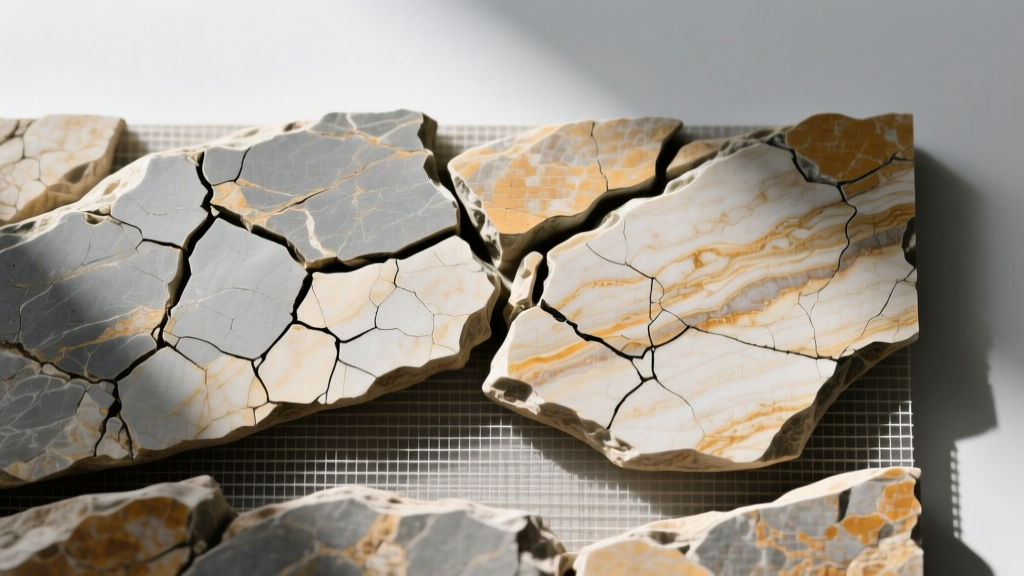
Manufacturing Processes and Surface Topography
The texture of natural stone veneer sheets is determined by the extraction and finishing methodology. Unlike traditional thick stone slabs, veneer sheets must maintain structural integrity at thicknesses under 3mm, which restricts the types of mechanical texturing that can be applied without fracturing the stone matrix.
Natural Cleft and Split-Face: Achieved by hydraulically splitting the stone along its natural bedding planes. This produces the highest macro-relief (15mm–25mm) and exposes the raw, unpolished mineral structure. Because the fracture is natural, the peak-to-valley variance is non-linear, requiring specialized setting materials.
Leathered and Antiqued: Created using diamond-tipped abrasive brushes of varying grits (typically 60 to 120 grit) that selectively wear away softer minerals in the stone, leaving harder quartz or feldspar veins raised. This yields a tactile, low-glare texture with a macro-relief of just 1.5mm to 4mm.
CNC-Routed MSV Panels: For manufactured stone veneer sheets, textures are cast from polyurethane molds taken from real stone. Advanced 2026 manufacturing utilizes multi-axis CNC routing to carve the master molds, allowing for precise control over draft angles and undercuts, ensuring the resulting texture does not trap air during the casting process.
Texture Profile Comparison Matrix
| Profile Type | Peak-to-Valley Depth | Surface Roughness (Ra) | Light Reflectance (LRV) | Primary Application |
|---|---|---|---|---|
| Split-Face | 15.0 – 25.0 mm | > 500 µm | Low (Matte/Shadowed) | Exterior facades, feature walls |
| Natural Cleft | 5.0 – 15.0 mm | 200 – 400 µm | Medium-Low | Interior accent, commercial lobbies |
| Leathered | 1.5 – 4.0 mm | 50 – 150 µm | Medium (Satin) | High-touch interiors, wet areas |
| Honed | 0.1 – 0.5 mm | < 20 µm | High (Smooth Matte) | Clean-room environments, minimalist design |
Technical Implications of Texture on Adhesion and Sealing
The most frequent failure mode in stone veneer sheet installation is treating all textures as having uniform adhesion and sealing requirements. The macro-relief directly dictates the rheology of the setting material and the mil-thickness of protective sealers.
Adhesion and Mortar Selection
For highly textured sheets (e.g., 15mm+ split-face), standard 1/4-inch notch trowels are structurally inadequate. The mortar must bridge the deep valleys on the back of the stone sheet while maintaining full contact with the substrate. According to Natural Stone Institute technical guidelines, installations with deep surface relief require a 1/2-inch x 1/2-inch square-notch trowel. Furthermore, the fiberglass or polymer backing on flexible sheets must be 'back-buttered' with the flat side of the trowel to ensure 95% minimum mortar coverage, preventing void spaces where moisture can accumulate and freeze.
Sealant Consumption and Chemistry
Texture multiplies the effective surface area. A heavily clefted stone sheet possesses up to 45% more surface area than a honed sheet of the same nominal dimensions. This drastically alters sealant coverage rates.
Applying topical acrylic or urethane sealers to deep split-face textures often results in 'pooling' in the valleys. As the carrier solvent evaporates, the pooled sealer forms a thick, milky-white film that mimics efflorescence. For textures exceeding 5mm in depth, specify penetrating silane/siloxane water repellents (compliant with ASTM C1400) which do not form a surface film and are unaffected by macro-relief variations.
ASTM Standards and Performance Testing
When specifying stone veneer sheets texture for commercial or exterior applications, the material must be tested not just for its base composition, but for how its texture affects environmental performance. Deep textures trap moisture and debris, altering the stone's freeze-thaw durability.
- ASTM C97 (Absorption and Bulk Specific Gravity): Highly textured sheets will show higher apparent absorption rates during testing because water is held in the surface clefts via capillary action, not just absorbed into the stone matrix. Specifiers must differentiate between matrix absorption and surface retention.
- ASTM C1670: For manufactured stone veneer sheets, ASTM C1670 outlines strict requirements for flexural strength and weathering. The texture molds used in MSV must not create stress concentrators (sharp internal corners) that reduce the panel's flexural tolerance when bent around curved substrates.
- ANSI A108.02: Governs the preparation and application of setting materials, dictating the required mortar contact percentages based on the profile of the stone backing and face.
Light Reflectance and Visual Depth Metrics
Texture interacts dynamically with architectural lighting. When utilizing grazing light (wall washers placed less than 12 inches from the wall surface), a 5mm texture will cast shadows that visually exaggerate the depth to appear as 20mm. If the design intent requires a subtle texture under grazing light, specify leathered or honed profiles with an Ra (roughness average) below 100 µm. Conversely, to maximize the dramatic shadow lines of split-face sheets, position light fixtures at a 15-degree angle to the wall plane.
Specification Guide: Selecting Texture by Application
Use the following decision framework to align the stone veneer sheets texture with the physical demands of the installation environment.
High-Traffic / Touch Zones
Recommended: Honed or Leathered (Depth < 4mm)
Rationale: Prevents snagging of fabrics, minimizes dirt accumulation in valleys, and allows for easy wipe-down maintenance. Avoid topical sealers; use dense impregnators.
Exterior / Freeze-Thaw Zones
Recommended: Natural Cleft or Split-Face (Depth 10mm+)
Rationale: Deep textures shed water rapidly via gravity and capillary breaking. Requires a modified polymer mortar (ANSI A118.4) to accommodate thermal expansion differentials between the textured stone and the substrate.
By treating texture as a quantifiable engineering metric rather than a purely visual choice, architects and contractors can eliminate adhesion failures, optimize sealant budgets, and ensure the long-term structural integrity of stone veneer sheet installations.
Written by
James ThorntonJames Thornton is a construction industry veteran with 25 years of hands-on experience in wood framing, lumber grading, and residential building codes. He started as a framing carpenter in rural Oregon, earned his ICC Residential Building Inspector certification, and eventually became a senior plan reviewer for the City of Portland Bureau of Development Services. James holds a B.S. in Wood Science & Technology from Oregon State University and is a certified lumber grader through the West Coast Lumber Inspection Bureau (WCLIB). He has inspected over 3,000 residential construction sites and authored the city's internal guide on advanced framing techniques (2x6 at 24" O.C.). James lives in Bend, OR, where he builds custom timber-frame cabins and competes in lumberjack sports.
More from James Thornton
View all
Insulation
Best Home Insulation Materials: Complete 2026 Guide
Compare top home insulation materials for 2026. Find R-values, installed costs per square foot, and best uses for fiberglass, spray foam, and mineral wool.
Aug 4, 2026

Sustainable Building
Certify Your Green Building Material for LEED and WELL
Step-by-step guide to certifying a green building material for LEED v5 and WELL v2. Master EPDs, HPDs, and VOC limits for 2026 project specifications.
Aug 4, 2026

Stone & Masonry
Veneer Stacked Stone Panels: Interior Design & Style Showcase
Discover how veneer stacked stone panels transform interiors. Explore modern design profiles, material pairings, and technical installation specs.
Aug 4, 2026