How to Install a Crushed Limestone Base for Paver Driveways and Patios
Master crushed limestone base installation for paver driveways and patios. Learn gradation selection, compaction lifts, and 2026 cost estimates.
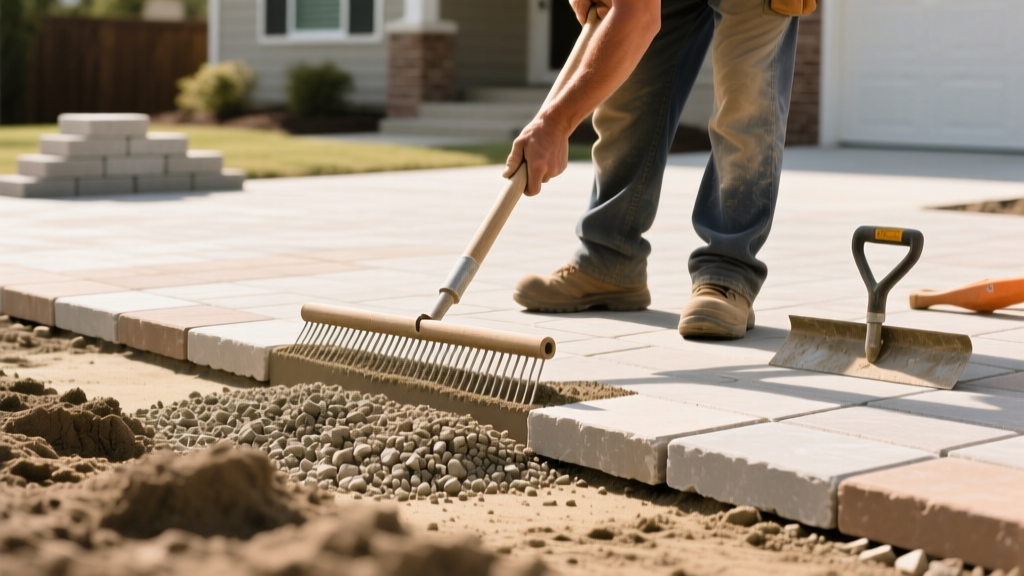
The Engineering Advantage of Crushed Limestone
Crushed limestone is the premier aggregate for hardscape base layers due to its angular fracture planes and chemical composition. Unlike rounded river gravel, which shifts under dynamic loads, mechanically crushed limestone features sharp edges that mechanically interlock when compacted. Furthermore, the inherent calcium carbonate in limestone reacts with moisture to create a weak cementitious bond over time, significantly increasing the shear strength of the base layer. For paver driveways subject to vehicular loads and patios requiring strict planar tolerances, this interlocking matrix prevents the differential settlement that causes paver rotation and joint sand loss.
Gradation Selection Matrix: Choosing the Right Aggregate
Selecting the correct gradation is critical. Using a uniformly graded stone (all one size) provides excellent drainage but poor compaction density. Using a poorly graded stone with excessive fines leads to frost heave and water trapping. Dense-graded aggregates, often referred to as Crusher Run or Dense Grade Aggregate (DGA), provide the optimal balance of structural support and permeability.
| Gradation Name | Nominal Size Range | Fines Content | Primary Application | Drainage Rate |
|---|---|---|---|---|
| #57 Stone | 0.5' to 1.0' | < 2% | French drains, permeable paver bases, deep sub-base layers | High (Free-draining) |
| #8 Stone | 0.125' to 0.375' | < 5% | Bedding layer for retaining wall blocks, pipe bedding | Moderate-High |
| Crusher Run (DGA) | 0' to 1.5' | 8% - 12% | Primary structural base for standard paver driveways and patios | Moderate (Sheds surface water) |
| Limestone Screenings | 0' to 0.25' | 15% - 25% | Alternative bedding layer, walkway surface (decomposed limestone) | Low (Semi-impermeable when compacted) |
For standard vehicular driveways, specify 3/4-inch minus Crusher Run. According to Pavement Interactive's aggregate base guidelines, a well-graded aggregate with a maximum size of 1.5 inches and sufficient fines to fill the void spaces yields the highest California Bearing Ratio (CBR), ensuring the base can distribute point loads from vehicle tires across the subgrade without localized punching.
Subgrade Excavation and Geotextile Protocol
The base layer is only as stable as the soil beneath it. Excavation depth must account for the paver thickness (typically 2.375 inches), the sand bedding layer (1 inch), and the crushed limestone base (4 inches for pedestrian patios; 8 to 12 inches for driveways).
If your soil test reveals high-plasticity clay (PI > 15), the subgrade will expand when wet and shrink when dry, destroying the limestone base from below. In these conditions, over-excavate an additional 4 to 6 inches and install a non-woven geotextile separation fabric (minimum 3.4 oz/sq yd) before placing the first layer of crushed limestone. The fabric prevents the clay from pumping up into the aggregate voids under dynamic loading.
Proper subgrade preparation requires compacting the native soil to at least 90% Standard Proctor density before introducing the aggregate. Grade the subgrade to match the final surface slope, typically a 1% to 2% minimum pitch away from structures to facilitate subsurface drainage.
Step-by-Step Compaction and Lift Procedures
Achieving 95% Modified Proctor density requires strict adherence to established compaction standards. Dumping 10 inches of crusher run and attempting to compact it in a single pass will result in a false compaction reading on the surface while the bottom 4 inches remain loose and compressible.
- Moisture Conditioning: Crushed limestone requires an Optimum Moisture Content (OMC) of 10% to 14% for maximum density. Perform a field squeeze test: grab a handful of the aggregate and squeeze it tightly. It should hold its shape without crumbling, but no free water should drip out. If it crumbles, mist it with a hose while spreading. If it drips, let it aerate.
- Spread the First Lift: Dump and spread the first layer of Crusher Run to a loose depth of 6 inches (which will compress to roughly 4.5 inches). Use a skid steer with a flat bucket or manual lutes to achieve a uniform depth.
- Initial Compaction Pass: Run a vibratory plate compactor (minimum 5,000 lbs of centrifugal force) or a 1.5-ton ride-on vibratory roller over the lift. Make two passes in overlapping rows. Do not use a vibratory roller near retaining walls or house foundations within a 10-foot radius to prevent structural vibration damage; use a plate compactor in these zones.
- Verify Density and Grade: Check the compacted depth. A 6-inch loose lift should compress to 4.5 inches. If it compresses to 4 inches, your moisture content was likely too low or the lift was too thick. Check the slope with a laser level or string line.
- Subsequent Lifts: Repeat the process for the second lift. For driveways requiring an 8-inch compacted base, two 4.5-inch compacted lifts (from 6-inch loose spreads) will yield the correct structural depth.
- Surface Sealing: For the final half-inch of the base, some contractors broadcast a thin layer of limestone screenings and compact it to create a smooth, impermeable 'crust' that prevents the overlying bedding sand from washing down into the base voids.
2026 Material and Installation Cost Breakdown
Material costs for crushed limestone fluctuate based on quarry proximity and regional fuel surcharges. The following estimates reflect Q1 2026 national averages for residential hardscape projects.
| Cost Category | Unit | Estimated 2026 Cost | Notes |
|---|---|---|---|
| Crusher Run (DGA) Limestone | Per Ton | $42.00 - $58.00 | Bulk pricing at the quarry; excludes delivery. |
| Dump Truck Delivery | Per Load (up to 20 tons) | $160.00 - $280.00 | Highly dependent on mileage from the quarry. |
| Non-Woven Geotextile Fabric | Per Sq Ft | $0.35 - $0.55 | 3.4 oz to 4.0 oz weight; essential for clay soils. |
| Vibratory Plate Compactor Rental | Per Day | $85.00 - $120.00 | Includes water tank and urethane pad for pavers. |
| Skid Steer / Mini-Excavator Rental | Per Day | $250.00 - $380.00 | Required for driveways; manual spreading is viable for small patios. |
Volume Calculation Rule of Thumb: One ton of compacted Crusher Run limestone covers approximately 80 square feet at a 2-inch depth, or 40 square feet at a 4-inch depth. For a 400-square-foot patio requiring a 4-inch base, order exactly 10 tons, plus a 5% overage allowance for edge spillage and subgrade irregularities.
Troubleshooting Common Base Failures
Even with premium materials, procedural errors during installation will compromise the hardscape. Use this diagnostic framework to identify and correct base failures before laying the bedding sand.
- Symptom: 'Spongy' or yielding base underfoot after compaction.
Cause: Over-watering during moisture conditioning, or compacting over a saturated, unmolested clay subgrade.
Fix: Scarify the top 2 inches of the limestone base, allow it to dry and aerate for 24 hours, and re-compact. If the subgrade is pumping mud, you must excavate the affected area, install geotextile fabric, and backfill with clean #57 stone before replacing the DGA. - Symptom: Visible tire tracks or deep depressions after a single vehicle pass on a finished driveway base.
Cause: Lifts were placed too thick (exceeding 6 inches loose), resulting in inadequate energy transfer to the bottom of the lift.
Fix: For localized depressions, scarify the area, add fresh DGA, and re-compact. For widespread failure, the base must be milled or excavated and rebuilt in thinner 4-inch loose lifts. - Symptom: Fines washing out of the base edges during heavy rain.
Cause: Lack of edge restraint at the base level, or using an aggregate with insufficient fines (e.g., using #57 stone instead of Crusher Run for the main structural layer).
Fix: Install a rigid perimeter restraint (such as poured concrete curbing or heavy-duty plastic paver restraints spiked into the subgrade) to confine the lateral spreading of the aggregate matrix.