Stone Wall Veneer Exterior Styles: 2026 Trends & Pairings
Explore 2026 stone wall veneer exterior design trends. Discover architectural pairings, specific product profiles, color palettes, and installation costs.

The Architectural Impact of Exterior Stone Veneer
Applying stone wall veneer exterior cladding fundamentally alters the visual weight and perceived permanence of a structure. Unlike traditional siding materials such as vinyl or fiber cement, stone veneer introduces deep shadow lines, organic color variations, and a tactile surface that grounds the architecture. According to data from the National Association of Home Builders (NAHB), stone and stone-veneer combinations consistently rank among the highest-performing exterior materials for boosting curb appeal and resale value. However, achieving a high-end architectural result requires moving beyond basic material selection and focusing on profile geometry, mortar joint techniques, and complementary material pairings.
In 2026, the design paradigm has shifted away from full-coverage stone facades toward strategic accentuation. Architects and designers are utilizing stone veneer to anchor specific structural elements—such as foundation water tables, entryway columns, and intersecting wall planes—creating a dynamic interplay between heavy masonry and lighter cladding materials.
2026 Design Profiles: Choosing Your Stone Veneer Style
The profile of the stone dictates the architectural language of the home. Selecting the wrong profile for a specific architectural style is the most common design failure in exterior cladding.
Modern Ashlar & Geometric Precision
For contemporary, mid-century modern, and transitional architecture, Ashlar profiles provide clean, horizontal sightlines. Products like Cultured Stone's Dressed Ashlar feature rectangular units with varying lengths but consistent heights (typically 2 to 8 inches). The tight, stacked mortar joints (or dry-stacked installations) emphasize linear geometry. This profile pairs exceptionally well with large-format fiber cement panels and standing seam metal roofing, reinforcing a structured, deliberate aesthetic.
Rustic Ledgestone & Organic Textures
Ledgestone profiles consist of thin, elongated rectangular pieces that create dense, horizontal shadow lines. Eldorado Stone's Rustic Ledgestone is a prime example, offering a rugged, layered appearance. This profile is heavily utilized in modern farmhouse, craftsman, and mountain contemporary designs. The deep crevices inherent in ledgestone interact dramatically with exterior uplighting, making it an ideal choice for highlighting entryways and retaining walls where landscape lighting is integrated.
Classic Fieldstone & Timeless Elegance
Fieldstone profiles mimic naturally rounded, river-tumbled stones. Coronado Stone's Classic Fieldstone offers irregular, organic shapes that require wider, more pronounced mortar joints. This profile is strictly reserved for traditional, colonial, and rustic architectural styles. Attempting to use fieldstone on a strict modern geometric build creates visual dissonance. Fieldstone excels when used on curved exterior walls or arched entryways, as the irregular shapes adapt to radii more gracefully than rigid ashlar cuts.
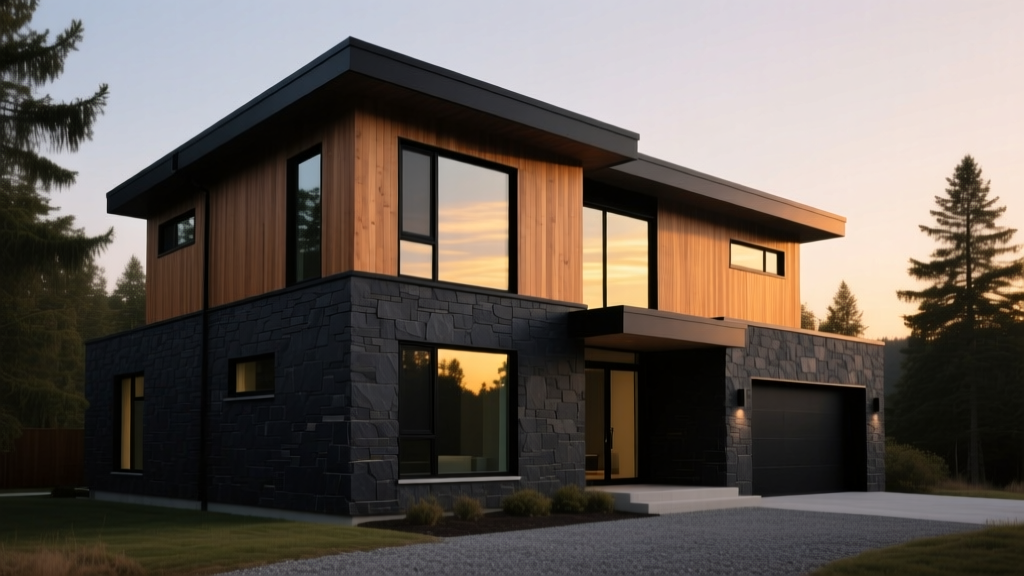
Material Pairings: What to Combine with Stone Veneer
Stone veneer rarely exists in isolation. The secondary and tertiary exterior materials must be carefully calibrated to balance the visual mass of the stone. The U.S. Department of Energy notes that exterior wall assemblies combining masonry veneer with continuous insulation require careful detailing at material transitions to manage moisture and thermal bridging.
| Primary Siding Material | Ideal Stone Profile Match | Visual Effect | Transition Detailing |
|---|---|---|---|
| Vertical Cedar / Redwood | Ledgestone or Limestone | Warm, organic contrast; emphasizes vertical/horizontal interplay. | Z-channel flashing with a 1/2 inch shadow gap. |
| Smooth Stucco (3-coat) | Ashlar or Cut Stone | Refined, Mediterranean or Modern transitional elegance. | Reveal trim or casing bead to separate textures cleanly. |
| Charcoal Fiber Cement Lap | Light Fieldstone or Chalk Ledge | High contrast, modern farmhouse or craftsman grounding. | Corbelled stone course or metal cap flashing. |
| Standing Seam Metal Panels | Large Format Ashlar | Industrial chic; balances cold metal with earthy masonry. | Concealed reglet flashing integrated into panel ribs. |
Mortar Joints and Color Palettes: The 2026 Perspective
The mortar joint is not merely an adhesive; it is a primary design element that accounts for up to 20% of the visible surface area on a stone wall veneer exterior.
Joint Profile Decision Matrix
- Raked Joint: Mortar is scraped back 1/4 to 1/2 inch. Maximizes shadow lines. Best for Ledgestone and rustic applications. Warning: Requires proper sealing in freeze-thaw climates to prevent water pooling.
- Flush Joint: Mortar is struck flat with the stone face. Creates a unified, monolithic surface. Ideal for Ashlar and modern applications.
- Overgrout (German Smear): Mortar is intentionally smeared over the edges of the stone, partially obscuring the rock. Highly trending in 2026 for European farmhouse and cottage styles. Best applied to Fieldstone and lighter color palettes.
Regarding color, the 2026 trend favors monochromatic and analogous palettes over high-contrast stone colors. Instead of multi-colored stones with stark reds and blues, designers are specifying 'chalk,' 'weathered wood,' and 'charcoal' tones. These desaturated palettes allow the texture and shadow lines of the stone to take precedence over color, resulting in a more sophisticated, timeless facade that integrates seamlessly with natural landscaping.
Installation Considerations for Design Integrity
A beautiful design is instantly compromised by poor execution. The Masonry Veneer Manufacturers Association (MVMA) outlines strict protocols for manufactured stone veneer (MSV) installation to prevent moisture intrusion and aesthetic failures.
The 'Veneer Tell' and Corner Solutions
The most glaring indicator of a poorly executed stone veneer project is the 'veneer tell' at exterior corners. If standard flat stone pieces are butted together at a 90-degree angle, the thin edge of the veneer (usually 1 to 2.5 inches thick) is exposed, instantly revealing it as a faux appliqué rather than solid masonry.
Expert Directive: Always specify and purchase manufactured 90-degree corner pieces. While corner units cost 15% to 25% more per linear foot than flat pieces and require careful inventory planning, they wrap the corner seamlessly, mimicking the depth and continuity of full-bed natural stone. Never miter-cut manufactured stone veneer to create a corner; the exposed aggregate core will ruin the illusion.
Weep Screeds and Grade Clearances
Stone veneer is a drainage plane system, not a barrier system. Water that penetrates the masonry must be directed out and away from the wall assembly. A code-compliant weep screed (minimum 0.019-inch thick galvanized steel or PVC) must be installed at the base of all stone veneer applications. To maintain design integrity and prevent soil staining or moisture wicking, the weep screed must be positioned a minimum of 4 inches above final soil grade, or 2 inches above paved surfaces like concrete walkways and driveways. Designing landscaping plans that bury the weep screed is a critical failure that leads to trapped moisture and structural rot.
Cost Breakdown by Design Profile
Budgeting for a stone wall veneer exterior requires accounting for both the material profile complexity and the specialized labor required for installation. The costs below reflect 2026 national averages for Manufactured Stone Veneer (MSV), which dominates the market due to its consistent weight (under 15 lbs per sq ft) and structural versatility.
| Stone Profile | Material Cost (per sq. ft.) | Labor Cost (per sq. ft.) | Total Installed (per sq. ft.) | Design Complexity Factor |
|---|---|---|---|---|
| Ledgestone (Linear) | $9.50 - $13.00 | $14.00 - $18.00 | $23.50 - $31.00 | Moderate (Requires horizontal leveling) |
| Dressed Ashlar | $10.50 - $14.50 | $15.00 - $20.00 | $25.50 - $34.50 | High (Requires precise joint alignment) |
| Fieldstone (Organic) | $8.50 - $12.00 | $16.00 - $22.00 | $24.50 - $34.00 | High (Puzzle-like fitting, wider joints) |
| 90-Degree Corners (Add-on) | $12.00 - $18.00 (per lin. ft.) | Included in base | $12.00 - $18.00 (per lin. ft.) | Low (Pre-cast returns) |
When specifying a stone wall veneer exterior, allocate an additional 10% to 15% of the total material budget for waste, cuts, and pattern matching. High-end architectural designs that require blending specific color ratios from multiple pallets will push labor costs toward the upper end of the spectrum, as masons must hand-select and dry-fit stones to achieve the desired aesthetic distribution before applying mortar.
Written by
Sarah WhitfieldSarah Whitfield is a chartered quantity surveyor (MRICS) and construction cost analyst with 15 years of experience in material pricing, procurement strategy, and project budgeting. She earned her degree in Construction Management from the University of Reading (UK) and has worked on projects ranging from $2M custom homes to $180M mixed-use developments across North America and Europe. Sarah currently leads cost estimating for BuildMat Insight, maintaining a proprietary database of 4,000+ material price points updated quarterly. She is a frequent contributor to RSMeans cost data panels and has presented at the International Cost Engineering Council (ICEC) congress. Based in Denver, CO, Sarah is an avid trail runner and volunteer mentor for Women in Construction.
More from Sarah Whitfield
View all
Wood & Lumber
What Are the Different Types of Wood? A Builder's Guide
Compare structural softwoods, finish hardwoods, and engineered lumber. Analyze Janka ratings, MOE values, and 2026 pricing for construction.
Aug 4, 2026

Walls & Panels
Steel Framing vs Wood Framing: Corrosion and Moisture Defense
Compare steel framing vs wood framing for moisture resistance. Learn about galvanized coatings, condensation risks, and corrosion protection strategies.
Jul 21, 2026

Stone & Masonry
How to Cut Stone Veneer: Wet Saw vs Grinder Comparison
Compare the best tools for cutting stone veneer. We review wet saws, angle grinders, and chop saws to help you achieve clean, chip-free cuts.
Jul 21, 2026