Stone Veneer Suppliers Syosset: Design Showcase for Long Island Homes
Explore top stone veneer suppliers Syosset homeowners use for custom exteriors. Compare 2026 costs, Tudor designs, and Nassau County installation specs.

The Syosset Architectural Landscape: Why Stone Veneer?
Syosset, situated in the heart of Nassau County, features a diverse architectural inventory ranging from mid-century ranches and classic Colonials to sprawling new-construction Tudors and modern transitional estates. For homeowners and custom builders in the 11791 zip code, achieving high-end curb appeal without the structural burden and expense of full-thickness masonry is a primary design objective. This is where adhered stone veneer becomes the definitive solution.
Unlike traditional 4-inch brick or full-bed stone, manufactured and natural thin stone veneers weigh between 7 and 15 pounds per square foot. This lightweight profile allows for direct application over properly prepared wood or steel framing, making it ideal for retrofitting existing Syosset facades, upgrading foundation wainscots, or cladding complex gable ends. According to the National Association of Home Builders, stone veneer remains one of the highest-ROI exterior materials in the Northeast, consistently recouping over 90% of its installed cost at resale.
Navigating Stone Veneer Suppliers: Syosset & Nassau County Sourcing
When sourcing materials, it is critical to understand the local supply chain. While Syosset itself is predominantly residential and commercial, the stone veneer suppliers Syosset contractors rely on are the major masonry distributors located in neighboring hubs like Hicksville, Farmingdale, and Plainview. These regional yards stock the premium lines required for Long Island's luxury market.
Top-tier local distributors primarily carry two dominant categories of veneer:
- Manufactured Stone Veneer (MSV): Brands like Cultured Stone (by Westlake Royal) and Eldorado Stone (by Oldcastle APG) dominate the local market. These concrete-based products are molded from real stone and hand-colored with iron oxide pigments to replicate regional geology.
- Natural Thin Veneer (NTV): Sliced from real quarried stone, typically sourced from the Hudson Valley, Bucks County, or the Carolinas. NTV is favored for ultra-custom, high-budget Syosset estates where absolute geological authenticity is required.
Design Showcase: 3 Signature Styles for Long Island Homes
The success of a stone veneer project hinges on matching the stone profile to the home's architectural lineage. Here are three dominant design applications currently shaping Syosset exteriors.
1. The Modern Tudor Accent
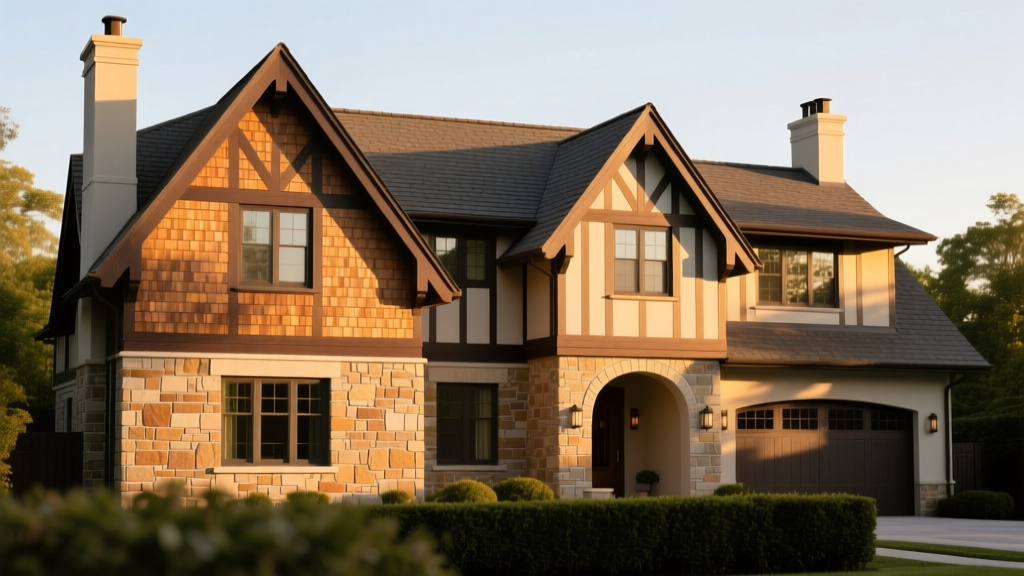
Tudor architecture relies heavily on masonry infill between timber framing. For modern Tudor revivals, builders are moving away from flat, uniform brick and utilizing rugged ledgestone profiles. Eldorado Stone's RoughCut or Cultured Stone's Ledgestone provide the necessary horizontal shadow lines. The design rule for Tudors is to use a contrasting, slightly darker mortar (such as a custom buff or light gray) and strike the joints flush or slightly recessed to emphasize the stone's linear geometry. This technique is frequently applied to the lower third of the facade and the prominent front-facing gables.
2. The Colonial Water Table & Wainscot
For traditional Colonials, the goal is grounded elegance. A 36-inch to 48-inch wainscot wrapping the foundation line, capped with a 2-inch thick natural bluestone or precast concrete water table, provides a historic aesthetic. The preferred profile here is a rounded fieldstone or an ashlar cut. Cultured Stone's Cobblefield in the 'Weathered Edge' colorway mimics the historic, hand-laid rubble stone found in original 18th-century Northeast homes. Installers must use a wide, raked mortar joint (typically 1/2 inch to 3/4 inch) to maintain the historic illusion.
3. The Transitional Limestone Facade
New-build transitional homes in Syosset often feature stark white fiber-cement siding paired with large, clean-lined stone elements. To complement this, designers specify linear ashlar profiles that mimic cut limestone. These stones feature sharp, saw-cut edges and are installed in a dry-stack or tight-mortar configuration. The result is a sophisticated, monochromatic texture that bridges the gap between traditional masonry and modern minimalism.
Material Matrix: Manufactured vs. Natural Thin Veneer
Selecting between MSV and NTV requires balancing budget, lead times, and aesthetic demands. The following matrix breaks down the technical specifications for both options as available through Long Island distributors in 2026.
| Feature | Manufactured Stone Veneer (MSV) | Natural Thin Veneer (NTV) |
|---|---|---|
| Weight | 7 - 12 lbs / sq. ft. | 10 - 15 lbs / sq. ft. |
| Thickness | 1.5 to 2.5 inches | 0.75 to 1.5 inches |
| Material Cost (2026) | $8.50 - $14.00 / sq. ft. | $13.00 - $24.00 / sq. ft. |
| Lead Time | 1 - 3 weeks (Stocked locally) | 4 - 8 weeks (Quarry dependent) |
| Color Consistency | High (Batch controlled) | Variable (Natural geological shifts) |
2026 Pricing & Labor Realities in Nassau County
The Long Island construction market commands premium labor rates due to the high cost of living and stringent local building codes. When budgeting a stone veneer project in Syosset, homeowners must look beyond the material cost per square foot.
As of 2026, the average installed cost for manufactured stone veneer in Nassau County ranges from $34.00 to $52.00 per square foot. This aggregate figure includes:
- Materials: $9.00 - $14.00/sq. ft. (Stone, corner pieces, mortar, lath, and WRB).
- Prep & Lath Installation: $6.00 - $9.00/sq. ft.
- Masonry Labor (Setting & Pointing): $19.00 - $29.00/sq. ft.
Note: Corner pieces are sold by the linear foot, not the square foot. A project with extensive architectural breaks, quoins, and window returns will see material costs increase by 15% to 20% due to the premium pricing of manufactured corner units.
Climate Considerations: Beating the Long Island Freeze-Thaw Cycle
Syosset experiences significant winter temperature fluctuations, with frequent freeze-thaw cycles that can destroy improperly installed masonry. The Manufactured Veneer Technical Advisory Committee (MVTAC) strictly outlines the moisture management requirements for adhered veneer in freezing climates.
"Failure to incorporate a weep screed and proper weather-resistive barrier is the leading cause of veneer delamination and wood rot in Northeast residential construction."
To ensure longevity, your Syosset installer must adhere to ASTM C1670 (Standard Specification for Adhered Manufactured Stone Masonry Veneer) and ASTM C1063 (Installation of Lathing and Furring). The mandatory moisture management assembly includes:
- Weather-Resistive Barrier (WRB): Two layers of Grade D asphalt-impregnated felt paper, or a code-approved fluid-applied membrane over the OSB/plywood sheathing.
- Corrosion-Resistant Lath: Minimum 2.5 lb per square yard galvanized expanded metal lath, fastened directly into the wall studs (not just the sheathing) with 1-inch penetration.
- Scratch Coat: A 1/2-inch thick Type S mortar scratch coat, deeply scored horizontally to provide a mechanical key for the setting bed.
- Weep Screed: A PVC or galvanized steel weep screed installed at the base of the wall, minimum 4 inches above grade or 2 inches above paved surfaces, to allow trapped moisture to escape the wall cavity.
Vetting Your Installer: Questions to Ask Before Signing
Not all siding contractors are qualified masons. When interviewing contractors for your Syosset project, require explicit answers to the following technical questions:
- "What type of mortar do you use for the setting bed?" The correct answer is a rich Type S mortar mix or a polymer-modified veneer mortar specifically rated for exterior freeze-thaw environments. Standard Type N is often too weak for Long Island winters.
- "How do you handle window and door returns?" Proper installers will use manufactured corner pieces to wrap the jambs, or they will install a continuous stone sill and casing. They should never butt flat stone directly against a vinyl or wood window frame without a proper sealant joint and backer rod.
- "Do you pull local permits and schedule Nassau County masonry inspections?" The local building department requires inspections of the WRB and lath before the stone is applied. If a contractor suggests skipping the lath inspection to save time, terminate the contract immediately.
By aligning premium materials from established regional distributors with rigorous, code-compliant installation practices, Syosset homeowners can achieve a timeless, durable stone facade that elevates both the architectural integrity and the market valuation of their property.
Written by
Priya KapoorPriya Kapoor is a real estate market analyst and construction economics researcher with expertise in housing affordability, development feasibility, and infrastructure investment. She holds a Master of Regional Planning from Cornell University and previously worked as a senior analyst at CBRE's Investment Properties group, where she modeled returns for $4B in mixed-use development pipelines. Priya now runs an independent research practice advising developers, municipalities, and REITs on construction cost forecasting and market timing. She publishes the quarterly "BuildMat Market Pulse" report tracking material price indices across 12 commodity categories. Based in Austin, TX, Priya serves on the board of Habitat for Humanity Austin and is a marathon runner.
More from Priya Kapoor
View all
Construction Cost
Cost to Build a 1600 Sq Ft Home in 2026: Full Breakdown
Accurate 2026 cost to build a 1600 sq ft home—material, labor, and regional pricing breakdowns included. Plan your budget with real-time estimates.
Aug 11, 2026

Wood & Lumber
Name the Types of Wood for Pressure Treatment and Preservation
Learn how to name the types of wood best suited for pressure treatment. Compare species treatability, chemical retention levels, and 2026 preservation costs.
Aug 4, 2026

Stone & Masonry
Stone Veneer Suppliers Lindenhurst: 2026 Cost Analysis
Analyze 2026 stone veneer costs in Lindenhurst, NY. Compare local supplier pricing, delivery fees, and Suffolk County installation labor rates.
Aug 4, 2026