Taj Mahal Quartzite Cost Calculator & 2026 Pricing Guide
Calculate your Taj Mahal quartzite project costs with our 2026 pricing guide. Includes slab rates, fabrication premiums, waste factors, and edge profiles.
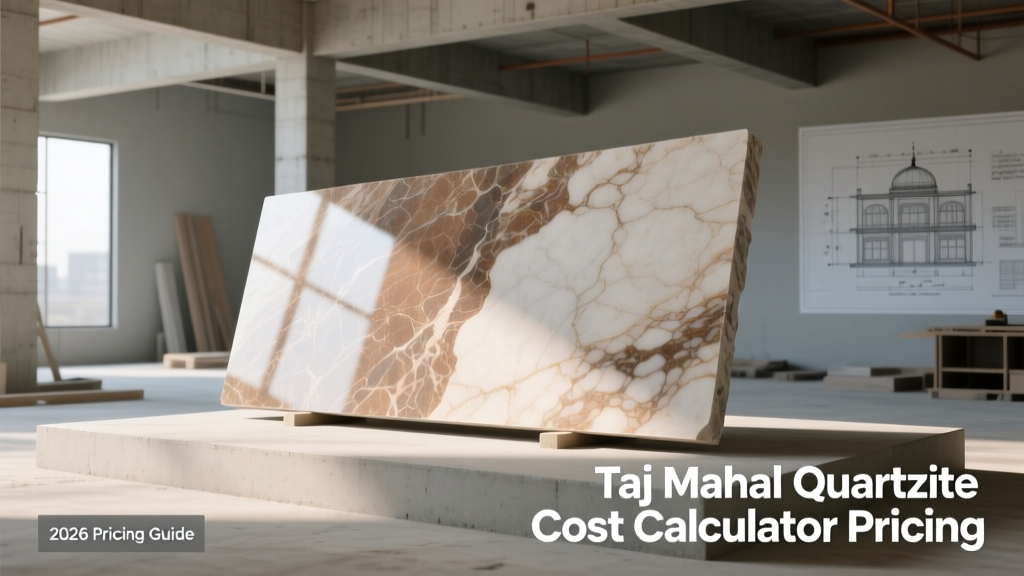
Deconstructing the 2026 Taj Mahal Quartzite Price Tag
Taj Mahal quartzite remains one of the most sought-after natural stones for high-end kitchen countertops and feature walls. Mined primarily in Brazil, this stone features a creamy white background with striking gold, tan, and brown veining that mimics the look of soft marble but delivers the durability of granite. However, estimating the cost of Taj Mahal quartzite requires moving beyond simple square-footage material pricing. The final invoice is heavily influenced by slab yield, fabrication complexity, and the extreme hardness of the stone.
As of 2026, the national average for a fully installed Taj Mahal quartzite countertop ranges from $180 to $310 per square foot. Below is the granular breakdown of where those costs originate.
| Cost Component | 2026 Price Range | Pricing Metric |
|---|---|---|
| Raw Slab Material (Standard Grade) | $95 - $135 | Per Sq. Ft. |
| Raw Slab Material (Premium/Exotic) | $140 - $185 | Per Sq. Ft. |
| Fabrication (Cutting, Polishing, Sealing) | $55 - $95 | Per Sq. Ft. |
| Installation & Template Labor | $35 - $65 | Per Sq. Ft. |
| Demolition & Haul-Away (Existing Counters) | $400 - $800 | Flat Rate / Project |
Quartzite slabs are sold by the whole slab, not by the exact square footage you need. A standard Taj Mahal slab measures roughly 122" x 65" (approx. 55 sq. ft.), while jumbo slabs measure 130" x 78" (approx. 70 sq. ft.). If your net countertop area is 60 sq. ft., you cannot buy 60 sq. ft. of material; you must purchase two full standard slabs or one jumbo slab, meaning you are paying for 110 to 140 sq. ft. of raw stone.
The "Hard Stone" Fabrication Premium
One of the most common blind spots in quartzite estimation is the fabrication premium. True quartzite ranks at a 7 on the Mohs hardness scale, making it significantly harder than granite (which typically sits at 6 to 6.5) and vastly harder than marble or dolomite. This extreme density is exactly why Taj Mahal resists scratching and etching, but it also means it destroys standard diamond router bits and bridge saw blades at an accelerated rate.
Because of this tooling wear and the slower cutting speed required to prevent chipping the crystalline structure, most fabricators apply a 15% to 25% "hard stone" upcharge to their base fabrication rate. When requesting quotes, explicitly confirm whether the fabricator's per-square-foot fabrication rate includes the quartzite premium, or if it will be added as a line-item surcharge.
"Cutting Taj Mahal requires specialized CNC waterjets or high-torque bridge saws with continuous rim diamond blades designed specifically for ultra-hard silica. Rushing the cut leads to micro-chipping along the edges, which ruins the seamless polish required for a premium install." — Senior CNC Fabricator, Natural Stone Industry Standard Practices
Quantity Calculator: Net Area vs. Gross Slab Yield
To accurately calculate how many slabs you need to purchase, you must apply a waste factor to your net measurable area. Waste in natural stone is not just about the off-cuts; it is dictated by veining direction, slab defects, and the need to match patterns across seams.
Waste Factor Matrix
| Layout Complexity | Typical Waste Factor | Scenario Examples |
|---|---|---|
| Standard L-Shape / Galley | 15% - 20% | Straight runs, single sink cutout, no pattern matching required. |
| Complex Angles & Multiple Cutouts | 20% - 25% | Diagonal walls, dual undermount sinks, angled peninsulas, cooktop cutouts. |
| Bookmatched Waterfall Island | 30% - 45% | Veining must flow continuously from the top surface down the sides. Requires cutting sequential, mirrored sections from the exact same slab area. |
Calculation Formula:
Total Slab Area Required = (Net Sq. Ft. + (Net Sq. Ft. × Waste Factor))
Example: 45 net sq. ft. × 1.20 (20% waste) = 54 sq. ft. required. This fits perfectly onto one standard 55 sq. ft. slab.
Edge Profile & Cutout Cost Multipliers
Fabricators charge for edge detailing and cutouts based on linear footage and per-unit counts, not square footage. Taj Mahal's hardness makes complex edge profiles exponentially more expensive to execute than simple ones.
- Eased / Pencil Edge: $0 - $10 per linear ft. (Often included in base fabrication).
- Bullnose / Half-Bullnose: $15 - $25 per linear ft. (Requires extensive diamond pad polishing).
- Ogee / Dupont: $30 - $45 per linear ft. (High risk of chipping on quartzite; requires slow CNC routing).
- Mitered Apron (Waterfall Edge): $40 - $70 per linear ft. (Requires 45-degree precision cuts and specialized epoxy color-matching).
Cutout Pricing
- Standard Undermount Sink: $250 - $400 per cutout (includes polishing the interior reveal).
- Drop-in / Top-mount Sink: $150 - $200 per cutout.
- Cooktop Cutout: $200 - $350 (requires notching and structural support rodding underneath the stone).
Real-World Estimation Walkthrough: 55 Sq. Ft. Kitchen
Let us run a complete cost estimation for a standard 55 sq. ft. kitchen remodel using Taj Mahal quartzite in 2026. The layout includes an L-shaped perimeter, one undermount sink, one cooktop, and 40 linear feet of eased edge.
- Net Area: 55 sq. ft.
- Waste Factor: 20% (Standard layout). Gross area needed: 66 sq. ft.
- Slab Purchasing: 66 sq. ft. exceeds one standard slab (55 sq. ft.). You must purchase two standard slabs (110 sq. ft. total). At $115/sq. ft. for the material, the raw stone cost is $12,650.
- Fabrication (Billed on Net Sq. Ft.): 55 sq. ft. × $75/sq. ft. (includes hard stone premium) = $4,125.
- Edge Profiling: 40 linear ft. × $10 (eased edge) = $400.
- Cutouts: Sink ($300) + Cooktop ($250) = $550.
- Installation & Template: 55 sq. ft. × $45/sq. ft. = $2,475.
This equates to an effective installed rate of $367 per net square foot. This highlights why calculating costs based purely on advertised "per square foot" material rates will result in severe budget shortfalls. The requirement to purchase the second slab solely to cover the 20% waste factor added over $6,300 to the material cost alone.
Material Verification: Avoiding the Dolomite Trap
The most critical risk when budgeting for Taj Mahal quartzite is purchasing a mislabeled stone. The market is currently flooded with dolomites and hard marbles being sold under the "Taj Mahal" or "Quartzite" moniker. True quartzite is metamorphic sandstone composed almost entirely of silica. Dolomite contains calcium magnesium carbonate, making it susceptible to acid etching.
According to the Natural Stone Institute, proper geological classification is vital for setting performance expectations in kitchen environments. If you install a dolomite slab thinking it is Taj Mahal quartzite, your lemon juice, tomato sauce, and vinegar will permanently etch the surface within months.
The Field Verification Protocol
Before signing a purchase order or paying a deposit, perform these two non-destructive tests on the exact slab batch you are buying:
- The Acid Test: Apply a few drops of pure lemon juice or white vinegar to an inconspicuous area of the slab. Wait 5 minutes and wipe it clean. True Taj Mahal quartzite will show zero reaction. If the stone looks dull or etched where the liquid sat, it is dolomite or marble. Walk away.
- The Scratch Test: Take a standard steel pocket knife (Mohs hardness ~5.5) and attempt to scratch the surface with moderate pressure. True quartzite (Mohs 7) will not scratch; the steel will leave a metallic residue that wipes away. If the stone scratches easily, it is not quartzite.
For further technical specifications on stone hardness, porosity, and geological classifications, refer to the Natural Stone Institute's technical bulletins on metamorphic stones. Ensuring you are buying genuine silica-based quartzite guarantees that your significant financial investment will withstand decades of heavy culinary use without requiring constant chemical resealing or professional honing.