Stone Veneer Siding Installation Cost Breakdown for 2026
Explore the 2026 stone veneer siding installation cost, comparing manufactured and natural options while matching premium styles to your architectural budget.

The Intersection of Curb Appeal and Budget
Exterior design in 2026 is defined by textural contrast and organic materiality. Homeowners and architects are increasingly turning to stone facades to anchor modern builds and elevate traditional renovations. However, achieving this high-end aesthetic requires a precise understanding of the stone veneer siding installation cost, which fluctuates based on material origin, profile complexity, and structural preparation. Unlike vinyl or fiber cement, stone veneer is a multi-layered cladding system that demands specialized masonry labor and strict moisture management protocols.
This guide deconstructs the financial and design elements of stone veneer siding. By aligning specific stone profiles with their true installed costs, you can make informed decisions that satisfy both your architectural vision and your construction budget.
2026 Stone Veneer Siding Installation Cost Matrix
The total stone veneer siding installation cost is dictated by the interplay between material weight, profile intricacy, and regional masonry rates. The matrix below outlines current 2026 pricing for a standard single-story exterior wall application (excluding complex scaffolding or structural reinforcement).
| Stone Profile & Origin | Material Cost (Per Sq Ft) | Labor Cost (Per Sq Ft) | Total Installed (Per Sq Ft) | Ideal Architectural Match |
|---|---|---|---|---|
| Manufactured Ledgerock (Linear) | $7.50 - $11.00 | $9.00 - $13.00 | $16.50 - $24.00 | Modern Farmhouse, Contemporary |
| Manufactured Fieldstone (Organic) | $8.00 - $12.50 | $12.00 - $16.00 | $20.00 - $28.50 | Craftsman, Tudor Revival |
| Natural Thin Veneer (Limestone) | $14.00 - $22.00 | $14.00 - $18.00 | $28.00 - $40.00 | French Country, Traditional Estate |
| Natural Thin Veneer (Granite) | $18.00 - $28.00 | $16.00 - $22.00 | $34.00 - $50.00 | Mountain Modern, Rustic Luxury |
| Panels (Interlocking MSV) | $9.00 - $14.00 | $6.00 - $9.00 | $15.00 - $23.00 | Commercial, Accent Walls |
Note: Corner pieces are typically sold by the linear foot, ranging from $6.00 to $14.00 per linear foot depending on the profile, and must be factored into the total material takeoff.
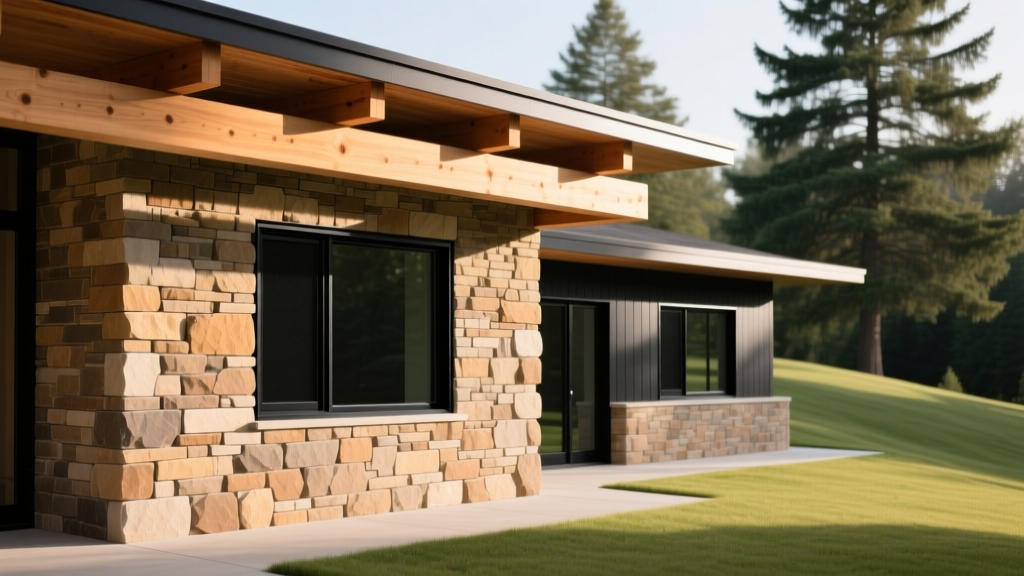
Design Profiles: Matching Stone Styles to Architectural Trends
Understanding the stone veneer siding installation cost is only half the equation; selecting the right profile ensures the investment enhances the property's architectural integrity.
Modern Farmhouse: Linear Ledgerock
The Modern Farmhouse trend relies on clean, horizontal lines. Manufactured ledgerock profiles, such as Eldorado Stone's Cliffstone or Coronado Stone's Vintage Flat Stone, provide a stacked, linear aesthetic. Because these pieces are uniform in height and feature straight edges, masons can lay them rapidly with tight, dry-stacked joints (no visible mortar). This reduces pointing labor, keeping the installation cost on the lower end of the spectrum while delivering a highly customized look.
Craftsman Revival: Organic Fieldstone & River Rock
Craftsman and Prairie-style homes demand organic, irregular textures. Profiles mimicking round river rock or rugged fieldstone require a traditional 'overgrout' or 'standard' mortar joint. The mason must carefully fit irregular shapes together like a puzzle, significantly increasing labor time. The stone veneer siding installation cost for these profiles is heavily weighted toward labor, often accounting for 60% of the total project budget. However, the resulting depth and shadowing are impossible to replicate with flat architectural panels.
Contemporary Minimalist: Large-Format Limestone Panels
For ultra-modern builds, large-format natural thin veneer (NTV) limestone offers a monolithic, seamless appearance. While the natural stone material cost is premium, the large surface area of each piece (often 12x24 inches or larger) can offset some labor time. The design requires precise leveling and specialized diamond-blade wet saws on-site for cutting, which adds equipment rental fees to the contractor's bid.
⚠️ Hidden Cost Triggers in Stone Veneer Projects
- Structural Reinforcement: Natural stone veneer weighs 12-15 lbs per sq ft. If your existing wood framing was designed only for vinyl siding, you may need to add blocking or upgrade sheathing to 5/8-inch OSB, adding $1.50-$3.00 per sq ft.
- Scaffolding & Access: Second-story installations require pump jacks or pipe scaffolding. Expect a 15-20% labor premium for heights exceeding 12 feet.
- Weep Screed & Flashing: Code-compliant installation requires corrosion-resistant weep screeds at the foundation line. Omitting this to save $200 in materials will result in trapped moisture and catastrophic wall failure within five years.
- Sealing Requirements: While many manufactured stones are pre-sealed, natural porous stones (like sandstone or certain limestones) require a breathable silane/siloxane penetrating sealer post-installation, adding $0.75-$1.25 per sq ft.
Wall Assembly Anatomy: Where the Labor Budget Goes
To evaluate contractor bids accurately, you must understand the mandatory layers of a code-compliant stone veneer wall assembly. The Masonry Society and industry installation guidelines dictate a specific sequence that protects the structural framing from moisture intrusion. A proper installation involves the following steps, each contributing to the final labor cost:
- Weather-Resistive Barrier (WRB): Application of two layers of Grade D building paper or a high-performance housewrap (like Tyvek CommercialWrap) over the structural sheathing. (Labor: 10% of total)
- Flashing & Weep Screed: Installation of self-adhering flashing tape at all penetrations and a metal weep screed at the base to allow trapped water to escape. (Labor: 10% of total)
- Metal Lath Application: Fastening self-furring, galvanized metal lath (ASTM C847) using corrosion-resistant nails or staples driven directly into the wall studs, not just the sheathing. (Labor: 15% of total)
- Scratch Coat: Troweling a 1/2-inch layer of Type S or Type N mortar over the lath and scoring it horizontally to create a mechanical bond for the stone. This requires a 24-to-48-hour curing period. (Labor: 20% of total)
- Stone Setting & Pointing: Buttering the back of each stone with mortar, pressing it into the scratch coat, and tooling the joints. (Labor: 45% of total)
Manufactured vs. Natural: Structural and Material Realities
The debate between Manufactured Stone Veneer (MSV) and Natural Thin Veneer (NTV) heavily influences the stone veneer siding installation cost. MSV is cast in molds from real stone using lightweight aggregates (like pumice or expanded shale), resulting in a weight of roughly 10-12 lbs per sq ft. NTV is real stone sliced to a 1-inch thickness, weighing 13-15 lbs per sq ft.
While the weight difference seems marginal, the handling difference is substantial. MSV pieces are uniform, lighter, and can be cut with standard masonry blades. NTV pieces are dense, brittle, and require continuous water-cooled cutting to prevent silica dust and blade warping. Consequently, masons often charge a 15% to 25% premium for natural stone labor due to the physical toll and slower pace of installation. However, NTV offers unparalleled color variation and UV stability that manufactured pigments can only approximate.
ROI and Resale Value: The Financial Verdict
When analyzing the stone veneer siding installation cost, it is critical to view the expense through the lens of long-term equity. Exterior upgrades that boost curb appeal consistently yield strong returns at resale. According to housing economics data tracked by the National Association of Home Builders (NAHB), stone veneer accents and full facades remain among the most highly desired exterior features for premium homebuyers.
A full front-facade stone veneer application typically recoups 75% to 90% of its installed cost in immediate home value, significantly outperforming standard vinyl siding replacements. Furthermore, stone veneer requires virtually zero maintenance compared to wood clapboard or painted fiber cement, eliminating recurring painting and caulking costs over a 30-year ownership cycle.
"The highest ROI in stone veneer installation doesn't come from siding the entire house. It comes from strategic placement: anchoring the front entryway, cladding the garage columns, and wrapping the lower third of the facade to create a permanent, grounded water-table effect that elevates the entire architectural profile."
Ultimately, the stone veneer siding installation cost is an investment in architectural permanence. By selecting the right profile for your home's design language and ensuring your contractor adheres to strict moisture-management protocols, you secure a facade that will outlast the mortgage and define the property's character for decades.
Written by
James ThorntonJames Thornton is a construction industry veteran with 25 years of hands-on experience in wood framing, lumber grading, and residential building codes. He started as a framing carpenter in rural Oregon, earned his ICC Residential Building Inspector certification, and eventually became a senior plan reviewer for the City of Portland Bureau of Development Services. James holds a B.S. in Wood Science & Technology from Oregon State University and is a certified lumber grader through the West Coast Lumber Inspection Bureau (WCLIB). He has inspected over 3,000 residential construction sites and authored the city's internal guide on advanced framing techniques (2x6 at 24" O.C.). James lives in Bend, OR, where he builds custom timber-frame cabins and competes in lumberjack sports.
More from James Thornton
View all
Insulation
Best Home Insulation Materials: Complete 2026 Guide
Compare top home insulation materials for 2026. Find R-values, installed costs per square foot, and best uses for fiberglass, spray foam, and mineral wool.
Aug 4, 2026

Sustainable Building
Certify Your Green Building Material for LEED and WELL
Step-by-step guide to certifying a green building material for LEED v5 and WELL v2. Master EPDs, HPDs, and VOC limits for 2026 project specifications.
Aug 4, 2026

Stone & Masonry
Veneer Stacked Stone Panels: Interior Design & Style Showcase
Discover how veneer stacked stone panels transform interiors. Explore modern design profiles, material pairings, and technical installation specs.
Aug 4, 2026