How Much Does It Cost to Paint Exterior Commercial Building Facades for Weather Resistance?
Discover how much it costs to paint exterior commercial building facades for weather resistance, including 2026 pricing, coating types, and climate specs.
The True Cost of Weather-Resistant Commercial Painting
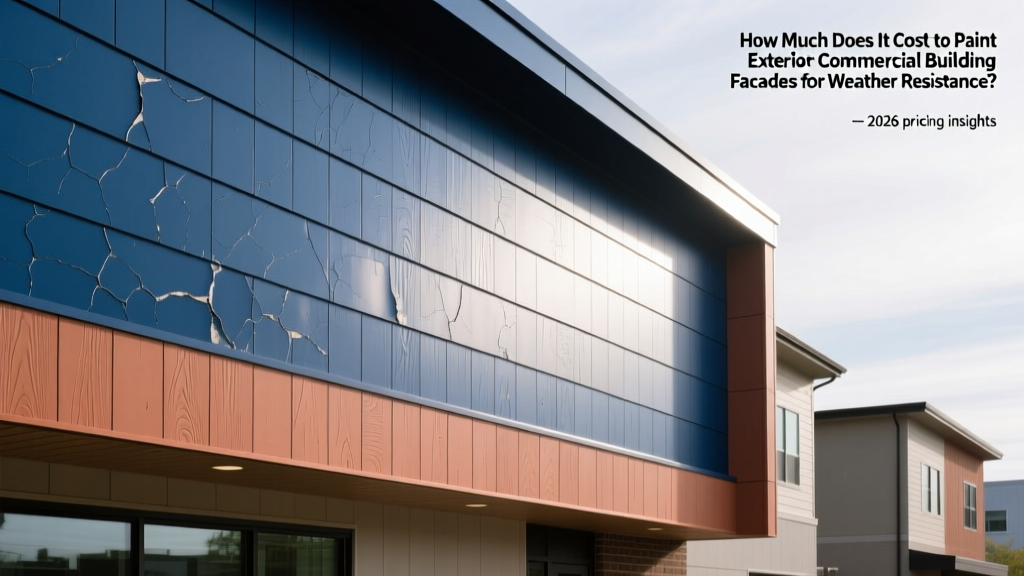
Commercial building envelopes face relentless degradation from UV radiation, wind-driven rain, thermal cycling, and chemical pollutants. When facility managers and property owners ask, 'how much does it cost to paint exterior commercial building structures,' the answer depends entirely on the required level of weather resistance. A standard aesthetic refresh costs a fraction of a high-performance protective coating system designed to withstand harsh microclimates.
In 2026, the commercial painting market has shifted heavily toward advanced polymer chemistries that offer extended lifecycle warranties. Standard acrylics are no longer sufficient for buildings in coastal, high-UV, or extreme freeze-thaw environments. This analysis breaks down the exact costs, material specifications, and climate-driven failure modes you must consider when budgeting for a weather-resistant commercial exterior paint job.
2026 Cost Breakdown: Standard vs. High-Performance Coatings
The cost to paint a commercial exterior is calculated per square foot of surface area, not floor space. Below is a comparative matrix of coating systems, their dry film thickness (DFT), and current 2026 installed costs (including standard surface preparation and labor).
| Coating System | Specific Product Example | DFT (Mils) | Installed Cost / Sq. Ft. | Best Climate Application |
|---|---|---|---|---|
| High-Build Acrylic | Sherwin-Williams Sher-Cryl HPA | 4.0 - 6.0 | $1.50 - $2.50 | Mild, inland temperate zones |
| Elastomeric Acrylic | Tnemec Series 156 Enviro-Crete | 12.0 - 16.0 | $2.75 - $4.50 | Freeze-thaw, masonry cracking |
| Epoxy Primer + Polyurethane | Carboline Carboguard 890 + UV Top | 6.0 - 8.0 | $4.00 - $6.50 | Coastal, high-salinity, industrial |
| PVDF / Fluoropolymer | Kynar 500 Resin Systems | 3.0 - 4.0 | $6.00 - $9.50 | Extreme UV, arid, high-fade risk |
| Mineral Silicate | Keim Concretal-Lasur | 2.0 - 3.0 | $3.50 - $5.00 | High moisture, historic masonry |
Climate-Driven Failure Modes and Coating Selection
Selecting a coating without analyzing the local weather vectors guarantees premature failure. The Association for Materials Protection and Performance (AMPP) emphasizes that environmental exposure dictates the chemical composition required for the topcoat and primer.
Coastal and High-Salinity Environments
Buildings within five miles of a coastline face chloride ion ingress, which penetrates porous concrete and causes the underlying rebar to oxidize and expand, leading to concrete spalling. Standard acrylics offer zero chloride resistance. For these facades, a two-component epoxy primer (like Carboguard 890) is mandatory to create an impermeable moisture barrier, topped with an aliphatic polyurethane to resist UV degradation. Expect to pay a 40% premium over standard interior/exterior commercial rates for this dual-coat system.
Extreme UV and Arid Climates
In regions like the American Southwest, intense UV radiation breaks down the polymer chains in standard paints, causing severe chalking, fading, and loss of mil thickness within 36 months. Polyvinylidene fluoride (PVDF) coatings, commonly known by the trade name Kynar 500, are the gold standard here. While the upfront cost approaches $9.00 per square foot, PVDF resins maintain color stability and gloss retention for over 20 years under direct, unshaded solar exposure.
Freeze-Thaw and High-Moisture Zones
Water ingress followed by freezing temperatures expands and destroys masonry substrates. Elastomeric coatings are frequently specified here because their high build (up to 16 mils) bridges hairline cracks up to 1/16th of an inch wide. However, elastomerics carry a severe risk if misapplied.
Never apply a vapor-impermeable elastomeric coating over damp masonry or below-grade retaining walls. If moisture is trapped behind the membrane, thermal expansion will cause catastrophic blistering and delamination. For high-moisture environments, specify breathable mineral silicate paints or penetrating silane/siloxane water repellents instead.
Wind-Driven Rain and ASTM D6904 Testing
For high-rise commercial buildings, wind-driven rain is a primary vector for envelope failure. When evaluating weather-resistant coatings, facility managers should require products tested to ASTM D6904 (Standard Practice for Resistance to Wind-Driven Rain for Exterior Coatings Applied to Masonry). Coatings that pass this test at 15 mph wind velocities and 5.7 inches of rain per hour are essential for buildings in hurricane-prone or coastal storm corridors. Testing data should be explicitly requested from the manufacturer before finalizing the architectural specification.
Surface Preparation: The SSPC Standards That Dictate Price
The most common reason commercial exterior coatings fail is inadequate surface preparation. The Society for Protective Coatings (SSPC) sets the industry benchmarks for prep work, which can account for 40% to 60% of the total project cost.
- SSPC-SP1 (Solvent Cleaning): Basic degreasing. Adds $0.15 - $0.25 per sq. ft.
- SSPC-SP12 / NACE No. 5 (Waterjetting): Using ultra-high-pressure water (up to 5,000 PSI) to remove laitance, efflorescence, and failing previous coatings from concrete. Adds $0.75 - $1.25 per sq. ft.
- SSPC-SP6 (Commercial Blast): Abrasive blasting required for structural steel or heavily corroded metal cladding. Adds $1.50 - $3.00 per sq. ft.
Skipping rigorous preparation to save on the initial bid will void the manufacturer's warranty and guarantee peeling within the first 24 months.
Access Equipment and Labor Multipliers
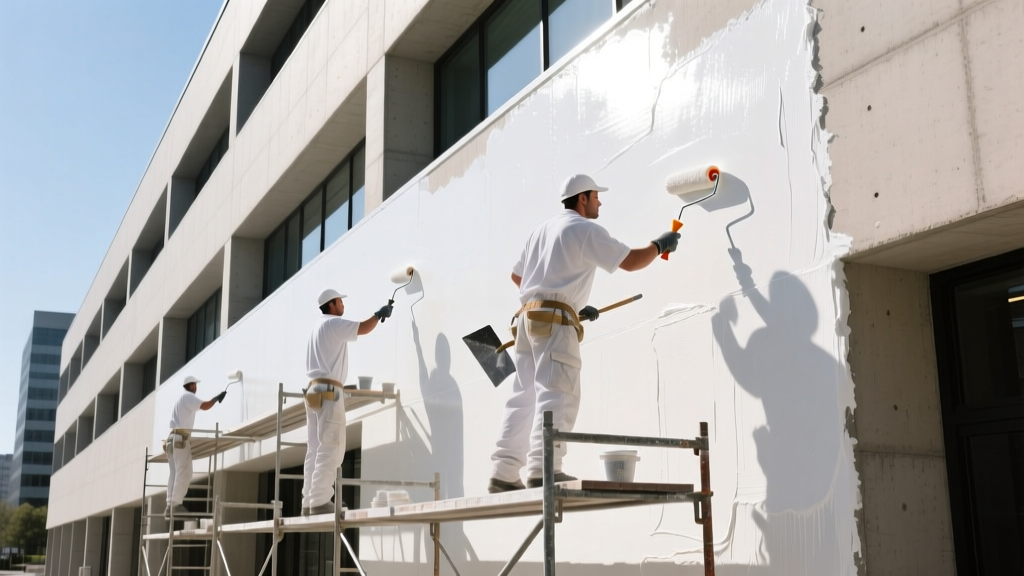
The physical geometry of the commercial building drastically alters the final price. A single-story tilt-up concrete warehouse can be painted using standard boom lifts and rolling scaffolding, keeping labor costs near the baseline. Conversely, multi-story structures require specialized access equipment.
Suspended swing stages (scaffolding) typically cost between $1,200 and $1,800 per day to rent, mobilize, and operate, requiring certified technicians and strict adherence to OSHA fall protection standards. Rope access (industrial abseiling) is increasingly popular for complex geometric facades or high-rises where swing stages cannot be rigged, often reducing mobilization time but requiring highly specialized, premium-rate labor. Expect access logistics to add 15% to 30% to the total project budget for structures exceeding four stories.
Lifecycle ROI: Calculating the Long-Term Value
When determining how much it costs to paint an exterior commercial building, evaluating the 15-year lifecycle cost is more accurate than looking at the initial bid. Consider a 20,000 sq. ft. concrete facade in a humid, subtropical climate:
- Standard Acrylic System: Costs $2.00/sq. ft. ($40,000 initial). Fails in 5 years due to mildew and UV degradation. Requires repainting at Year 5 and Year 10. Total 15-year cost: $120,000.
- High-Performance Polyurethane System: Costs $5.50/sq. ft. ($110,000 initial). Maintains integrity and aesthetic for 15+ years. Total 15-year cost: $110,000.
The Painting Contractors Association (PCA) consistently advises facility managers to prioritize lifecycle durability over initial square-foot pricing, noting that the cost of mobilizing access equipment and scaffolding makes frequent repaints financially devastating.
Ultimately, investing in climate-specific, high-performance weather-resistant coatings minimizes long-term operational expenditures, protects the structural integrity of the building envelope, and maintains the asset's commercial valuation.
Written by
James ThorntonJames Thornton is a construction industry veteran with 25 years of hands-on experience in wood framing, lumber grading, and residential building codes. He started as a framing carpenter in rural Oregon, earned his ICC Residential Building Inspector certification, and eventually became a senior plan reviewer for the City of Portland Bureau of Development Services. James holds a B.S. in Wood Science & Technology from Oregon State University and is a certified lumber grader through the West Coast Lumber Inspection Bureau (WCLIB). He has inspected over 3,000 residential construction sites and authored the city's internal guide on advanced framing techniques (2x6 at 24" O.C.). James lives in Bend, OR, where he builds custom timber-frame cabins and competes in lumberjack sports.
More from James Thornton
View all
Insulation
Best Home Insulation Materials: Complete 2026 Guide
Compare top home insulation materials for 2026. Find R-values, installed costs per square foot, and best uses for fiberglass, spray foam, and mineral wool.
Aug 4, 2026

Sustainable Building
Certify Your Green Building Material for LEED and WELL
Step-by-step guide to certifying a green building material for LEED v5 and WELL v2. Master EPDs, HPDs, and VOC limits for 2026 project specifications.
Aug 4, 2026

Stone & Masonry
Veneer Stacked Stone Panels: Interior Design & Style Showcase
Discover how veneer stacked stone panels transform interiors. Explore modern design profiles, material pairings, and technical installation specs.
Aug 4, 2026