Siding Materials With Strongest Manufacturer Warranties for 2026
Discover the siding materials with strongest manufacturer warranties for 2026. Learn maintenance rules, repair claims, and how to avoid voiding coverage.

The True Value of a Siding Warranty: Beyond the Marketing Badge
When evaluating exterior cladding, homeowners often fixate on the length of a warranty—seeing '50-year' or 'Lifetime' and assuming they are fully protected. However, from a maintenance and repair perspective, the strongest siding warranties are not defined by their duration, but by their transferability, labor coverage, and the clarity of their maintenance stipulations. A 50-year prorated warranty that excludes labor after year five is vastly inferior to a 30-year non-prorated warranty that covers full replacement costs including installation.
For 2026, the leading cladding manufacturers have tightened their quality control while simultaneously expanding coverage for extreme weather events. Yet, the vast majority of warranty repair claims are denied not because the product failed, but because the homeowner violated a specific maintenance clause. This guide dissects the siding materials with strongest manufacturer warranties, detailing the exact maintenance protocols you must follow to keep your repair coverage intact.
Warranty Heavyweights: Coverage Matrix and Repair Realities
Not all warranties are created equal. The matrix below breaks down the top-tier cladding options, contrasting their headline warranty terms with the actual repair realities you will face if a panel fails, cracks, or delaminates.
| Manufacturer / Product | Material Type | Base Warranty Term | Labor Coverage | Transferability |
|---|---|---|---|---|
| James Hardie (HardiePlank) | Fiber Cement | 30-Year Non-Prorated | Included (Years 1-10) | One-time transfer |
| LP SmartSide ExpertFinish | Engineered Wood | 50-Year Prorated | 100% (Years 1-5), then prorated | One-time transfer |
| CertainTeed Cedar Impressions | Polypropylene/Vinyl | Lifetime Limited | Included (Years 1-5) | One-time transfer |
| ATAS International (CastleTop) | Metal (Steel/Aluminum) | 30-Year PVDF Finish | Excluded (Material only) | Non-transferable |
Decoding the Math: Prorated vs. Non-Prorated Repairs
Understanding the financial mechanics of a repair claim is critical. If your LP SmartSide siding suffers from fungal decay in year 15, the LP Building Solutions warranty operates on a prorated schedule. The manufacturer will only cover a percentage of the material cost, and you will be responsible for 100% of the labor to remove the damaged boards, treat the wall cavity, and install the replacements. Conversely, if a James Hardie panel cracks due to a manufacturing defect in year 12, their non-prorated structure means the manufacturer covers the full material cost, though labor coverage typically phases out after the first decade. Always budget for out-of-pocket scaffolding and carpentry labor when planning repairs on older cladding.
Many top-tier warranties, including the James Hardie 30-year warranty, contain a 'proper installation' caveat. If your repair claim requires replacing a section of siding, and the contractor performing the repair is not certified by the manufacturer, the adjuster can legally deny the claim for the entire wall. Always verify your repair contractor's active certification status before signing a work order.
The 'Void' Traps: Maintenance Mistakes That Kill Your Coverage
The most common reason for denied siding repair claims is improper maintenance. Manufacturers deploy independent adjusters who look for specific environmental and maintenance failures before approving a payout. Avoid these warranty-voiding traps:
1. The Soil and Sprinkler Clearance Violation (Fiber Cement & Wood)
Fiber cement and engineered wood are highly susceptible to capillary action (wicking). Manufacturer guidelines strictly mandate a minimum 6-inch clearance between the bottom edge of the siding and the soil, and a 2-inch clearance from rooflines. Furthermore, if your irrigation system constantly sprays the siding, causing localized moisture saturation and subsequent swelling or efflorescence, the manufacturer will classify this as 'environmental abuse' and void the warranty for that specific elevation of the house.
2. The High-Pressure Washing Melt (Vinyl & Polypropylene)
While vinyl siding is virtually rot-proof, it is highly sensitive to heat and pressure. The Vinyl Siding Institute and major manufacturers explicitly state that using a pressure washer with a 0-degree (pinpoint) nozzle, or exceeding 1,500 PSI, can micro-fracture the substrate or warp the profile. If a windstorm later tears off a warped panel, the manufacturer will point to the pressure-washing damage as the root cause of the structural weakening, denying the wind-damage repair claim.
3. Galvanic Corrosion from Dissimilar Metals (Metal Cladding)
For architectural metal siding, the finish warranty (often 30 years against chalking and fading) is robust. However, if a roofer or HVAC technician installs copper flashing or uses untreated steel screws to mount a satellite dish to your aluminum or galvalume panels, it triggers galvanic corrosion. This chemical reaction eats through the PVDF paint finish and the metal substrate. Manufacturers will immediately void the finish and perforation warranties upon spotting dissimilar metal contact.
Step-by-Step: Filing a Successful Siding Repair Claim
When you discover a manufacturing defect—such as delamination, excessive chalking, or premature locking-edge failure—follow this precise sequence to maximize your chances of a successful warranty repair:
- Document the Failure with Scale: Take high-resolution photos of the defect. Include a tape measure or a coin in the frame to provide scale. Photograph the wider elevation to prove the installation clearance requirements (soil and roof gaps) were met.
- Locate the Original Proof of Purchase: Warranties are tied to the original purchase date and the specific product batch. Find the contractor's invoice that lists the exact product line, color code, and square footage.
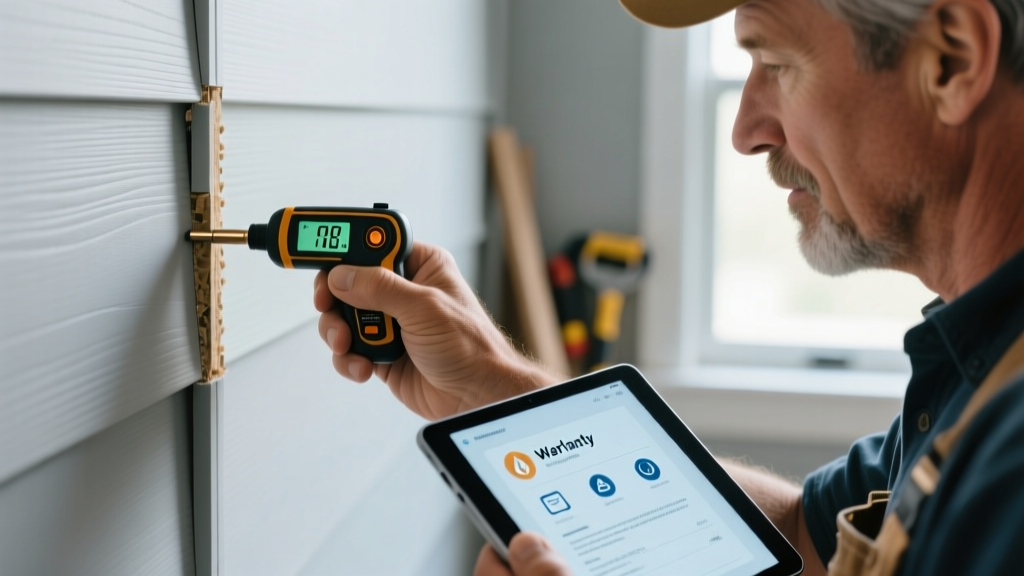
- Hire a Manufacturer-Certified Inspector: Do not rely solely on your general contractor's opinion. Contact the manufacturer's regional representative to schedule a site visit. They will use a moisture meter, a gloss meter (for finish fading), and a caliper to measure board thickness.
- Submit the Formal Claim Packet: The inspector will generate a report. Submit this alongside your photos, original invoice, and a formal repair estimate from a certified installer.
- Negotiate the 'Blend' Repair: If the manufacturer only covers the defective boards, the new panels will not perfectly match the UV-faded existing panels. Negotiate for the manufacturer to cover the cost of 'blending'—replacing panels on multiple elevations to hide the color mismatch.
Transferability and the Resale ROI
From a long-term maintenance and real estate perspective, a transferable warranty is a massive financial asset. When you sell your home, the ability to transfer the remaining years of a non-prorated siding warranty to the new buyer can increase the property's appraised value. Buyers are highly wary of deferred maintenance on exterior envelopes. Providing a documented maintenance log (showing annual gentle washings, caulking inspections, and clearance checks) alongside a formally transferred warranty document removes the buyer's fear of impending $15,000+ siding replacement costs. Ensure you submit the transfer paperwork to the manufacturer within 30 days of your property closing to keep the coverage active.
Written by
Sarah WhitfieldSarah Whitfield is a chartered quantity surveyor (MRICS) and construction cost analyst with 15 years of experience in material pricing, procurement strategy, and project budgeting. She earned her degree in Construction Management from the University of Reading (UK) and has worked on projects ranging from $2M custom homes to $180M mixed-use developments across North America and Europe. Sarah currently leads cost estimating for BuildMat Insight, maintaining a proprietary database of 4,000+ material price points updated quarterly. She is a frequent contributor to RSMeans cost data panels and has presented at the International Cost Engineering Council (ICEC) congress. Based in Denver, CO, Sarah is an avid trail runner and volunteer mentor for Women in Construction.
More from Sarah Whitfield
View all
Wood & Lumber
What Are the Different Types of Wood? A Builder's Guide
Compare structural softwoods, finish hardwoods, and engineered lumber. Analyze Janka ratings, MOE values, and 2026 pricing for construction.
Aug 4, 2026

Walls & Panels
Steel Framing vs Wood Framing: Corrosion and Moisture Defense
Compare steel framing vs wood framing for moisture resistance. Learn about galvanized coatings, condensation risks, and corrosion protection strategies.
Jul 21, 2026

Stone & Masonry
How to Cut Stone Veneer: Wet Saw vs Grinder Comparison
Compare the best tools for cutting stone veneer. We review wet saws, angle grinders, and chop saws to help you achieve clean, chip-free cuts.
Jul 21, 2026