Corner Bead Drywall Specs: Metal vs Vinyl vs Paper Performance
Compare corner bead drywall specs for metal, vinyl, and paper-faced profiles. Explore ASTM standards, impact ratings, and failure modes.
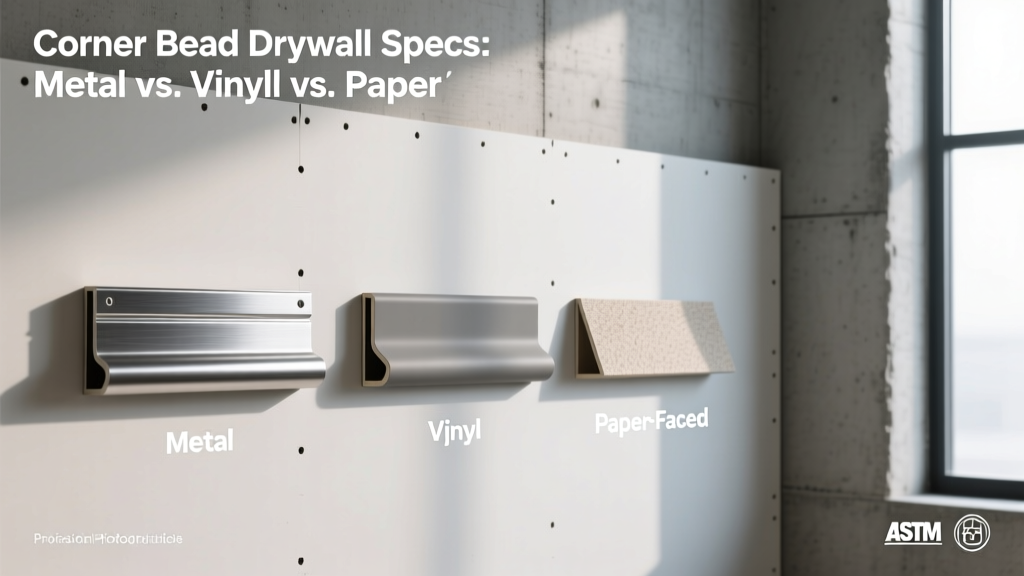
The Hidden Weak Point in Drywall Assemblies
Outside corners are the most vulnerable intersection in any gypsum board assembly. While installers often focus on panel thickness and fire ratings, the corner bead drywall profile dictates the long-term structural integrity, impact resistance, and aesthetic longevity of the corner. A failure at the corner compromises the entire wall plane. In 2026, the market has shifted heavily toward composite and paper-faced solutions, but traditional galvanized steel and extruded vinyl still hold specific engineering advantages depending on the environmental and mechanical demands of the space. Selecting the correct profile requires a strict adherence to ASTM testing standards and an understanding of material-specific failure modes.
- ASTM C1047: Standard Specification for Accessories for Gypsum Wallboard and Gypsum Veneer Base (Covers metal and standard rigid profiles).
- ASTM D256: Standard Test Methods for Determining the Izod Pendulum Impact Resistance of Plastics (Used to rate vinyl/PVC bead durability).
- ASTM C847: Standard Specification for Metal Lath (Relevant for expanded metal flange adhesion properties).
Material Performance Matrix: Metal vs. Vinyl vs. Paper-Faced
The table below synthesizes field performance data and manufacturer engineering specs for the three dominant corner bead categories. Use this matrix to match the bead type to your specific project requirements.
| Profile Type | Impact Resistance | Moisture Tolerance | Crack Resistance | Avg. Cost (per lin. ft.) |
|---|---|---|---|---|
| Galvanized Steel (G60/G90) | Moderate (Dents, does not shatter) | Low (Cut ends rust) | Low (Flange cracking) | $0.35 - $0.55 |
| Extruded Vinyl (PVC) | High (Rebounds from blunt force) | Excellent (Impervious) | Moderate (Flange separation) | $0.45 - $0.80 |
| Paper-Faced Composite | Very High (Monolithic bond) | Moderate to High (Core dependent) | Excellent (Tensile paper) | $0.90 - $1.40 |
Galvanized Steel & Aluminum: The Traditional Baseline
Metal corner beads, governed by ASTM C1047 specifications, remain the default in many commercial bids due to low upfront material costs and familiarity. However, their performance profile is highly dependent on the galvanization coating and the mechanical fastening method.
Specification Breakdown & Edge Cases
- Coating Grades: Standard beads use a G60 zinc coating (0.60 oz/sq ft). In high-humidity zones (commercial restrooms, coastal residential), specify G90 (0.90 oz/sq ft) to delay oxidation. Aluminum beads (0.018" thickness) eliminate rust entirely but are significantly softer and prone to severe denting from cart or furniture impact.
- Flange Adhesion: Metal relies on mechanical fasteners (drywall nails, staples, or crimp-on tools). The expanded metal flange provides a mechanical key for joint compound, but the transition point between the rigid metal flange and the flexible drywall paper is a primary stress riser, leading to longitudinal hairline cracking.
- The Cut-End Vulnerability: When installers cut metal beads with tin snips, the raw steel edge is exposed. If embedded in standard setting-type compound, moisture from the mud initiates oxidation immediately, causing rust bleed-through that stains latex primers and topcoats.
Extruded Vinyl (PVC) Corner Beads: Impact and Moisture Superiority
Vinyl corner beads solve the denting and rusting issues inherent to metal. Manufactured via co-extrusion, these profiles feature a rigid PVC nose for corner protection and flexible, often perforated, flanges for mud adhesion. They are the mandatory choice for high-moisture environments and high-traffic corridors where blunt-force impact is expected.
Field Insight: Vinyl beads possess "memory." If a corner is struck by a hospital bed or luggage cart, the PVC will temporarily deform and snap back to its original 90-degree extrusion, whereas a metal bead would permanently crumple, requiring a full tear-out and patch. However, vinyl flanges require a heavier bed coat of joint compound to prevent telegraphing, as the plastic does not absorb moisture like metal mesh.
Real-World Failure Modes for Vinyl
While impact-resistant, vinyl beads fail primarily through flange separation. Because PVC is non-porous, standard drying-type joint compounds (like all-purpose mud) rely solely on mechanical adhesion to the perforations. If the installer fails to press the flange tightly against the gypsum panel, or if the framing is bowed by more than 1/8" over 8 feet, the rigid vinyl will bridge the gap and eventually pop off the wall when the building settles. Always pre-straighten framing studs to a maximum tolerance of 1/8" in 48" before installing rigid vinyl profiles.
Paper-Faced Composite Beads: The Crack-Proof Solution
Paper-faced corner beads (such as the Strait-Flex Perfect-90 or Trim-Tex Magic Corner) represent the highest performance tier for residential and premium commercial drywall. These beads feature a rigid core (vinyl or thin metal) laminated with heavy Kraft paper flanges. For a comprehensive look at modern engineered profiles, review the Trim-Tex Engineering Specs.
Installation Tolerances & Mud Adhesion Specs
The engineering advantage of paper-faced beads lies in the monolithic bond. The Kraft paper flanges are chemically and physically compatible with the paper face of the gypsum board. When embedded in a starch-based joint compound, the mud penetrates the paper fibers, creating a continuous, unified surface that moves as a single membrane during thermal expansion and structural settling.
- Off-Angle Capability: Unlike rigid 90-degree metal or vinyl, composite paper beads can be folded to accommodate any angle from 70 to 110 degrees without requiring custom extrusions, making them ideal for vaulted ceilings and non-standard architecture.
- Fastener Elimination: These beads require zero nails or staples. Eliminating mechanical fasteners removes the risk of rust pops and eliminates the physical stress points where cracks originate.
- Application Protocol: Apply a 1/16" to 1/8" layer of setting-type compound (e.g., 45-minute hot mud) to both wall surfaces. Press the bead into the mud, then squeegee the excess through the paper face. Do not over-embed, which starves the joint of adhesive.
When installing corner beads on 1-hour or 2-hour fire-rated assemblies (e.g., UL Design U419), the corner bead material can affect the rating. Metal beads act as thermal bridges, rapidly conducting heat to the gypsum core and potentially causing premature paper calcination and corner blowout during a fire. For strict fire-rated corridors, specify paper-faced composite beads or heavy-gauge steel beads fully encapsulated in a minimum of two coats of fire-rated setting compound to insulate the nose from direct thermal transfer.
Troubleshooting Decision Tree: Corner Failures
When diagnosing a failed drywall corner during a renovation or warranty call-back, follow this diagnostic sequence to identify the root cause and specify the correct remediation.
- Symptom: Longitudinal hairline crack exactly 2 inches from the corner.
Diagnosis: Flange telegraphing. The framing lumber shrank, pulling the drywall panel away from the rigid bead flange.
Fix: Cut out the cracked section, transition to a paper-faced composite bead to bridge the movement joint, and tape with fiberglass mesh. - Symptom: Brown/orange staining bleeding through the paint at the corner nose.
Diagnosis: Galvanized steel oxidation. Moisture from the initial taping coats rusted the cut ends or a compromised zinc coating.
Fix: Seal the corner with a heavy-bodied shellac-based primer (e.g., B-I-N) to block the stain, then skim coat and repaint. Do not use standard PVA drywall primer. - Symptom: The corner nose is flattened or indented, but the mud is intact.
Diagnosis: Impact damage on thin-gauge aluminum or low-durometer vinyl.
Fix: If using vinyl, apply heat (heat gun on low) to encourage memory rebound. If aluminum, the core is permanently deformed; cut the drywall back 6 inches, replace the bead with a heavy-duty PVC profile, and re-tape. - Symptom: Flaking or delamination of the paper layer on paper-faced beads.
Diagnosis: Starved joint. The installer wiped too much compound out from under the paper flange during embedding, leaving air pockets.
Fix: Inject elastomeric caulk or thin setting compound under the loose paper, clamp flat until cured, and apply a skim coat over the surface.
Specifying the correct corner bead drywall profile is not merely an aesthetic choice; it is a critical structural decision that dictates the maintenance cycle of the interior environment. By aligning the ASTM performance metrics of metal, vinyl, and composite beads with the specific moisture, impact, and fire-rating demands of your project, you eliminate the most common drywall failure points before the first coat of mud is even mixed.