Gypsum Board Price News 2026: Drywall vs. Alternative Wall Panels
Analyze the latest gypsum board price news for 2026 and compare total installed costs of drywall against fiber cement, MgO, and WPC alternatives.
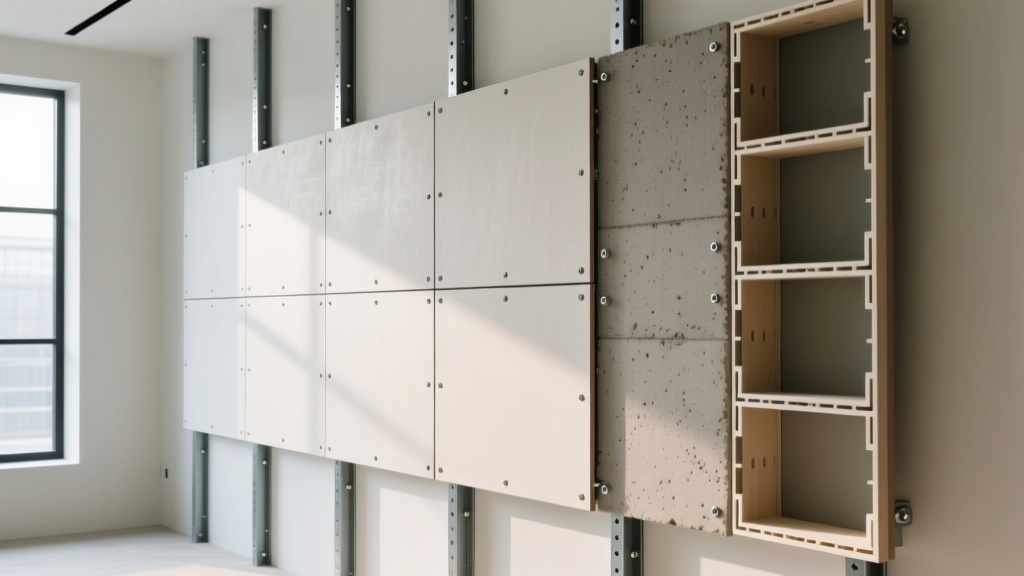
The 2026 Gypsum Market: Why the Latest Pricing Shifts Matter
For decades, standard gypsum board (drywall) has been the undisputed baseline for interior wall and ceiling assemblies in North America. However, tracking the latest gypsum board price news in 2026 reveals a structural shift in the market. The historical reliance on synthetic gypsum—specifically flue-gas desulfurization (FGD) gypsum produced as a byproduct of coal-fired power plants—has been disrupted by accelerating coal plant retirements. According to the USGS Mineral Commodity Summaries, the transition toward naturally mined gypsum has increased raw material extraction and freight costs, as natural deposits are geographically concentrated in states like Texas, Iowa, and Nevada.
This macroeconomic pressure has narrowed the cost gap between traditional gypsum board and premium alternative wall panels. For general contractors and procurement managers, the decision is no longer simply 'drywall by default.' It requires a rigorous total-installed-cost analysis comparing standard and Type X gypsum against fiber cement, magnesium oxide (MgO), and wood-plastic composite (WPC) systems.
Head-to-Head Material Cost Matrix
Before evaluating performance, we must establish the baseline material costs. The table below reflects Q1 2026 national average wholesale pricing for standard commercial volumes (pallet-quantity purchases). Note that regional freight surcharges can skew local pricing by 10% to 18%.
| Material Type | Standard Thickness | Sheet Dimensions | 2026 Sheet Price | Cost per Sq. Ft. (Material Only) |
|---|---|---|---|---|
| Standard Gypsum (ASTM C1396) | 1/2 in. | 4 ft. x 8 ft. | $14.50 - $16.00 | $0.45 - $0.50 |
| Type X Fire-Rated Gypsum | 5/8 in. | 4 ft. x 8 ft. | $19.00 - $22.50 | $0.59 - $0.70 |
| Glass Mat Gypsum (e.g., DensGlass) | 5/8 in. | 4 ft. x 8 ft. | $32.00 - $36.00 | $1.00 - $1.12 |
| Fiber Cement Board (e.g., HardieBacker) | 1/4 in. | 3 ft. x 5 ft. | $28.00 - $34.00 | $1.86 - $2.26 |
| Magnesium Oxide (MgO) Board | 1/2 in. | 4 ft. x 8 ft. | $38.00 - $46.00 | $1.18 - $1.43 |
| WPC Fluted Demountable Panels | 3/8 in. (Profiled) | 1 ft. x 10 ft. | $45.00 - $60.00 | $4.50 - $6.00 |
The Hidden Variable: Total Installed Cost vs. Material Cost
When analyzing Bureau of Labor Statistics Producer Price Index data for building materials, it is critical to separate material procurement from installed cost. Gypsum board has a uniquely high finishing labor burden. Achieving a Level 4 or Level 5 finish requires taping, multiple coats of joint compound, sanding, and priming. In 2026, union and prevailing wage labor rates for drywall finishing range from $1.85 to $3.20 per square foot, depending on the finish level and regional market.

Application-Specific Decision Framework
Rather than viewing alternatives as universal replacements, contractors should deploy them strategically based on environmental and code requirements. Below is a technical breakdown of when to pivot away from traditional gypsum.
High-Moisture & Exterior Soffits: Glass Mat vs. Fiber Cement
Standard paper-faced gypsum fails rapidly when exposed to sustained moisture, as the paper facing harbors mold and the gypsum core degrades. For exterior soffits, semi-exterior corridors, and high-humidity commercial kitchens, the choice narrows to glass mat gypsum (e.g., Georgia-Pacific DensGlass) or fiber cement.
- Glass Mat Gypsum: Offers superior fire resistance and is lighter than fiber cement, reducing structural load and installer fatigue. It cuts and snaps like standard drywall. However, the fiberglass mat can cause skin irritation during installation, requiring PPE.
- Fiber Cement: Highly impervious to water and impact. It is the mandatory choice for direct water exposure zones (e.g., commercial shower surrounds). The trade-off is weight (a 3x5 sheet weighs nearly 30 lbs) and the need for carbide-tipped scoring tools or diamond blades, which slows installation velocity.
Fire-Rated Shafts & Elevator Cores: Type X vs. Magnesium Oxide (MgO)
Type X gypsum board achieves its fire rating through the inclusion of glass fibers and vermiculite, which hold the calcined gypsum core together as it dehydrates under extreme heat (meeting UL Design U419 for 1-hour and 2-hour assemblies). However, in high-impact shaft walls, Type X is vulnerable to mechanical damage before the building is enclosed.
MgO board has emerged as a high-performance alternative for fire-rated assemblies. It is non-combustible, highly impact-resistant, and impervious to mold. Critical 2026 Specification Note: Early generations of imported MgO board suffered from 'halide leaching' (the 'crying board' phenomenon), where magnesium chloride salts absorbed atmospheric moisture and corroded adjacent steel studs. When specifying MgO in 2026, procurement teams must explicitly require sulfate-based MgO (MgSO4) formulations, which eliminate the chloride corrosion risk while maintaining the Class A fire rating.
Fast-Track Commercial Fit-Outs: Standard Drywall vs. WPC Demountable Panels
For corporate offices, boutique hotels, and retail spaces requiring rapid turnover or future reconfigurability, Wood-Plastic Composite (WPC) fluted panels are disrupting the drywall monopoly. WPC panels install via a tongue-and-groove blind-nailing system directly to furring strips or existing substrates. Because they arrive with a factory-applied laminate finish (woodgrain, solid matte, or metallic), they eliminate the 5-to-7-day drying and sanding cycle associated with drywall joint compound. For projects with strict liquidated damages for delayed handover, the schedule compression offered by WPC easily justifies the premium material cost.
Strategic Procurement: Navigating the Latest Gypsum Board Price News
To protect margins against supply chain volatility, commercial estimators and purchasing agents should adopt the following strategies when tracking gypsum board price news and market trends:
- Lock in Natural Gypsum Freight Rates: Because the industry is shifting from synthetic to mined gypsum, freight represents a larger percentage of the delivered cost. Negotiate long-haul delivery contracts in Q4 for Q1/Q2 project starts to avoid spring fuel surcharge spikes.
- Hybridize Wall Assemblies: Use standard 1/2 in. gypsum for low-traffic, non-rated partition walls, but specify 5/8 in. Type X or MgO exclusively for shaft walls, stairwells, and mechanical room enclosures. This optimizes the budget without compromising life-safety codes.
- Monitor The Gypsum Association Technical Bulletins: Keep abreast of updates to ASTM C1396 and new UL fire designs that may allow for single-layer Type X applications in lieu of older, material-heavy double-layer assemblies, effectively cutting both material and labor costs by 30%.
Summary Verdict
The latest gypsum board price news underscores a permanent realignment in wall panel economics. While standard drywall remains the most cost-effective solution for standard interior partitions when factoring in both material and labor, the rising costs of natural gypsum extraction and specialized finishing labor have made alternatives highly competitive in niche applications. By evaluating total installed costs and matching specific material properties—such as sulfate-based MgO for impact-resistant fire shafts or WPC for zero-downtime commercial finishes—contractors can engineer more resilient, predictable, and profitable wall systems in 2026 and beyond.
Written by
Elena RodriguezElena Rodriguez is a civil engineer and technical writer specializing in concrete technology, masonry systems, and ASTM/ACI compliance. She earned her B.S. in Civil Engineering from Texas A&M University and spent a decade at a materials testing laboratory, performing over 2,000 concrete compressive strength tests and masonry prism evaluations. Elena is an ACI-certified Field Testing Technician (Grade I) and a member of ASTM Committee C12 on Natural Building Stone. She currently consults on forensic engineering cases involving concrete failures and moisture intrusion. Based in San Antonio, TX, Elena is a proud member of the Society of Women Engineers (SWE) and coaches her daughter's FIRST Robotics team.
More from Elena Rodriguez
View all
Walls & Panels
Cost Analysis: Light Gauge Steel Framing Advantages and Disadvantages
Evaluate light gauge steel framing advantages and disadvantages through a strict cost analysis lens, comparing material, labor, and lifecycle expenses.
Aug 4, 2026

Walls & Panels
Gypsum Board Types: Exact Specifications, Thickness & Dimensions
Compare standard, Type X, and moisture-resistant gypsum board types. Get exact specifications, thicknesses, dimensions, and ASTM standards for your project.
Aug 4, 2026

Fire Resistance
Best Fire-Resistant Outdoor Decking Materials: 2026 Buyer Guide
Discover the best fire-resistant outdoor decking materials for 2026. Compare Class A PVC, aluminum, and hardwood options for WUI compliance and safety.
Aug 4, 2026