Gypsum Board Fire Resistance Rating: 2026 Cost Analysis
Analyze the 2026 costs of gypsum board fire resistance ratings. Compare Type X, Type C, and multi-layer assembly expenses for code-compliant builds.

The Economics of Fire-Rated Gypsum Assemblies
When evaluating the gypsum board fire resistance rating for commercial, institutional, and multi-family residential projects, the initial material cost is only a fraction of the total assembly expense. In 2026, supply chain stabilization has normalized base drywall prices, but the premium for specialized fire-rated cores and the stringent labor required for code-compliant installation continue to drive budgets. Achieving a specific hourly rating under ASTM E119 (Standard Test Methods for Fire Tests of Building Construction and Materials) dictates not just the panel type, but the stud gauge, fastener schedule, insulation density, and joint treatment.
Understanding the true cost of a fire-rated assembly requires moving beyond the per-sheet price of drywall. Contractors and estimators must account for the systemic cost of the entire UL-listed or GA-600 design. A 1-hour rating might only require a single layer of 5/8-inch Type X board, but stepping up to a 2-hour or 3-hour rating exponentially increases material volume, labor hours, and quality assurance overhead.
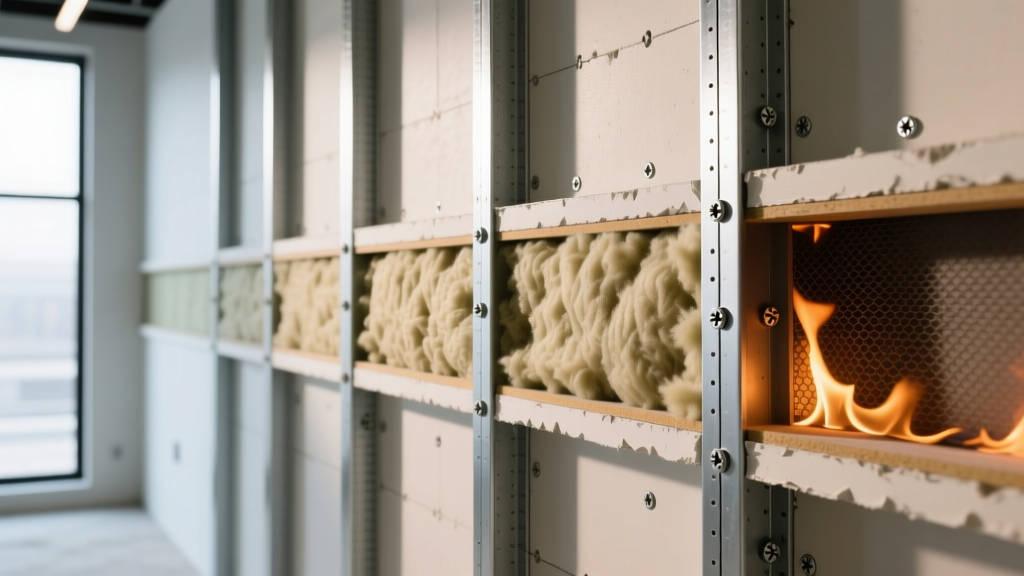
Material Cost Breakdown by Gypsum Board Type
The core composition of the gypsum board directly dictates its fire performance and its price point. Standard panels rely on the natural moisture within the gypsum core to delay heat transfer. Once that moisture boils off (calcination), the core shrinks and cracks, allowing fire to penetrate. Fire-rated boards incorporate glass fibers, vermiculite, or other proprietary additives to maintain structural integrity at the gypsum shrinkage temperature (approx. 212°F to 300°F).
| Panel Type | Thickness | Core Additives | 2026 Material Cost (per sq. ft.) | Typical Max Rating (Single Layer) |
|---|---|---|---|---|
| Standard Regular | 1/2" | None | $0.45 - $0.55 | Not Rated |
| Type X (e.g., USG Firecode X) | 5/8" | Glass fibers | $0.65 - $0.85 | 1-Hour |
| Type C (e.g., USG Firecode C) | 5/8" | Glass fibers + Vermiculite | $0.95 - $1.25 | 1-Hour (Enhanced) / 2-Hour |
| Fire-Rated Glass Mat | 5/8" | Glass fibers + Fiberglass facing | $1.40 - $1.75 | 1-Hour to 2-Hour (Moisture exposed) |
Product Spotlight: Premium Type C vs. Standard Type X
The decision between Type X and Type C often comes down to spatial constraints versus material costs. According to USG Sheetrock Brand Firecode X technical data, a standard Type X panel achieves a 1-hour rating on 3-5/8" steel studs. However, if a design requires a 2-hour rating on the same stud depth, using Type X requires two layers per side (4 layers total). Upgrading to a high-density Type C panel, which features a proprietary core that resists shrinkage at higher temperatures, can sometimes achieve a 2-hour rating with fewer layers or on narrower stud profiles, offsetting its 30-40% higher per-sheet cost through reduced labor and floor-space savings.
Labor and Installation: The Hidden Multipliers
The most frequent cause of budget overruns in fire-rated construction is not the drywall itself, but the labor required to install it to the exact specifications of the tested design. Fire-rated assemblies are unforgiving; deviating from the tested fastener schedule or joint treatment instantly voids the rating.
Labor Cost Variables for 2026:
- Standard Hanging (Non-Rated): $0.55 - $0.75 per sq. ft.
- Single-Layer Fire-Rated (Type X): $0.75 - $0.95 per sq. ft. (Requires tighter screw spacing, typically 8" on center at edges and 12" in the field, compared to 12"/16" for non-rated).
- Multi-Layer Fire-Rated (2+ Layers): $1.40 - $1.90 per sq. ft. (Includes base layer screwing, adhesive application between layers, and staggered face-layer screwing).
- Fire-Rated Taping and Finishing: $0.60 - $0.85 per sq. ft. (Requires setting-type compounds like Durabond for base layers in specific UL designs, rather than standard air-drying all-purpose mud).
Single-Layer vs. Multi-Layer Assembly Cost Matrix
To accurately bid a project, estimators must look at the complete wall assembly cost. The following matrix outlines the fully burdened costs (materials, labor, and standard firestop caulking at the top/bottom tracks) for common steel-stud partition walls in commercial environments.
| Target Rating | Typical Assembly (e.g., UL Design U419/U465) | Total Board Layers | Estimated Total Installed Cost (per sq. ft. of wall) |
|---|---|---|---|
| 1-Hour | 3-5/8" 25ga Studs, 1 layer 5/8" Type X each side | 2 | $3.80 - $4.50 |
| 2-Hour | 3-5/8" 25ga Studs, 2 layers 5/8" Type X each side | 4 | $7.20 - $8.80 |
| 3-Hour | 6" 20ga Studs, 3 layers 5/8" Type X each side | 6 | $11.50 - $13.50 |
| 4-Hour | 6" 18ga Studs, 4 layers Type X/C + Mineral Wool | 8+ | $16.00 - $19.50 |
As the data illustrates, moving from a 1-hour to a 2-hour rating effectively doubles the installed cost, while a 4-hour shaft wall or area separation wall assembly can cost upwards of five times more than a standard non-rated partition. This exponential cost curve makes early architectural collaboration vital to minimize unnecessary 3-hour and 4-hour rating requirements where 2-hour designs might suffice under IBC (International Building Code) alternatives.
Code Compliance, Penetrations, and ROI
A wall is only as fire-resistant as its weakest penetration. The Gypsum Association's GA-600 Fire Resistance Design Manual provides exhaustive details on how electrical boxes, HVAC ducts, and plumbing pipes compromise rated assemblies. In 2026, the cost of firestopping penetrations is a major line item.
For every 100 square feet of rated wall, expect to spend an additional $0.35 to $0.60 per square foot on firestop materials and specialized labor. This includes intumescent fire caulk (e.g., 3M Fire Barrier Sealant), firestop putty pads for electrical boxes, and specialized collars for PVC pipe penetrations. Skipping these or using standard acrylic caulk will result in failed fire marshal inspections, leading to costly tear-outs and project delays.
The ROI of Upgrading to Type C or Glass Mat: While Type C and fiberglass-faced panels carry a higher upfront material cost, they offer significant ROI in high-moisture, high-risk areas like stairwells, elevator shafts, and mechanical rooms. Glass mat panels (such as DensGlass or Securock) resist mold and water damage during the construction phase before the building is fully enclosed. Replacing water-damaged standard Type X drywall before a project even receives its Certificate of Occupancy can wipe out any initial material savings, making the 2026 premium for glass mat fire-rated boards a highly justifiable insurance policy for general contractors.
Frequently Asked Questions
Can I mix Type X and Type C in the same fire-rated assembly?
No. The UL Fire Resistance Directory and specific tested designs mandate the exact panel type. If a UL design specifies Type C for the face layer to achieve a 2-hour rating, substituting Type X will void the rating, even if the total thickness remains the same. The core chemistry and shrinkage temperatures differ, and fire inspectors will check the end-tape markings on the boards to verify compliance.
Does the type of joint compound affect the fire rating?
Yes. While standard air-drying joint compound is acceptable for the final finish coat in many assemblies, the base taping layers in multi-layer fire-rated systems often require a setting-type compound (like USG Durabond or Easy Sand). Setting compounds undergo a chemical cure that provides higher structural integrity and heat resistance than air-drying compounds, which can shrink and crack under extreme thermal stress.
How much does it cost to repair a voided fire-rated wall?
Repairing a compromised fire-rated assembly is significantly more expensive than the initial installation. If an unsealed penetration is discovered during inspection, contractors must cut out the affected gypsum, install approved firestop materials, patch the board, re-tape with setting compound, and repaint. This localized repair typically costs $150 to $300 per penetration, not including the potential schedule delay costs if the fire marshal halts the final walkthrough.
Written by
Priya KapoorPriya Kapoor is a real estate market analyst and construction economics researcher with expertise in housing affordability, development feasibility, and infrastructure investment. She holds a Master of Regional Planning from Cornell University and previously worked as a senior analyst at CBRE's Investment Properties group, where she modeled returns for $4B in mixed-use development pipelines. Priya now runs an independent research practice advising developers, municipalities, and REITs on construction cost forecasting and market timing. She publishes the quarterly "BuildMat Market Pulse" report tracking material price indices across 12 commodity categories. Based in Austin, TX, Priya serves on the board of Habitat for Humanity Austin and is a marathon runner.
More from Priya Kapoor
View all
Construction Cost
Cost to Build a 1600 Sq Ft Home in 2026: Full Breakdown
Accurate 2026 cost to build a 1600 sq ft home—material, labor, and regional pricing breakdowns included. Plan your budget with real-time estimates.
Aug 11, 2026

Wood & Lumber
Name the Types of Wood for Pressure Treatment and Preservation
Learn how to name the types of wood best suited for pressure treatment. Compare species treatability, chemical retention levels, and 2026 preservation costs.
Aug 4, 2026

Stone & Masonry
Stone Veneer Suppliers Lindenhurst: 2026 Cost Analysis
Analyze 2026 stone veneer costs in Lindenhurst, NY. Compare local supplier pricing, delivery fees, and Suffolk County installation labor rates.
Aug 4, 2026