Self Drilling Anchors for Drywall: Brand Deep-Dive Guide
Compare top self drilling anchors for drywall. We analyze ITW E-Z Ancor, Cobra, and Hillman load capacities, failure modes, and installation specs.
The Engineering Challenge of Gypsum Anchoring
Hanging heavy objects on gypsum board presents a unique structural challenge. Unlike wood or masonry, the Gypsum Association defines standard drywall as a friable, non-structural core of calcium sulfate dihydrate encased in paper facers. When a concentrated load is applied, the gypsum core easily crumbles, and the paper facing can delaminate. Self drilling anchors for drywall solve this by utilizing wide, aggressive external threads that cut into the core and distribute shear and tensile forces across a broader surface area of the board. However, not all self-drilling fasteners are engineered equally. The market is dominated by three primary manufacturers, each utilizing distinct metallurgical and polymer formulations that drastically alter load capacities in standard 1/2-inch and fire-rated 5/8-inch Type X boards.
Brand Deep-Dive: The Big Three Manufacturers
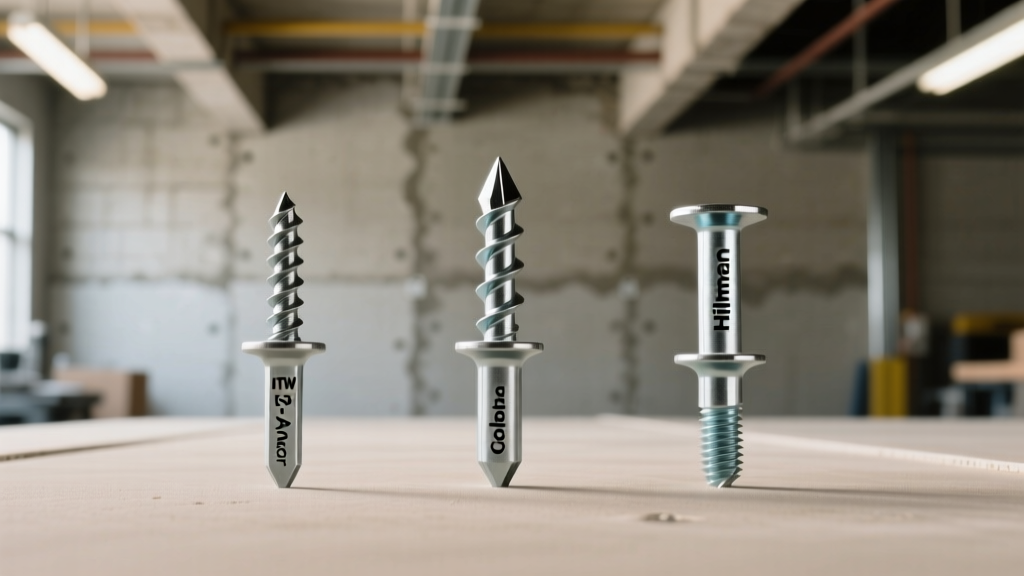
ITW E-Z Ancor (The Industry Benchmark)
ITW’s E-Z Ancor line is the undisputed heavyweight in the self-drilling category. Their flagship product, the E-Z Ancor ToggleLock, bridges the gap between a traditional self-drilling threaded anchor and a spring-loaded toggle bolt. Constructed from zinc-plated steel, the ToggleLock features a self-drilling tip that cuts through the drywall, followed by a metal toggle bar that springs open behind the board. In 1/2-inch standard gypsum, the ToggleLock achieves an ultimate tensile (pull-out) strength of 100 lbs and a shear strength of 140 lbs. For lighter applications, their Stud Solver line utilizes a unique dual-purpose design: the self-drilling tip is engineered to penetrate drywall but will also bite into a wood or metal stud if encountered, offering a 50-lb capacity in drywall and up to 200 lbs in wood.
Cobra Anchors (The Polymer Innovator)
Cobra Anchors focuses heavily on advanced polymer composites and high-volume contractor packaging. Their Cobra Self-Drilling line utilizes glass-filled nylon and high-density polyethylene (HDPE) rather than die-cast zinc. The primary advantage of Cobra’s polymer formulation is its resistance to stripping under high-torque power driver applications. The Cobra Triple Grip model features an expandable split-wing design that deploys behind the drywall once the provided screw is driven, achieving a 75-lb tensile load in 1/2-inch board. Cobra’s 2026 pricing structure remains highly competitive for multi-family and commercial fit-outs, often undercutting zinc alternatives by 15% to 20% in bulk quantities.
Hillman (The Hardware Store Staple)
Hillman provides accessible, traditional self-drilling options, most notably the Sharkie and their standard Zinc Die-Cast Self-Drillers. Hillman’s zinc anchors feature deep, sharp external threads that excel in older, slightly denser gypsum boards. However, their standard 35-lb rated zinc anchors are highly susceptible to head-stripping if the installer uses an impact driver rather than a standard drill/driver with a clutch setting. Hillman’s primary value proposition is immediate retail availability and standardized sizing that perfectly matches their proprietary screw lines, eliminating the guesswork of matching screw gauges to anchor internal diameters.
Load Capacity & Pricing Matrix (2026 Data)
The following table outlines the verified ultimate load capacities and current average retail costs for the leading self drilling anchors for drywall. Note that safe working loads are universally calculated at 25% of the ultimate failure limit.
| Brand & Model | Material | Ultimate Tensile (1/2' Board) | Ultimate Shear (1/2' Board) | Avg. Cost Per Unit (2026) |
|---|---|---|---|---|
| E-Z Ancor ToggleLock | Zinc-Plated Steel | 100 lbs | 140 lbs | $1.85 |
| E-Z Ancor Stud Solver | Steel / Polymer Hybrid | 50 lbs (Drywall) | 75 lbs (Drywall) | $0.95 |
| Cobra Triple Grip | Glass-Filled Nylon | 75 lbs | 90 lbs | $0.75 |
| Hillman Zinc Die-Cast | Zinc Alloy | 35 lbs | 50 lbs | $0.45 |
When anchoring into 5/8-inch Type X fire-rated gypsum board, the increased core density and fiberglass mesh reinforcement typically yield a 20% to 30% increase in ultimate load capacities across all self-drilling models listed above. However, the increased density also requires higher installation torque, making polymer anchors (like Cobra) more prone to internal thread stripping if the wrong screw gauge is used. Always use the exact screw provided by the manufacturer when installing into Type X board.
Anatomy of an Anchor Failure in Gypsum
According to testing data referenced by Family Handyman engineering reviews, self-drilling anchor failures rarely occur due to the anchor itself snapping. Failures are almost exclusively caused by the degradation of the surrounding gypsum matrix. Understanding these failure modes is critical for specifiers and installers:
- Core Crushing (Over-torqueing): The most common failure. When an installer uses an impact driver or drives the anchor past the flush point, the wide external threads pulverize the gypsum core. This turns the anchor hole into a smooth, oversized cylinder, resulting in zero pull-out resistance.
- Paper Delamination: If the anchor is subjected to high shear (downward) loads, the stress transfers to the paper facing. If the paper tears away from the gypsum core, the anchor will pivot and pull through the wall, regardless of how deeply the threads are seated.
- Internal Thread Stripping: Occurs when a screw with an incorrect pitch or gauge is forced into the anchor, or when the screw is over-tightened, destroying the internal threads before the clamping force is achieved against the mounted object.
Optimized Installation Protocol for Maximum Hold
To achieve the published load ratings, installation must follow a strict mechanical protocol. Manufacturer specifications from ITW mandate the following sequence for self drilling anchors for drywall:
- Bit Selection: Use a #2 Phillips bit for standard zinc anchors and a #3 square drive or heavy-duty Phillips for toggle-style metal anchors. Ensure the bit is not worn, as cam-out will destroy the anchor head.
- Speed Control: Set the drill to a low speed (under 1,000 RPM). High speeds generate friction heat, which can melt polymer anchors or scorch the paper facing of the drywall.
- The 'Flush-Minus' Rule: Drive the anchor until the flange is exactly 1/16-inch proud of the drywall surface. Do not drive it completely flush or countersink it. The final 1/16-inch will be pulled tight when the mounting screw and fixture are drawn down, ensuring the flange seats perfectly without crushing the core beneath it.
- Screw Engagement: Insert the provided screw and drive it until snug. Stop driving the moment the fixture stops moving. Do not apply 'one more turn' to tighten it, as this will strip the internal threads.
Procurement Decision Matrix: Which Line to Buy?
Selecting the correct self-drilling anchor requires matching the specific load profile of your project to the manufacturer's strengths. Use this framework for your 2026 procurement strategy:
- For Heavy Shelving, TVs, and Cabinetry (50+ lbs): Procure E-Z Ancor ToggleLock. The mechanical toggle behind the board is the only self-drilling mechanism that safely handles dynamic, heavy loads without relying solely on the friable gypsum core.
- For High-Volume Commercial Fit-Outs (Acoustic Panels, Light Fixtures): Procure Cobra Triple Grip in bulk. The glass-filled nylon resists stripping during high-speed production installation, and the per-unit cost savings scale significantly on projects requiring 500+ anchors.
- For Residential Remodels and Mixed Substrates: Procure E-Z Ancor Stud Solver. The ability to seamlessly transition from drywall to wood/metal studs without changing fastener types saves immense labor time in retrofit scenarios where stud locations are inconsistent.
- For Light Decor, Mirrors, and Toilet Paper Holders (Under 30 lbs): Standard Hillman Zinc Die-Cast anchors are perfectly adequate, highly cost-effective, and readily available for small-scale maintenance and repair operations.