Selecting the Right Drywall Primer and Paint for Gypsum Board Substrates
Expert guide to drywall primer and paint selection for gypsum board. Compare PVA, acrylic, and shellac primers, plus sheen frameworks for flawless finishes.
The Chemistry of Gypsum Board Substrates: Why Primer Matters
Gypsum board presents a unique micro-porous challenge that dictates the success or failure of any topcoat. The paper face of standard drywall and the applied joint compound (mud) possess fundamentally different absorption rates and surface textures. When exposed to liquid coatings, the joint compound acts as a sponge, absorbing moisture and binder from the paint at a significantly higher rate than the surrounding paper. If a contractor applies paint directly to unfinished drywall, this differential absorption results in 'joint banding' (also known as photographing), where the taped seams become visibly distinct under oblique lighting.
According to the finishing levels outlined in Gypsum Association GA-216 standards, a proper primer is not merely an undercoat; it is a critical equalizer. It seals the porous substrate, creates a uniform surface profile, and provides a chemically stable anchor for the topcoat. Selecting the correct drywall primer and paint requires matching the chemical base of the primer to the specific gypsum board type (standard, moisture-resistant, or fire-rated) and aligning the paint sheen with the room's functional and lighting requirements.
Primer Taxonomy: Matching the Base Coat to the Board Type
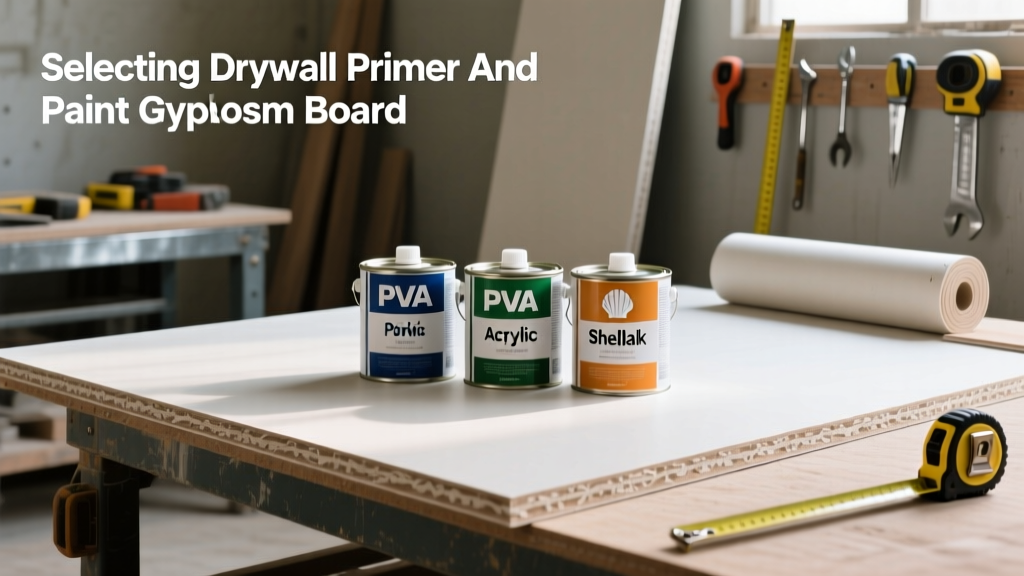
The market offers three primary primer chemistries for gypsum substrates. Choosing the wrong chemistry is the leading cause of premature coating failure, peeling, and sheen inconsistency.
| Primer Type | Chemical Base | Best Substrate | Dry Time (70°F/50% RH) | Avg. Cost per Gallon |
|---|---|---|---|---|
| PVA (Polyvinyl Acetate) | Water-based vinyl resin | Standard white gypsum board (Level 4 & 5) | 1-2 hours | $25 - $35 |
| 100% Acrylic | Water-based acrylic polymer | Moisture-resistant (Green/Purple) & Type X | 2-4 hours | $45 - $65 |
| Pigmented Shellac | Alcohol-based resin | Spot-priming water stains, smoke, or knots | 45 minutes | $55 - $75 |
PVA Primers: The Industry Standard for Standard Board
PVA primers are engineered specifically for the high-pH, highly porous environment of new, standard gypsum board. They penetrate the paper face and joint compound, sealing the pores without raising the grain. Products like Sherwin-Williams Drywall Primer or Kilz PVA are cost-effective and provide excellent hiding power. However, PVA is highly sensitive to moisture post-curing; it can re-emulsify if exposed to prolonged high humidity, making it unsuitable for bathrooms or steam rooms.
100% Acrylic Primers: Mandatory for Moisture-Resistant Boards
Moisture-resistant (MR) and mold-resistant gypsum boards feature specialized facers (often fiberglass mat or treated heavy paper) that are less porous than standard paper. PVA primers struggle to adhere to these denser facers and can peel when exposed to bathroom humidity. A high-build 100% acrylic primer, such as Zinsser Bulls Eye 1-2-3 or Benjamin Moore Fresh Start, provides superior adhesion to MR boards and remains stable in high-moisture environments.
Paint Sheen Selection: A Room-by-Room Decision Framework
Once the substrate is properly sealed, the selection of the topcoat sheen dictates both the aesthetic and the maintenance lifecycle of the wall. Sheen is measured by the amount of light reflected at a 60-degree angle, as defined by Painting and Decorating Contractors of America (PDCA) standards.
- Flat (0-5% Reflectance): The ultimate hide for imperfections. Flat paint diffuses light, making it the only acceptable choice for ceilings and walls with Level 4 finishes where minor trowel marks or framing undulations exist. The trade-off is low scrub resistance; it cannot withstand aggressive cleaning.
- Matte (5-10% Reflectance): The modern contractor's compromise. Premium matte finishes (e.g., Sherwin-Williams Emerald Matte) offer the light-diffusing properties of flat paint but utilize advanced acrylic resins that allow for repeated washing without burnishing (creating shiny spots when scrubbed).
- Eggshell / Satin (10-25% Reflectance): Required for high-traffic zones, kitchens, and bathrooms. The tighter molecular structure of satin paints resists moisture and grease. However, higher sheens act like a mirror for surface defects. Applying eggshell over a Level 4 finish will highlight every taped seam and screw dimple; a Level 5 skim coat is mandatory.
Specialized Scenarios: Fire-Rated and Sound-Rated Assemblies
Type X (fire-rated) gypsum board is denser and contains glass fibers to maintain structural integrity during a fire. Because of its density and the rigorous taping requirements for fire-rated assemblies, the finishing process generates more joint compound. When selecting drywall primer and paint for Type X partitions in commercial corridors or multi-family garages, prioritize high-build acrylic primers that can bridge the micro-cracks that occasionally form in dense fire-tape applications. Furthermore, avoid dark, high-sheen topcoats in long commercial corridors, as the grazing light from overhead fixtures will expose the slightest variance in the drywall plane.
Cost Breakdown and Coverage Rates (2026 Estimates)
Accurate bidding requires understanding the real-world coverage rates, which often fall short of manufacturer claims due to the aggressive absorption of unprimed joint compound.
| Material Category | Manufacturer Claimed Coverage | Real-World Coverage (New Drywall) | Material Cost per Sq. Ft. |
|---|---|---|---|
| PVA Primer | 350 - 400 sq. ft. / gal | 250 - 300 sq. ft. / gal | $0.10 - $0.14 |
| Acrylic Primer | 300 - 350 sq. ft. / gal | 225 - 275 sq. ft. / gal | $0.18 - $0.28 |
| Premium Matte Paint | 350 - 400 sq. ft. / gal | 300 - 350 sq. ft. / gal | $0.25 - $0.35 |
| Semi-Gloss Trim/Door Paint | 350 - 400 sq. ft. / gal | 325 - 375 sq. ft. / gal | $0.28 - $0.40 |
Application Protocol: Avoiding the Top 3 Drywall Finish Failures
Even with premium materials, improper application protocols will ruin a gypsum board finish. Building science experts at Building Science Corporation emphasize that moisture management and surface prep are the primary drivers of coating longevity.
1. Flashing (Uneven Sheen)
The Cause: Flashing occurs when the primer is applied too thinly over joint compound, leaving those areas more porous than the paper face. The topcoat sinks into the mud, drying with a duller sheen.
The Fix: Always apply primer using a 3/8-inch or 1/2-inch nap roller to ensure adequate film thickness. Back-roll the primer immediately to force it into the substrate and ensure a uniform mil thickness across both paper and mud.
2. Joint Banding (Photographing)
The Cause: The texture difference between the smooth joint compound and the slightly textured paper face becomes visible under oblique (side) lighting, especially with eggshell or satin paints.
The Fix: If a Level 5 skim coat was not specified, you must use a high-build primer and apply two coats of a premium matte paint. Never use satin or semi-gloss on Level 4 drywall in rooms with large windows that cast grazing natural light.
3. Peeling on Moisture-Resistant Board
The Cause: Using a standard PVA primer on greenboard or purpleboard in a bathroom. The humidity from showers penetrates the topcoat, reactivates the water-soluble PVA, and breaks the bond.
The Fix: Mandate 100% acrylic primers for all MR boards. In shower surrounds that will be tiled, do not paint the gypsum board at all; apply a liquid waterproofing membrane (like RedGard) directly to the board before setting tile.
FAQ: Quick Answers for Contractors and DIYers
Can I mix paint into my PVA primer to tint it?
Yes, but limit the tint to no more than 10% of the total volume. Over-tinting a PVA primer compromises its sealing resins and reduces its ability to equalize substrate porosity.
How long should I wait between mudding and priming?
Joint compound must be 100% dry. In standard conditions (70°F, 50% RH), this takes 24 hours. In high humidity or cold environments, it can take up to 48 hours. Priming over damp mud traps moisture, leading to blistering and microbial growth.