Gold Bond XP Hi-Impact Gypsum Board: Specs & Dimensions Guide
Detailed specifications, dimensional tolerances, and 2026 pricing for Gold Bond XP Hi-Impact gypsum board in high-abuse commercial interiors.

Core Engineering and Material Composition
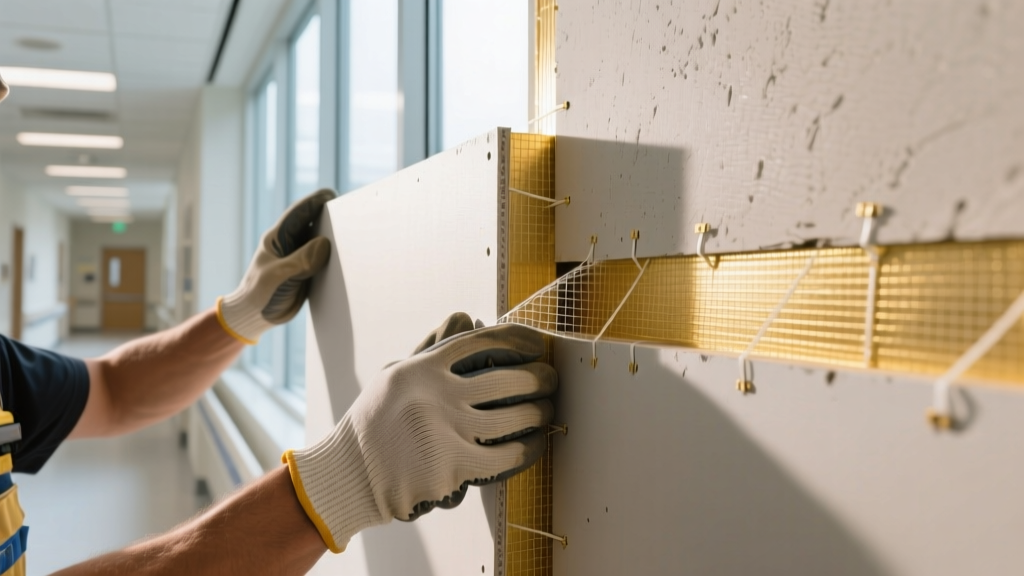
Specifying wall assemblies for high-traffic, moisture-prone commercial environments requires a material that bridges the gap between structural resilience and environmental resistance. Gold Bond XP Hi-Impact gypsum board, manufactured by National Gypsum, achieves this through a dual-action core architecture. Unlike standard Type X boards that rely solely on glass fibers mixed into the gypsum slurry for fire resistance, this product integrates a continuous, heavy-duty fiberglass mesh directly into a high-density, polymer-modified gypsum core.
The "XP" designation indicates that the core and the heavy-duty fiberglass mat facers are treated for moisture and mold resistance, achieving a score of 10 (the highest possible) when tested in accordance with ASTM D3273. This makes it fundamentally different from paper-faced impact boards, which can wick moisture and degrade in humid corridors or mechanical chase enclosures. The embedded mesh acts as a tensile catch-net, preventing through-penetration from localized hard-body impacts while maintaining the dimensional stability required for stringent fire-rated assemblies.
- Core Type: High-density, moisture-resistant, polymer-modified
- Reinforcement: Continuous embedded fiberglass mesh
- Facer Material: Heavy-duty fiberglass mat (front and back)
- Standard Thickness: 5/8 in. (15.9 mm)
- Edge Profile: Tapered long edges, square short ends
Dimensional Tolerances and Available Sizes
Procurement and framing layout depend on strict adherence to dimensional tolerances. Gold Bond XP Hi-Impact is manufactured to meet or exceed the requirements of ASTM C1629 and ASTM C1658 (Standard Specification for Fiberglass Mat Water-Resistant Gypsum Panel Products). The high-density core increases the overall weight of the panel, which must be factored into structural loading and labor handling calculations.
| Dimension / Property | Specification | Tolerance / Variance |
|---|---|---|
| Thickness | 5/8 in. (15.9 mm) | ± 1/32 in. (0.8 mm) |
| Width | 48 in. (1220 mm) | ± 1/8 in. (3 mm) |
| Lengths Available | 8 ft, 9 ft, 10 ft, 12 ft | ± 1/4 in. (6 mm) |
| Weight (Nominal) | 2.25 lbs / sq. ft. | ~72 lbs per 4x8 sheet |
| Thermal Resistance (R-Value) | 0.56 (at 5/8 in.) | Tested per ASTM C518 |
Performance Standards and Testing Classifications
The primary differentiator for this product is its abuse and impact resistance. Standard gypsum board fails rapidly under localized kinetic energy. To quantify resilience, the industry relies on ASTM C1629, which classifies panels into distinct performance tiers based on four specific stress tests.
Decoding ASTM C1629 Impact Categories
- Surface Abuse (Indentation & Abrasion): Tests the facer and outer core density against scraping and blunt denting. The fiberglass mat facer on the XP Hi-Impact board prevents the surface tearing commonly seen in paper-faced boards when subjected to cart traffic or luggage scraping.
- Soft-Body Impact: A 60-pound leather bag is swung as a pendulum into the panel to simulate a person falling against or being pushed into the wall. Gold Bond XP Hi-Impact achieves Level 3 classification, absorbing significant kinetic energy without structural core fracture.
- Hard-Body Impact: A 16-pound steel sphere is dropped or swung against the panel to simulate concentrated strikes from equipment, stretchers, or vandalism. The embedded fiberglass mesh distributes the point-load across a wider area of the high-density core, achieving Level 2 or 3 penetration resistance.
- Fire Resistance: While not an impact metric, the board's core formulation allows it to be used in various 1-hour and 2-hour fire-rated assemblies. Designers can verify specific UL designs via the UL Product iQ database using the manufacturer's classification codes.
"When specifying abuse-resistant panels, architects frequently confuse surface indentation resistance with through-penetration resistance. The embedded mesh in hi-impact boards specifically targets the latter, ensuring that a localized hard-body strike does not compromise the acoustic or fire-rating integrity of the partition."
2026 Market Pricing and Procurement Guide
Premium abuse-resistant panels carry a significant cost premium over standard commercial drywall, driven by the polymer modifiers, fiberglass mesh manufacturing process, and specialized mat facers. As of early 2026, supply chain stabilization has normalized lead times, but raw material costs for fiberglass and high-grade gypsum keep prices elevated.
| Product Comparison | Est. Cost per 4x8 Sheet (2026) | Cost per Sq. Ft. |
|---|---|---|
| Standard 5/8" Type X (Paper-faced) | $22.00 - $26.00 | $0.68 - $0.81 |
| Standard 5/8" XP (Moisture/Mold) | $34.00 - $40.00 | $1.06 - $1.25 |
| Gold Bond XP Hi-Impact (5/8") | $68.00 - $82.00 | $2.12 - $2.56 |
| Extreme Impact / Shaftliner (1" or specialized) | $110.00 - $145.00 | $3.43 - $4.53 |
Note: Pricing reflects bulk commercial pallet quantities (typically 50-70 sheets per pallet). Small-quantity retail purchases at big-box stores will incur a 20-30% markup. Always factor in a 5-8% waste allowance for complex corridor cuts and mechanical penetrations.
Installation Parameters and Fastening Schedules
The impact resistance of the board is entirely dependent on the rigidity of the underlying framing and the fastening schedule. A high-density panel mounted to flexible or improperly spaced studs will transfer impact energy into fastener pull-through rather than absorbing it through core compression. Installation must strictly follow Gypsum Association GA-216 guidelines, adapted for high-density abuse-resistant panels.
Framing and Fastening Requirements
- Framing Gauge: Minimum 20-gauge (0.033 in. design thickness) steel studs are mandatory for hi-impact applications. 16-gauge is highly recommended for corridors subject to heavy cart traffic (e.g., hospital gurneys, hotel luggage carts).
- Stud Spacing: 16 inches on center (o.c.) is the standard maximum. Do not frame at 24 inches o.c. for hi-impact boards, as the increased weight and impact loads will cause fastener fatigue and joint ridging.
- Fastener Type: Use only corrosion-resistant, bugle-head drywall screws specifically rated for high-density and fiberglass-faced boards. Standard coarse-thread screws may strip the dense core or fail to seat properly without tearing the fiberglass mat.
- Screw Spacing: Maximum 12 inches o.c. on vertical edges and 12 inches o.c. in the field. For severe abuse zones (e.g., below 48 inches from the floor in school hallways), reduce field spacing to 8 inches o.c.
- Adhesive Application: Applying a continuous bead of acoustical sealant or specialized drywall adhesive to the stud face before panel application significantly reduces drumming effects and increases overall assembly rigidity.
Decision Matrix: When to Specify Hi-Impact XP
Over-specifying abuse-resistant board inflates project budgets unnecessarily, while under-specifying leads to premature lifecycle maintenance costs. Use the following matrix to determine if Gold Bond XP Hi-Impact is the correct material for your specific zone.
| Application Zone | Moisture Risk? | Impact Risk Level | Recommended Specification |
|---|---|---|---|
| Standard Office Interiors | Low | Low | Standard 5/8" Type X |
| Commercial Restrooms / Kitchens | High | Low/Medium | Standard Gold Bond XP (No mesh) |
| Hospital Corridors / Stairwells | Medium (Cleaning) | High (Gurneys/Carts) | Gold Bond XP Hi-Impact |
| School Hallways (Below 4ft) | Medium | Extreme (Vandalism) | XP Hi-Impact + Polycarbonate guards |
| Elevator Shafts / Mechanical Chases | Variable | High (Equipment) | 1" Shaftliner or Extreme Impact |
By aligning the specific kinetic and environmental threats of a space with the engineered properties of Gold Bond XP Hi-Impact gypsum board, project teams can optimize lifecycle durability without defaulting to more expensive masonry or specialized cementitious wall systems.
Written by
Elena RodriguezElena Rodriguez is a civil engineer and technical writer specializing in concrete technology, masonry systems, and ASTM/ACI compliance. She earned her B.S. in Civil Engineering from Texas A&M University and spent a decade at a materials testing laboratory, performing over 2,000 concrete compressive strength tests and masonry prism evaluations. Elena is an ACI-certified Field Testing Technician (Grade I) and a member of ASTM Committee C12 on Natural Building Stone. She currently consults on forensic engineering cases involving concrete failures and moisture intrusion. Based in San Antonio, TX, Elena is a proud member of the Society of Women Engineers (SWE) and coaches her daughter's FIRST Robotics team.
More from Elena Rodriguez
View all
Walls & Panels
Cost Analysis: Light Gauge Steel Framing Advantages and Disadvantages
Evaluate light gauge steel framing advantages and disadvantages through a strict cost analysis lens, comparing material, labor, and lifecycle expenses.
Aug 4, 2026

Walls & Panels
Gypsum Board Types: Exact Specifications, Thickness & Dimensions
Compare standard, Type X, and moisture-resistant gypsum board types. Get exact specifications, thicknesses, dimensions, and ASTM standards for your project.
Aug 4, 2026

Fire Resistance
Best Fire-Resistant Outdoor Decking Materials: 2026 Buyer Guide
Discover the best fire-resistant outdoor decking materials for 2026. Compare Class A PVC, aluminum, and hardwood options for WUI compliance and safety.
Aug 4, 2026