Cedar Shake Roof Cost Calculator & Pricing Guide 2026
Calculate cedar shake roofing costs for 2026. Get exact material prices, labor rates, waste factors, and estimator formulas for Certi-Shake roofs.
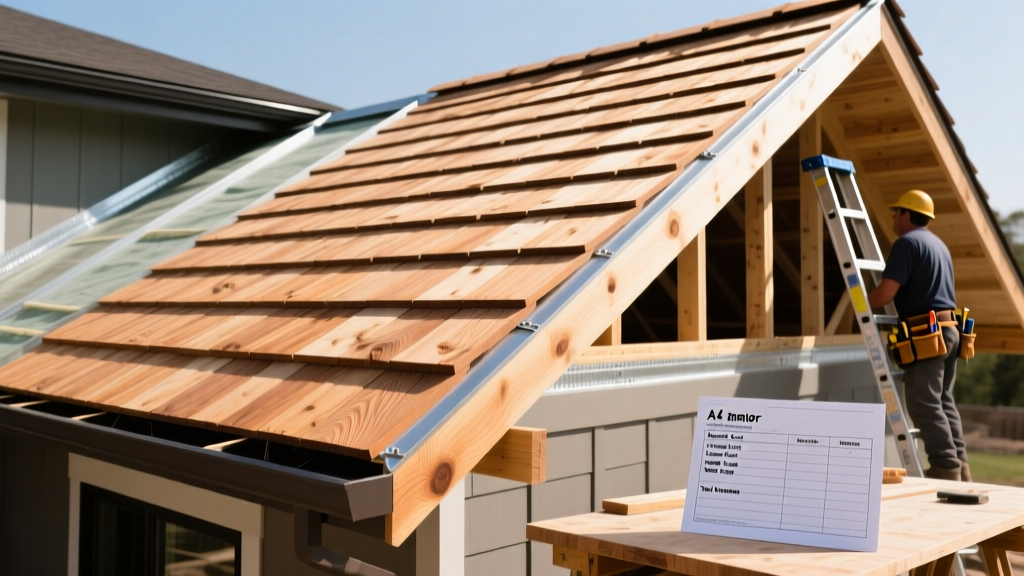
The True Cost of Cedar Shake Roofing in 2026
Estimating a cedar shake roof requires moving beyond basic square-footage multipliers. Unlike asphalt shingles, wood roofing costs are heavily dictated by roof pitch, weather exposure lengths, and the specific grade of cedar selected. In 2026, the national average for a professionally installed cedar shake roof ranges from $14.50 to $22.00 per square foot, translating to $14,500 to $22,000 for a standard 1,000-square-foot roof area (10 squares).
According to the Cedar Shake & Shingle Bureau (CSSB), the longevity and structural performance of the roof depend entirely on proper installation techniques, specifically the use of breathable underlayment systems and correct fastener placement. This guide provides the exact formulas, material tiers, and hidden cost factors required to build an accurate estimator for your project.
Material Quantity Calculator: Bundles and Exposure
Cedar shakes are not sold by the square foot; they are sold in bundles. The number of bundles required to cover one "square" (100 square feet) fluctuates based on the weather exposure—the portion of the shake left visible after the next course is applied. Standard 18-inch Certi-Split shakes require different bundle counts than 24-inch Resawn shakes.
Bundle Coverage Matrix by Exposure Length
| Shake Type & Length | Weather Exposure | Bundles per Square (100 sq ft) | Estimated Material Cost per Square |
|---|---|---|---|
| 18" Certi-Split (Hand-split) | 5.0 inches | 4.0 bundles | $420 - $520 |
| 18" Certi-Split (Hand-split) | 5.5 inches | 3.6 bundles | $378 - $468 |
| 24" Resawn Shake | 7.5 inches | 4.0 bundles | $580 - $740 |
| 24" Resawn Shake | 10.0 inches | 3.0 bundles | $435 - $555 |
| 24" Tapersawn Shake | 8.5 inches | 3.5 bundles | $610 - $780 |
Never estimate a wood roof using flat footprint dimensions. You must apply a pitch multiplier to account for the increased surface area of sloped planes and the slower installation pace on steep roofs. Use these multipliers for your base area calculations:
- 4/12 to 6/12 pitch: Multiply flat area by 1.05
- 7/12 to 9/12 pitch: Multiply flat area by 1.15
- 10/12 to 12/12 pitch: Multiply flat area by 1.30
Cost Breakdown: Material vs. Labor Tiers
Labor for cedar shakes is significantly higher than composite or asphalt alternatives. Installers must hand-split, align, and nail each piece individually, ensuring joints are offset by at least 1.5 inches between courses. The National Roofing Contractors Association (NRCA) notes that specialized wood roofing contractors often charge a 30% to 50% premium over standard roofing labor rates due to the artisan skill required.
2026 Installed Cost Tiers
| Material Grade | Material Cost (per sq ft) | Labor Cost (per sq ft) | Total Installed Cost |
|---|---|---|---|
| #2 Red Label (Allows flat grain/sapwood) | $4.00 - $5.50 | $7.50 - $9.50 | $11.50 - $15.00 |
| #1 Blue Label (100% edge grain, heartwood) | $6.00 - $8.50 | $8.50 - $11.50 | $14.50 - $20.00 |
| Premium Tapersawn (Sawn both sides, thick butt) | $8.00 - $11.00 | $9.00 - $12.00 | $17.00 - $23.00 |
Hidden System Costs: Underlayment and Fasteners
The most common failure point in cedar shake estimation is ignoring the critical ventilation and fastening subsystems. Cedar is highly susceptible to moisture trapping, which leads to cupping, splitting, and fungal decay.
The CedarBreather Requirement
Installing shakes directly over solid decking or standard felt paper is a critical error in modern building science. You must budget for a 3D mesh underlayment, such as CedarBreather or KeeneVent. This creates a continuous air space between the decking and the shakes, allowing moisture to escape and preventing the bottom of the shakes from rotting. Budget an additional $1.10 to $1.60 per square foot for this mesh system, including the specialized cap nails required to secure it.
Fastener Specifications
Cedar contains high levels of tannic acid, which will rapidly corrode standard galvanized nails, causing black streaks and structural failure. Your estimator must include:
- Standard Environments: Hot-dipped galvanized nails (minimum 1.5" for 18" shakes, 2" for 24" shakes).
- Coastal/Salt-Air Environments: Type 304 or Type 316 Stainless Steel nails. Budget an extra $0.45 per square foot for stainless fasteners.
- Application Rule: Exactly two fasteners per shake, placed 1 inch from each edge and 2 inches above the exposure line.
Step-by-Step Estimation Framework
To build a comprehensive bid, follow this sequential calculation flow:
- Calculate Base Area: Measure the footprint of the home and multiply by the pitch factor.
- Add Waste Factor: Add 10% for standard gable roofs, or 15% for complex roofs with multiple valleys, dormers, and hips. Wood shakes require significant on-site trimming and sorting to discard defective pieces.
- Determine Squares: Divide the total adjusted area by 100.
- Calculate Bundles: Multiply total squares by the bundle-per-square ratio based on your chosen weather exposure (see matrix above).
- Compute Subsystem Costs: Add decking prep, synthetic underlayment, cedar breather mesh, stainless steel flashing, and fasteners.
- Apply Labor Multipliers: Add 15% to labor costs if the roof features a pitch steeper than 9/12 or requires extensive scaffolding.
Lifecycle Cost and Maintenance Realities
While the upfront cost of a #1 Blue Label cedar shake roof is high, the lifecycle value shifts when factoring in longevity. According to research on wood durability by the USDA Forest Products Laboratory, old-growth heartwood cedar possesses natural extractives (thujaplicins) that act as potent fungicides and insect repellents.
Expert Insight: A properly ventilated #1 Blue Label cedar shake roof with a 5-inch exposure will last 40 to 50 years in dry climates, and 25 to 30 years in humid or coastal environments. However, this requires a maintenance budget of $0.15 per square foot annually for debris removal and occasional moss treatment (using zinc-based solutions, avoiding copper which reacts with tannins).
When to Avoid Cedar Shakes
Do not specify cedar shakes if the project is located in a strict Wildland-Urban Interface (WUI) zone with active fire codes, unless you are budgeting for factory-applied Class C or Class B fire-retardant pressure treatments. Note that fire-retardant treatments can reduce the natural lifespan of the wood by accelerating moisture absorption if the chemical coating degrades over time. In high-fire-risk zones, consider stamped metal roofing or composite polymer shakes as a more code-compliant and insurable alternative.