What Are Different Types of Wood? A Structural Grading Guide
Learn what are different types of wood through a structural grading lens. Compare softwood, hardwood, and engineered lumber grades for construction.

The Core Question: What Are Different Types of Wood in Construction?
When builders and architects ask, "what are different types of wood," the answer extends far beyond simple species identification. In structural and architectural construction, wood types are categorized and regulated by rigorous grading systems that dictate their load-bearing capacity, moisture content, and visual yield. Understanding these classifications is critical for ensuring structural integrity, optimizing material costs, and passing municipal inspections.
According to the American Wood Council's National Design Specification (NDS), the structural capacity of a wood member is directly tied to its species, grade, and moisture condition at the time of fabrication. Misinterpreting a grade stamp or substituting a visually graded stud for a machine stress-rated (MSR) component can lead to catastrophic deflection or fastener withdrawal failures.
Softwood Dimensional Lumber: Visual vs. Machine Grading
Softwoods—primarily Spruce-Pine-Fir (SPF), Douglas Fir-Larch (DF-L), and Southern Yellow Pine (SYP)—dominate light-frame construction. These materials are graded using two distinct methodologies: visual inspection and machine evaluation.
Visual Stress Grades
Visual grading relies on trained inspectors evaluating the size, location, and frequency of strength-reducing characteristics like knots, splits, and wane. The primary structural grades for light framing (2x2 through 4x4) include:
- Select Structural: The highest visual grade. Maximum allowable knots are small and widely spaced. Used for critical load-bearing applications where maximum bending strength is required. Expect a 30% to 45% price premium over standard grades.
- No. 1: Excellent for general framing, trusses, and rafters. Knots are larger than Select Structural but tightly sound.
- No. 2: The industry workhorse for wall studs, joists, and plates. Allows larger knots and minor wane. In the 2026 market, SPF No. 2 typically hovers around $450 to $550 per thousand board feet (MBF).
- No. 3, Standard, and Utility: Restricted to non-load-bearing applications, temporary bracing, or blocking. Never use these for primary structural framing.
Machine Stress-Rated (MSR) and Machine Evaluated Lumber (MEL)
For engineered applications like roof trusses and floor joists, visual grading lacks the precision required. MSR lumber is mechanically tested by applying a bending force to every single piece, measuring its stiffness. This generates a specific grade designation, such as 1950f-1.7E or 2400f-2.0E.
In a "2400f-2.0E" designation:
• 2400f: The allowable extreme fiber in bending (Fb) is 2,400 psi.
• 2.0E: The average Modulus of Elasticity (MOE or stiffness) is 2,000,000 psi.
Pro Tip: Never substitute visually graded No. 2 lumber in a truss design specifically engineered for 1950f-1.7E MSR lumber. The visual grade lacks the guaranteed stiffness, leading to bouncy floors or sagging rooflines.
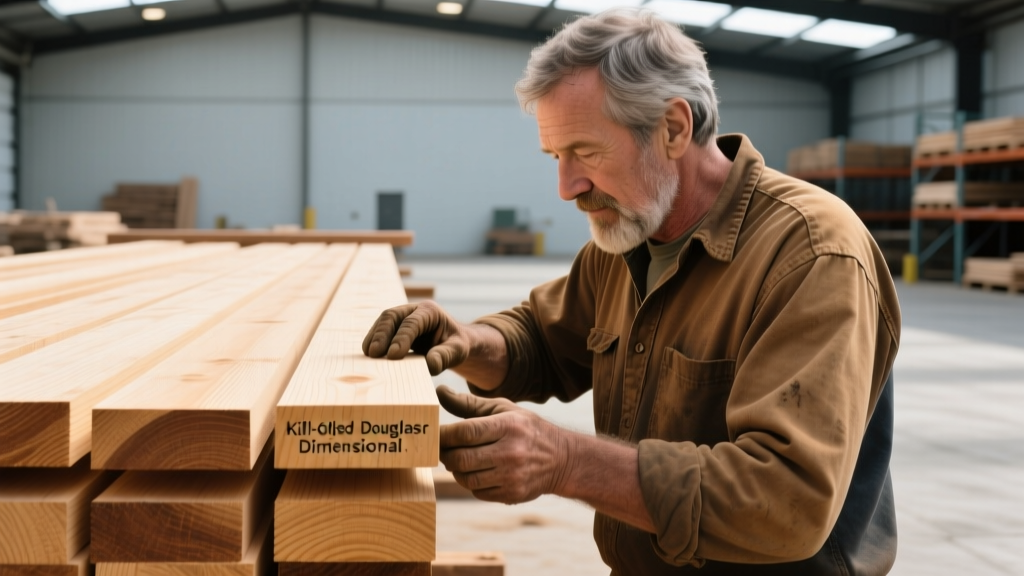
Hardwood Lumber: The NHLA Yield-Based System
When the question of "what are different types of wood" shifts to interior millwork, cabinetry, and flooring, hardwoods (Oak, Maple, Walnut, Cherry) take precedence. Unlike softwoods, hardwoods are not graded for structural strength. Instead, the Forest Products Laboratory and the National Hardwood Lumber Association (NHLA) grade hardwoods based on the percentage of clear, defect-free cuttings that can be yielded from a board.
| NHLA Grade | Minimum Clear Yield | Minimum Board Size | Primary Application |
|---|---|---|---|
| FAS (Firsts and Seconds) | 83.3% | 6" wide x 8' long | High-end architectural millwork, solid hardwood flooring, premium furniture. |
| Select | 83.3% (one face) | 4" wide x 6' long | Cabinet face frames, shorter clear mouldings. |
| No. 1 Common | 66.6% | 3" wide x 4' long | Standard cabinetry parts, furniture components (kitchen cabinet standard). |
| No. 2A Common | 50% | 3" wide x 4' long | Pallets, rustic flooring, small utility parts. |
Engineered Wood Products (EWP): Performance-Rated Grades
Modern construction increasingly relies on Engineered Wood Products to span longer distances and carry heavier loads than traditional sawn lumber. According to APA – The Engineered Wood Association, EWPs are graded by performance and manufacturing process rather than natural growth characteristics.
Laminated Veneer Lumber (LVL) and Glulam
LVL is manufactured by laminating thin wood veneers with parallel grains, creating a product with highly predictable structural properties. LVL grades are designated by their bending stress (Fb) and modulus of elasticity (E). For example, a standard 1.9E LVL has an MOE of 1.9 million psi, while high-capacity 2.4E or 2.8E LVLs are specified for heavy commercial headers and long-span floor beams.
Glued Laminated Timber (Glulam) utilizes thicker dimension lumber laminations. Glulam is graded into combinations (e.g., 24F-V8 for Douglas Fir), where the outer tension laminations are assigned a higher visual or MSR grade than the inner core laminations, optimizing cost without sacrificing bending strength.
"The most common failure in residential engineered floor systems is not the joist itself, but the mismatch between the I-joist flange grade and the bearing stiffeners. Always verify the manufacturer's specific reaction capacity tables before omitting web stiffeners at bearing points."
Moisture Content Designations: The Hidden Grade Modifier
A wood species and grade stamp are incomplete without the moisture content (MC) designation. Wood is hygroscopic; it swells when absorbing moisture and shrinks when drying. The NDS mandates specific design value adjustments based on MC at the time of installation.
- S-GRN (Surfaced Green): Moisture content is 19% or higher. The lumber will shrink significantly as it acclimates, potentially causing nail pops, drywall cracks, and structural settling. Design values are penalized.
- S-DRY (Surfaced Dry): Moisture content is 19% or less at the time of surfacing. This is the standard for most interior framing lumber.
- MC-15 (Moisture Content 15%): Moisture content is 15% or less. Required for high-end interior millwork, hardwood flooring installation, and exposed timber framing where dimensional stability is paramount.
Practical Selection Framework for Builders
To synthesize the different types of wood and their respective grades into actionable procurement decisions, utilize this framework:
- Exterior Load-Bearing Walls: Specify No. 2 or better DF-L or SYP, S-DRY. The higher specific gravity of these species provides superior fastener withdrawal resistance for shear wall nailing schedules.
- Pre-Fabricated Roof Trusses: Mandate 1950f-1.7E or 2400f-2.0E MSR lumber for chords. Visual grades introduce unacceptable variability in truss deflection calculations.
- Long-Span Headers (over 6 feet): Abandon sawn lumber. Specify 1.9E or 2.0E LVL to prevent long-term creep and sagging under sustained dead loads.
- Interior Paint-Grade Millwork: Procure MDF or paint-grade finger-jointed pine. Do not waste budget on FAS hardwoods for painted surfaces.
- Interior Stain-Grade Millwork: Specify NHLA FAS or Select grade hardwoods, strictly kiln-dried to MC-15 to prevent joint separation post-installation.
By mapping the specific structural or aesthetic requirement to the precise grading standard—whether visual, machine-stressed, or yield-based—construction professionals eliminate material waste, prevent structural callbacks, and ensure strict compliance with building codes.
Written by
Sarah WhitfieldSarah Whitfield is a chartered quantity surveyor (MRICS) and construction cost analyst with 15 years of experience in material pricing, procurement strategy, and project budgeting. She earned her degree in Construction Management from the University of Reading (UK) and has worked on projects ranging from $2M custom homes to $180M mixed-use developments across North America and Europe. Sarah currently leads cost estimating for BuildMat Insight, maintaining a proprietary database of 4,000+ material price points updated quarterly. She is a frequent contributor to RSMeans cost data panels and has presented at the International Cost Engineering Council (ICEC) congress. Based in Denver, CO, Sarah is an avid trail runner and volunteer mentor for Women in Construction.
More from Sarah Whitfield
View all
Wood & Lumber
What Are the Different Types of Wood? A Builder's Guide
Compare structural softwoods, finish hardwoods, and engineered lumber. Analyze Janka ratings, MOE values, and 2026 pricing for construction.
Aug 4, 2026

Walls & Panels
Steel Framing vs Wood Framing: Corrosion and Moisture Defense
Compare steel framing vs wood framing for moisture resistance. Learn about galvanized coatings, condensation risks, and corrosion protection strategies.
Jul 21, 2026

Stone & Masonry
How to Cut Stone Veneer: Wet Saw vs Grinder Comparison
Compare the best tools for cutting stone veneer. We review wet saws, angle grinders, and chop saws to help you achieve clean, chip-free cuts.
Jul 21, 2026