The Best Type of Wood for a Cutting Board: A Grade & Quality Guide
Discover the best type of wood for a cutting board based on Janka hardness, lumber grades, grain orientation, and food-safe toxicity standards.

The Science of Cutting Board Lumber: Hardness and Grain
When evaluating the best type of wood for a cutting board, the selection process extends far beyond simple aesthetics. Professional woodworkers and culinary experts rely on a strict matrix of Janka hardness, cellular structure, and lumber grading to determine a species' viability. The ideal cutting board material must resist knife scarring—which harbors pathogenic bacteria—while remaining soft enough to preserve the micro-serrations of high-carbon steel blades.
Top Tier: The Best Type of Wood for a Cutting Board
To meet commercial and high-end residential standards, lumber must be diffuse-porous, meaning the wood's pores are evenly distributed and relatively small. This prevents moisture and food particles from penetrating the surface. Below is a comparison of the premier species used in premium board manufacturing.
| Wood Species | Janka Hardness (lbf) | Cellular Structure | Est. Cost per BF (2026) | Best Application |
|---|---|---|---|---|
| Hard Maple (Acer saccharum) | 1,450 | Diffuse-porous | $6.50 - $9.00 | Heavy-duty end-grain blocks |
| Black Walnut (Juglans nigra) | 1,010 | Diffuse-porous | $12.00 - $16.00 | Edge-grain aesthetic boards |
| Teak (Tectona grandis) | 1,000 | Ring-porous (high silica) | $25.00 - $35.00 | High-moisture environments |
| Cherry (Prunus serotina) | 950 | Diffuse-porous | $8.00 - $11.00 | Light-duty charcuterie boards |
Hard Maple: The Industry Standard
Hard Maple remains the undisputed champion of commercial kitchens. Its tight grain structure and high hardness (1,450 lbf) provide a self-healing surface when cut into end-grain orientations. Furthermore, maple contains natural antimicrobial properties; as the wood fibers absorb moisture, they swell and trap bacteria, which then die off as the board dries out.
Black Walnut: The Premium Choice
Valued for its rich, dark chocolate heartwood, Black Walnut offers a slightly softer cutting surface (1,010 lbf) that is exceptionally gentle on Japanese high-carbon knives. Because walnut is highly dimensionally stable, it is less prone to warping during seasonal humidity shifts compared to maple, making it ideal for large, edge-grain serving and prep boards.
Teak: The High-Moisture Specialist
While technically ring-porous, plantation-grown Teak is heavily utilized in marine and high-humidity kitchen environments due to its high natural oil and silica content. However, the silica content (up to 1.4%) acts as an abrasive, meaning teak boards will dull knives faster than maple or walnut. It is best reserved for carving boards or wet-prep stations rather than daily vegetable chopping.
Grain Orientation Physics: End-Grain vs. Edge-Grain
The way the lumber is milled dictates the board's longevity, maintenance requirements, and cutting feel. Understanding wood anatomy is critical when specifying the best type of wood for a cutting board.
- End-Grain (Premium): The board is constructed by gluing blocks of wood with the growth rings facing up. When a knife strikes the surface, it slips between the vertical wood fibers (tracheids) rather than severing them. This creates a self-healing effect that hides cut marks and preserves knife edges. Drawback: Requires 30% more mineral oil maintenance and costs 2x to 3x more to manufacture.
- Edge-Grain (Standard): Long strips of wood are glued together with the edge of the board facing up. This provides excellent structural stability and resists warping. It is the most cost-effective and durable option for high-volume commercial prep tables.
- Face-Grain (Aesthetic Only): The wide face of the board is used as the cutting surface. While this showcases the most dramatic cathedral grain patterns, it is the weakest orientation. Knives easily scar the surface, and the board is highly susceptible to cupping if exposed to uneven moisture.
Lumber Grades and Moisture Content: What to Specify
Even the correct wood species will fail if the lumber grade and moisture content are improperly specified. Cutting boards require premium hardwood grades to ensure structural integrity during the intense clamping and gluing phases of manufacturing.
According to the Penn State Extension hardwood grading guidelines, FAS (Firsts and Seconds) grade lumber requires a minimum board size of 4 inches by 5 feet, yielding at least 83% clear-face cuttings. This is mandatory for end-grain blocks to ensure the vertical straws are continuous and free of internal knots, which can harbor moisture and cause delamination.
For edge-grain boards, Select or 1 Common grades can be utilized, as the shorter clear cuttings (minimum 3 inches by 4 feet) can be ripped into long strips and edge-glued. However, the most critical specification is Moisture Content (MC). Lumber must be kiln-dried to an interior Equilibrium Moisture Content (EMC) of 6% to 8%. Air-dried lumber, which typically sits at 12% to 15% MC, will inevitably warp, crack, or delaminate when introduced to a climate-controlled kitchen or subjected to repeated washing.
Woods to Avoid: Toxicity and Porosity Risks
Not all hardwoods are safe or practical for food contact. Exotic woods, while visually striking and highly durable, often pose significant health and sanitation risks.
Species like Red Oak and Ash are ring-porous, meaning they have large, open vessels in the earlywood that act like microscopic drinking straws. These large pores readily absorb meat juices and bacteria, making them impossible to fully sanitize. While White Oak is sealed by tyloses (making it suitable for whiskey barrels), it is still generally avoided for cutting boards due to its high tannin content, which can react with carbon steel knives and cause black staining.
Furthermore, wood toxicity is a major concern when dealing with exotic imports. The Wood Database toxicity index notes that many rosewoods (Dalbergia genus) and exotic species like Purpleheart and Cocobolo contain natural sensitizers and irritants. While the risk of ingesting these toxins via food prep is low, the dust generated during the manufacturing process is highly hazardous, and acidic foods can potentially leach compounds from the wood surface over time.
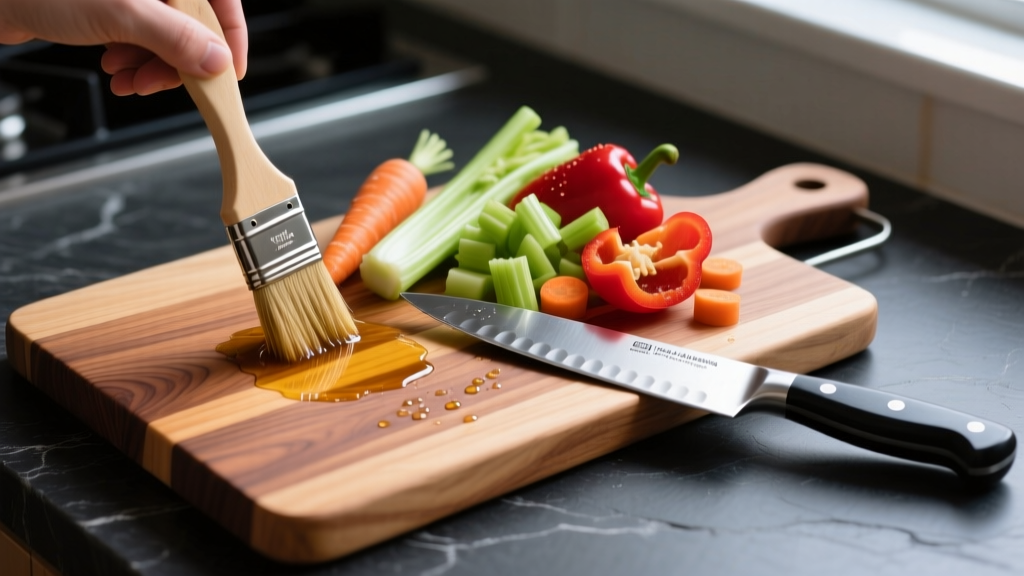
Maintenance and Finish: Food-Safe Oils and Waxes
The longevity of a cutting board relies entirely on its finish. Unsealed wood will absorb ambient moisture, leading to bacterial growth and structural failure. However, not all finishes are appropriate for culinary use.
The industry standard is USP-grade (food-safe) mineral oil, often blended with carnauba or beeswax to create a physical barrier on the surface. Mineral oil is an inert, non-drying hydrocarbon that will never oxidize or turn rancid. For premium boards, specialized board creams containing fractionated coconut oil (which has had the long-chain triglycerides removed to prevent rancidity) and beeswax offer superior water beading and a smoother tactile feel.
Summary: Specifying the Right Board
To specify the best type of wood for a cutting board, prioritize diffuse-porous domestic hardwoods like Hard Maple or Black Walnut. Ensure the lumber is FAS or Select grade, kiln-dried to 6-8% MC, and milled into an end-grain or edge-grain orientation. By adhering to these material science principles and avoiding ring-porous or toxic exotic species, you guarantee a sanitary, knife-friendly, and structurally permanent culinary surface.
Written by
David NakamuraDavid Nakamura is a licensed architect (AIA) and construction technology writer focused on sustainable building methods, mass timber engineering, and high-performance building envelopes. He holds a Master of Architecture from the University of Washington and is a certified Passive House Consultant (CPHC). David spent eight years at the Seattle firm Mithun, where he led the design of three LEED Platinum projects, before founding his own practice specializing in net-zero residential design. He serves on the editorial advisory board of GreenBuilder Magazine and has authored peer-reviewed papers on cross-laminated timber (CLT) connections for the Journal of Structural Engineering. In his spare time, David teaches woodworking at Pratt Fine Arts Center and kayaks the Puget Sound.
More from David Nakamura
View all
Construction Cost
Labor Cost to Build a Deck Per Sq Ft: 2026 Installation Guide
Discover the exact labor cost to build a deck per sq ft in 2026. This installation guide breaks down contractor rates, complexity factors, and hidden fees.
Aug 4, 2026

Construction Cost
How Much Does It Cost to Build a 3 Bedroom House? Financing Guide
Learn exactly how much it costs to build a 3 bedroom house and explore 2026 financing options, construction loan types, and budget frameworks for your build.
Aug 4, 2026

Construction Cost
Cost to Build a Tennis Court: 2026 Guide
How much does it cost to build a tennis court in 2026? Breakdowns for asphalt, concrete, and synthetic surfaces plus fencing and lighting.
Jul 30, 2026