Timber Christmas Tree Lumber Cost & Quantity Calculator 2026
Calculate exact lumber quantities, fastener counts, and 2026 material costs for building a custom DIY timber Christmas tree with our estimator guide.
Geometric Cut List & Linear Footage Formulas
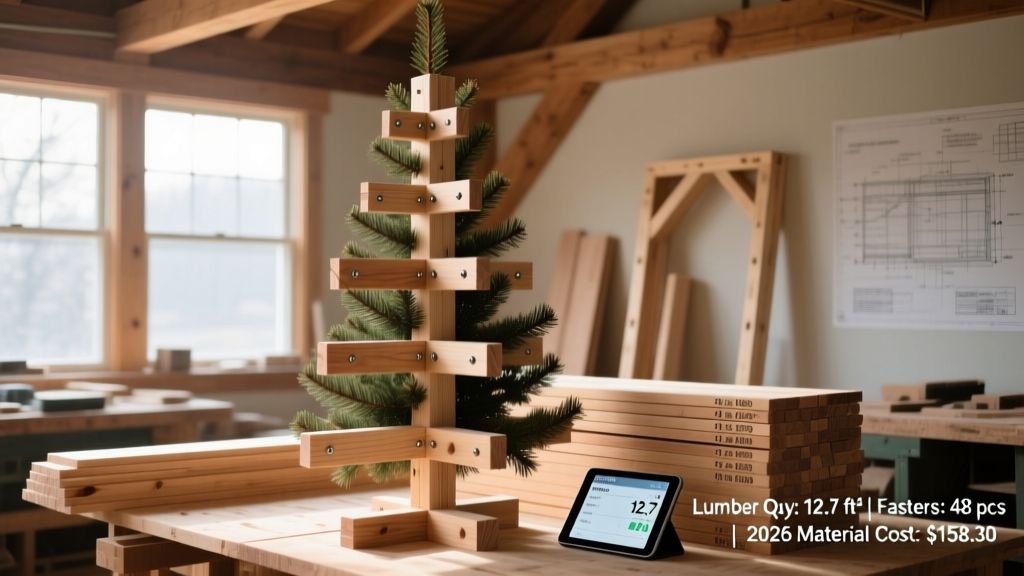
Building a structural timber Christmas tree requires moving beyond basic craft supplies and treating the project as a light framing exercise. A standard freestanding geometric tree utilizes a central vertical spine with horizontal or angled branching tiers. To estimate your lumber accurately, you must calculate the linear footage (LF) based on the tiered geometry rather than guessing at board counts.
For a standard 6-foot tall tree with a 4x4 central spine and 2x4 horizontal branches spaced every 12 inches, the math follows a predictable taper. If the bottom tier spans 48 inches wide and each subsequent tier narrows by 12 inches, your branch lengths are calculated as half the total tier width (since they extend from the center spine).
- Tier 1 (Base): 48" total width = two 24" branches
- Tier 2: 36" total width = two 18" branches
- Tier 3: 24" total width = two 12" branches
- Tier 4: 12" total width = two 6" branches
Total branch linear footage equals 10 feet. Add the 6-foot central spine, and your base requirement is 16 LF of dimensional lumber. However, you must apply a 15% waste factor for miter cuts, kerf loss, and end-squaring, bringing the total required lumber to 18.4 LF. Purchasing three 8-foot 2x4 boards (24 LF total) provides ample material for the branches and allows for mistakes.
2026 Lumber Species & Pricing Matrix
Material selection drastically alters both the aesthetic and the budget. While SPF (Spruce-Pine-Fir) is the standard for hidden structural framing, a timber Christmas tree is fully exposed, making grain pattern and natural decay resistance critical. Below is the 2026 pricing matrix for the most common species used in custom timber holiday displays.
| Species | Grade | Nominal Size | Avg. Cost per LF (2026) | Best Application |
|---|---|---|---|---|
| SPF (Spruce-Pine-Fir) | #2 Common | 2x4 | $0.65 - $0.85 | Painted trees, hidden spine |
| Douglas Fir | Select Structural | 2x4 | $1.40 - $1.90 | Clear-coated indoor trees |
| Western Red Cedar | #2 Clear | 2x4 | $3.80 - $5.20 | Outdoor displays, premium indoor |
| White Oak | FAS (First & Second) | 4x4 (Spine) | $12.50 - $16.00 | Heavy timber base spines |
For a premium indoor build using Select Structural Douglas Fir, expect to spend roughly $35 to $45 on the primary framing lumber. Upgrading to Western Red Cedar for an outdoor-rated timber Christmas tree will push the lumber cost to $90 - $125 for the same 6-foot footprint.
Structural Base & Ballast Requirements
The most common failure mode in DIY timber trees is tipping. A 6-foot tree built from dense Douglas Fir can easily exceed 45 lbs, with a high center of gravity. According to structural design principles outlined by the American Wood Council, any freestanding vertical timber structure must have a base footprint wide enough to counteract lateral loads (like a pet bumping into it or pulling on heavy ornaments).
Do not mount a 6-foot timber tree directly to a single 12x12 inch base. You must engineer a cross-braced base. Use a 24x24 inch 3/4-inch plywood sub-base, or construct a timber cross-buck base using two 30-inch 4x4 runners joined with a half-lap joint. This lowers the center of gravity and increases the tipping moment arm.
To calculate the ballast requirement, assume a lateral force of 20 lbs applied at the 4-foot mark. A 24x24 inch base requires at least 15 lbs of dead weight (such as concealed sandbags or steel plates) at the perimeter to maintain a 1.5 safety factor against overturning.
Fastener & Joinery Hardware Estimator
Standard drywall screws lack the shear strength required for structural timber joints, especially when supporting the weight of heavy ornaments or integrated LED lighting arrays. For a timber Christmas tree, you must use structural screws or specialized framing anchors.
- Primary Spine-to-Base Joint: Use (4) Simpson Strong-Tie A35 framing anchors with 1.5-inch Strong-Drive SD screws. Cost: ~$8.50 per joint.
- Branch-to-Spine Connections: Use GRK R4 multi-purpose structural screws (#9 x 3-1/8"). These feature a built-in washer head and cut thread that prevents the timber from splitting without pre-drilling. Cost: ~$0.45 per screw. You will need 2 per branch (16 total for an 8-branch tree).
- Angled Bracing (Optional): If your design features 45-degree downward branch angles, use 3-inch ledger locks to prevent shear failure at the joint.
Surface Area & Finish Coverage Math
Calculating finish requirements requires determining the exact exposed surface area of the dimensional lumber. A standard 2x4 actually measures 1.5 inches by 3.5 inches. Therefore, one linear foot of 2x4 exposes 0.83 square feet of surface area (accounting for all four sides, though the back of the spine is usually hidden).
For our 18.4 LF tree build, the total exposed surface area is approximately 15.2 square feet. Premium hardwax oils, such as Osmo Polyx-Oil or Rubio Monocoat, are highly efficient. According to the USDA Forest Products Laboratory Wood Handbook, wood porosity dictates absorption rates, but modern hardwax oils typically cover 400 square feet per liter on planed softwoods.
Because you only need to cover 15.2 square feet, a single 0.125-liter (125ml) sample tin of Osmo Polyx-Oil (costing roughly $14 in 2026) is mathematically sufficient for two coats, eliminating the need to purchase a full $45 quart.
Frequently Asked Questions
How heavy is a completed 6-foot timber Christmas tree?
Weight depends on the species density. Based on standard air-dried densities, a 6-foot tree built entirely from SPF (approx. 28 lbs/ft³) will weigh roughly 22 lbs. The same design built from dense Douglas Fir (approx. 34 lbs/ft³) will weigh closer to 28 lbs, before adding the base, hardware, and decorations.
Can I use green (undried) timber for an outdoor tree?
Yes, but you must account for radial and tangential shrinkage. The USDA Forest Products Laboratory notes that wood shrinks significantly as it drops from green moisture content (30%+) to equilibrium moisture content. If building with green cedar, use slotted holes for your branch fasteners to allow the timber to shrink without snapping the structural screws.
What is the best way to integrate lighting into the timber?
Instead of wrapping wires around the branches, use a 1/4-inch Forstner bit to drill a shallow channel down the center of the spine, or route a 1/4-inch groove on the back face of the 2x4 spine using a plunge router. This hides the main power conduit while keeping the front face visually clean.