Engineered Wood Flooring Selection: Core Types & Veneer Grades
Master engineered wood flooring selection with our taxonomy of core types, veneer grades, and environmental specs to prevent cupping and delamination.
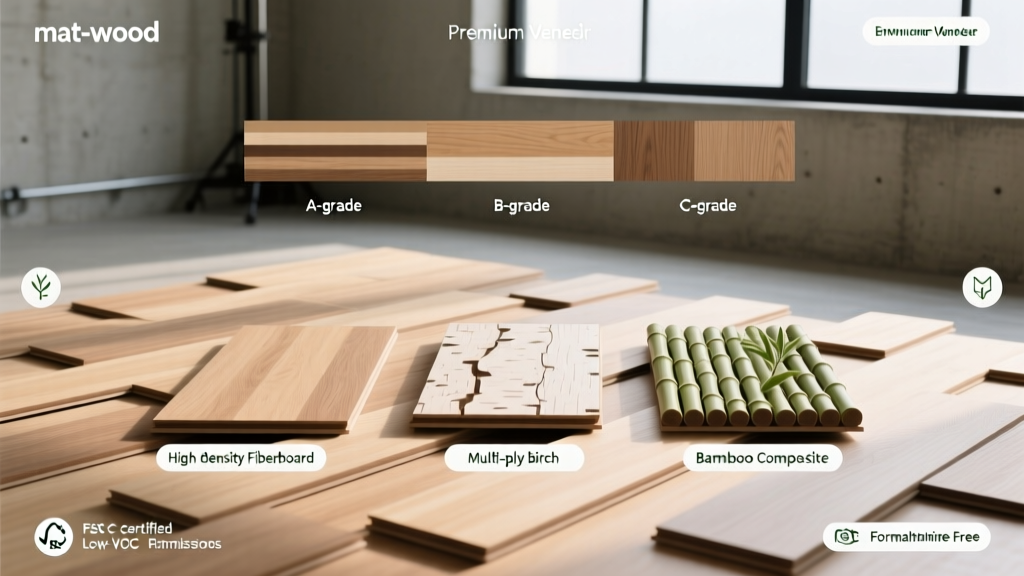
The Anatomy of Engineered Wood Flooring
Engineered wood flooring dominates the residential and commercial markets due to its superior dimensional stability compared to solid hardwood. However, the category is plagued by inconsistent terminology and vast quality disparities. To specify or purchase engineered wood correctly, you must deconstruct the product into its three primary structural layers: the wear layer (lamella), the structural core, and the balancing backing. The interaction between these layers dictates the floor's lifespan, moisture tolerance, and refinishing potential.
According to the National Wood Flooring Association (NWFA) technical guidelines, the performance of engineered wood is fundamentally governed by the thickness of the wear layer and the cross-grain tension of the core. Selecting the wrong combination for a specific subfloor or climate zone is the leading cause of post-installation failures such as edge cupping, telegraphing, and delamination.
Wear Layer Taxonomy: Sawn vs. Sliced vs. Rotary
The top veneer determines the aesthetic authenticity and the functional lifespan of the floor. Manufacturers utilize three distinct cutting methods, each yielding drastically different thicknesses and grain patterns.
| Cutting Method | Typical Thickness | Grain Appearance | Refinishing Potential | Cost Tier |
|---|---|---|---|---|
| Dry Sawn | 2.0mm – 6.0mm | Identical to solid hardwood; tight, natural grain. | 2 to 4 refinishes (depending on exact mm). | Premium |
| Sliced (Flat) | 1.0mm – 3.0mm | Similar to solid, but can exhibit latent tension fractures. | 1 to 2 refinishes (requires careful 100-grit stopping). | Mid-Tier |
| Rotary Peeled | 0.5mm – 1.5mm | Wide, cathedral grain; resembles plywood; prone to lathe checking. | 0 refinishes (sanding will burn through to core). | Budget |
Core Material Matrix: What Lies Beneath
The core provides the structural integrity and moisture resistance of the plank. The three primary core taxonomies serve entirely different environmental needs.
1. Multi-Ply Plywood Core (The Gold Standard)
Constructed from 9 to 11 cross-banded plies of birch, poplar, or eucalyptus, plywood cores offer the highest dimensional stability. The alternating 90-degree grain direction of each ply neutralizes the natural expansion and contraction of wood. This core is mandatory for environments with seasonal humidity swings (e.g., the US Northeast or Midwest) and is the only core type recommended for glue-down installations over concrete slabs.
2. High-Density Fiberboard (HDF) Core
HDF cores are heavily compressed wood fibers bonded with resin. They provide an exceptionally rigid, flat substrate that is ideal for floating click-lock installations (such as 5G fold-down profiles) over existing hard surfaces. However, HDF is highly susceptible to moisture.
3. Lumber Core (SPF Finger-Jointed)
Often found in extra-thick (3/4-inch) engineered planks, lumber cores use edge-glued, finger-jointed softwood blocks. While they mimic the feel of solid wood underfoot, they are prone to "telegraphing"—where the seams of the core blocks become visible through thin wear layers if the subfloor is not perfectly flat.
Environmental Selection Framework
Matching the engineered wood profile to the installation environment prevents catastrophic moisture-related failures.
- Below-Grade (Basements): Use floating multi-ply or HDF cores with a 6-mil polyethylene vapor barrier. Never use glue-down below grade. Maintain ambient humidity between 35% and 55%.
- On-Grade (Concrete Slabs): Use multi-ply plywood cores with a moisture-cured urethane adhesive (e.g., Bona K850 or Sika T55 J) which acts as a secondary vapor retarder. Slab moisture vapor emission rates (MVER) must be below 3 lbs per 1,000 sq ft per 24 hours (ASTM F1869).
- Above-Grade (Wood Subfloors): Any core type is acceptable. Staple/cleat nail-down installations require a minimum 5/8-inch plywood or 3/4-inch OSB subfloor.
Radiant Heat Compatibility Specs
Engineered wood is generally compatible with hydronic radiant heating systems, but strict parameters apply. The maximum surface temperature must never exceed 85°F (29°C). For optimal thermal transfer and stability, limit plank width to a maximum of 5 inches and select quarter-sawn White Oak, which possesses a high Janka hardness (1360 lbf) and exceptional cellular stability under thermal stress. Avoid Hickory and Maple over radiant heat, as their dense, interlocking grain structures are highly reactive to localized thermal expansion.
Decoding Veneer Species and Janka Hardness
The species of the wear layer dictates scratch resistance and dent tolerance. Below is a taxonomy of common engineered veneer species ranked by the Janka hardness scale, alongside their specific application recommendations.
| Wood Species | Janka Hardness (lbf) | Dimensional Stability | Best Application |
|---|---|---|---|
| Brazilian Walnut (Ipe) | 3,680 | Moderate | High-traffic commercial, pet-heavy homes. |
| Hickory | 1,820 | Low (Reactive) | Above-grade residential; avoid radiant heat. |
| White Oak | 1,360 | High | Universal application, including radiant heat. |
| European Oak | 1,120 | High | Residential, wide-plank aesthetics. |
| Black Walnut | 1,010 | Moderate | Low-traffic residential, formal areas. |
Common Failure Modes and Prevention
Edge Cupping and Washboarding
Cupping occurs when the bottom of the plank absorbs more moisture than the top, causing the edges to rise. In engineered wood, this is often caused by an inadequate balancing layer. Prevention: Specify products where the backing veneer is the same species and approximate thickness as the top wear layer to maintain symmetrical hygroscopic tension.
Delamination
Delamination is the separation of the wear layer from the core, usually manifesting as hollow spots or bubbling. This is almost exclusively an adhesive failure during manufacturing, exacerbated by high-heat environments or improper UV-cured urethane application. Prevention: Source exclusively from manufacturers utilizing cold-press or hot-press polyurethane dispersion (PUD) adhesives, and avoid exposing the floor to localized heat sources (like unventilated space heaters) exceeding 95°F.
Sourcing and Certification Checklist
To ensure indoor air quality and sustainable sourcing, verify the following certifications before procurement:
- CARB Phase 2 Compliance: Mandated by the EPA regulations on composite wood products, this ensures formaldehyde emissions from the core adhesives do not exceed 0.09 ppm for plywood or 0.11 ppm for MDF/HDF.
- FloorScore Certification: Administered by SCS Global Services, the FloorScore certification program tests for 35 individual volatile organic compounds (VOCs), ensuring the floor finishes and adhesives meet strict indoor air quality criteria for schools and healthcare facilities.
- FSC 100% or FSC Mix: Ensures the timber for the wear layer and core is harvested from responsibly managed forests, a critical requirement for LEED v4.1 material credit compliance.
By rigorously evaluating the wear layer cutting method, core taxonomy, and environmental compatibility, specifiers can eliminate the guesswork and deploy engineered wood flooring that performs flawlessly for decades.