Evaluating Types of Maple Wood for Structural Applications
Analyze the mechanical properties of different types of maple wood for structural uses, including heavy-duty flooring, LVL beams, and industrial framing.

Beyond Finish Carpentry: The Structural Reality of Maple
When architects and builders consider structural timber, species like Douglas Fir, Southern Yellow Pine, and Spruce-Pine-Fir (SPF) dominate the conversation. However, specific types of maple wood possess mechanical properties that outperform standard softwoods in bending strength and shear resistance. While rarely used for standard residential wall framing due to cost and density, maple is the undisputed king of specialized structural applications: heavy-duty athletic flooring, industrial work surfaces, and high-stress engineered lumber.
Understanding the structural divide between hard maple and soft maple is critical for engineers and contractors specifying materials for high-load, high-wear environments in 2026. Misidentifying the species or ignoring maple's unique moisture-shrinkage characteristics can lead to catastrophic fastener failure and structural buckling.
Hard Maple vs. Soft Maple: Mechanical Properties Compared
Not all maple is created equal. The genus Acer contains over 100 species, but structural applications rely almost exclusively on Hard Maple (Acer saccharum) and, to a lesser extent, Soft Maple (Acer rubrum). Below is a comparison of their structural benchmarks against standard framing lumber.
| Species | Modulus of Rupture (MOR) | Modulus of Elasticity (MOE) | Specific Gravity (Dry) | Janka Hardness |
|---|---|---|---|---|
| Hard Maple (Sugar Maple) | 15,800 psi | 1.83 Mpsi | 0.63 | 1,450 lbf |
| Soft Maple (Red Maple) | 13,400 psi | 1.64 Mpsi | 0.54 | 950 lbf |
| Douglas Fir (Benchmark) | 12,400 psi | 1.95 Mpsi | 0.51 | 660 lbf |
| Southern Yellow Pine | 10,100 psi | 1.71 Mpsi | 0.55 | 870 lbf |
As the data from the Wood Database indicates, Hard Maple boasts a Modulus of Rupture (bending strength) nearly 27% higher than Douglas Fir. However, its Modulus of Elasticity (stiffness) is slightly lower, meaning it will deflect more under heavy loads before failing. This combination of high strength and slight flexibility is exactly why hard maple is the mandated species for dynamic-load structures like gymnasium floors and bowling alleys.
Hard maple has a tangential shrinkage rate of 9.9% and radial shrinkage of 4.8%. This high volumetric shrinkage means maple framing or subflooring must be strictly acclimated to a 6%–9% moisture content (MC) before installation. Installing kiln-dried maple in a high-humidity environment without a vapor barrier will result in severe cupping and fastener shear.
Primary Structural Applications for Maple Species
1. Heavy-Duty Athletic and Industrial Flooring Systems
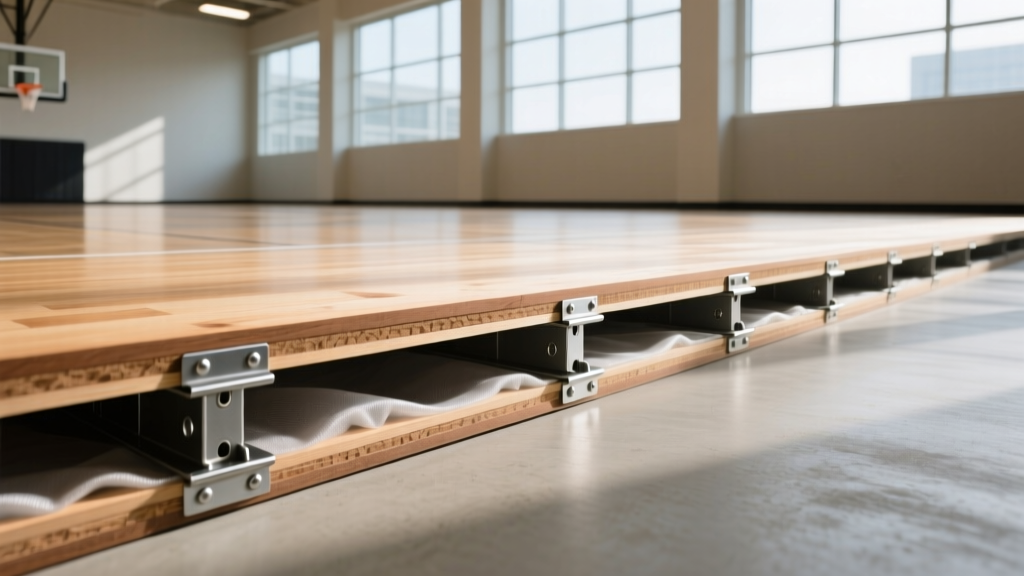
The most common structural use of hard maple is in the Maple Flooring Manufacturers Association (MFMA) certified flooring systems. These are not merely cosmetic wear layers; they are engineered structural diaphragms designed to absorb and distribute dynamic impact loads.
- Sleeper Systems: 3/4-inch thick MFMA-grade hard maple is blind-nailed to 2x4 southern pine sleepers spaced 12 inches on center. The maple acts as a structural membrane, distributing point loads (like a 300-lb athlete landing from a jump) across multiple sleepers.
- Industrial Subfloors: In manufacturing facilities where heavy forklift traffic occurs, 1-1/2-inch thick edge-grain hard maple block flooring is mechanically fastened directly to concrete slabs using epoxy and masonry anchors. The end-grain-up or edge-grain orientation provides compressive strength exceeding 7,800 psi.
2. Specialized Timber Framing and Worksurfaces
While too expensive for whole-home framing, hard maple is frequently used in timber framing for high-stress joints. Because of its high shear strength and density, maple is the preferred wood for pegs (treenails) in mortise-and-tenon joinery. A 1-inch diameter hard maple peg can withstand shear forces that would snap standard oak or ash pegs.
In industrial settings, structural workbenches utilize 3-inch to 4-inch thick solid hard maple tops, bolted through heavy-gauge steel frames. The density of the wood prevents deflection under 2,000+ lb static loads, while its tight grain resists the intrusion of industrial oils and solvents.
3. Engineered Maple: LVL and Glulam Cores
To bypass the dimensional limitations and shrinkage issues of solid sawn maple, manufacturers produce Laminated Veneer Lumber (LVL) using hard maple veneers. Maple LVL beams offer exceptional load-bearing capacities for specialized architectural features where the beam is exposed and requires a light, uniform aesthetic combined with extreme structural rigidity. These engineered beams routinely achieve allowable bending stresses (Fb) of 3,100 psi or higher, outperforming standard SPF LVLs.
Specification Guide: Fastening and Load Limits
Working with types of maple wood in structural contexts requires abandoning standard framing practices. The density of hard maple (45 lbs/ft³) causes rapid fastener fatigue and wood splitting if not executed correctly.
Rule of Thumb for Hard Maple Fastening: Any structural screw or nail placed within 2 inches of the end grain, or within 1 inch of the edge grain, must be pre-drilled. Failure to pre-drill will result in micro-fractures that compromise the withdrawal resistance of the fastener by up to 40%.
Recommended Fastener Schedule for 3/4" Structural Maple Flooring:
- Fastener Type: 2-inch ring-shank flooring nails or 2-inch structural wood screws (e.g., Simpson Strong-Tie SDWS).
- Blind Nailing Angle: 45 to 50 degrees through the tongue.
- Spacing: Maximum 10 inches on center along the joist/sleeper, with a minimum of two fasteners per board length.
- End Joint Stagger: End joints must be staggered by a minimum of 24 inches across adjacent rows to maintain structural diaphragm continuity.
2026 Cost Analysis: Maple vs. Standard Structural Timbers
Budgeting for structural maple requires an understanding of grading and market premiums. Unlike softwoods graded by the NLGA (National Lumber Grades Authority), hardwood maple is graded by the NHLA (National Hardwood Lumber Association). For structural uses, you are typically looking at MFMA grades or NHLA Select/Better.
| Material (2026 Pricing) | Average Cost per Board Foot | Primary Structural Use Case |
|---|---|---|
| SPF #2 Framing Lumber | $2.20 - $2.80 | Standard residential wall/roof framing |
| Douglas Fir #1 Structural | $3.50 - $4.75 | Heavy timber beams, load-bearing posts |
| Soft Maple (Red) FAS | $5.50 - $7.00 | Secondary framing, interior millwork, pallets |
| Hard Maple (Sugar) MFMA Flooring | $8.50 - $12.50 | Athletic floors, bowling alleys, dance studios |
| Hard Maple Industrial Block | $11.00 - $15.00 | Factory subfloors, heavy-duty workbenches |
While the upfront material cost of hard maple is 4x to 6x higher than SPF, the lifecycle cost in high-wear structural applications justifies the premium. A properly maintained MFMA hard maple gymnasium floor can last 50 to 70 years, surviving multiple sanding and refinishing cycles, whereas softwood alternatives would require complete replacement within 15 years under similar dynamic loading.
Frequently Asked Questions
Can I use soft maple for structural joists?
Soft maple (like Red or Silver Maple) has bending strength comparable to some softwoods, but it is rarely graded or stamped for structural joist use by building code authorities. It lacks the standardized span tables required for residential permitting. It is better suited for non-load-bearing interior framing, blocking, or specialized millwork.
Is boxelder considered a structural maple?
No. Boxelder (Acer negundo) is technically a maple, but it is exceptionally weak, lightweight, and prone to rot and insect infestation. It has an MOR of just 7,900 psi and should never be used in any load-bearing or structural capacity.
How does maple perform in exterior structural applications?
Maple is highly susceptible to decay and insect attack when exposed to moisture. It has virtually no natural rot resistance. Therefore, types of maple wood should strictly be limited to interior, climate-controlled structural applications unless heavily treated with industrial preservatives, which is rarely cost-effective compared to using naturally rot-resistant species or pressure-treated pine.
Written by
Sarah WhitfieldSarah Whitfield is a chartered quantity surveyor (MRICS) and construction cost analyst with 15 years of experience in material pricing, procurement strategy, and project budgeting. She earned her degree in Construction Management from the University of Reading (UK) and has worked on projects ranging from $2M custom homes to $180M mixed-use developments across North America and Europe. Sarah currently leads cost estimating for BuildMat Insight, maintaining a proprietary database of 4,000+ material price points updated quarterly. She is a frequent contributor to RSMeans cost data panels and has presented at the International Cost Engineering Council (ICEC) congress. Based in Denver, CO, Sarah is an avid trail runner and volunteer mentor for Women in Construction.
More from Sarah Whitfield
View all
Wood & Lumber
What Are the Different Types of Wood? A Builder's Guide
Compare structural softwoods, finish hardwoods, and engineered lumber. Analyze Janka ratings, MOE values, and 2026 pricing for construction.
Aug 4, 2026

Walls & Panels
Steel Framing vs Wood Framing: Corrosion and Moisture Defense
Compare steel framing vs wood framing for moisture resistance. Learn about galvanized coatings, condensation risks, and corrosion protection strategies.
Jul 21, 2026

Stone & Masonry
How to Cut Stone Veneer: Wet Saw vs Grinder Comparison
Compare the best tools for cutting stone veneer. We review wet saws, angle grinders, and chop saws to help you achieve clean, chip-free cuts.
Jul 21, 2026