High-Performance Wood Fence Ideas: Lumber Grades & Wind Specs
Evaluate wood fence ideas using structural performance ratings, AWPA lumber grades, and ASCE 7 wind load specs to ensure long-term durability.
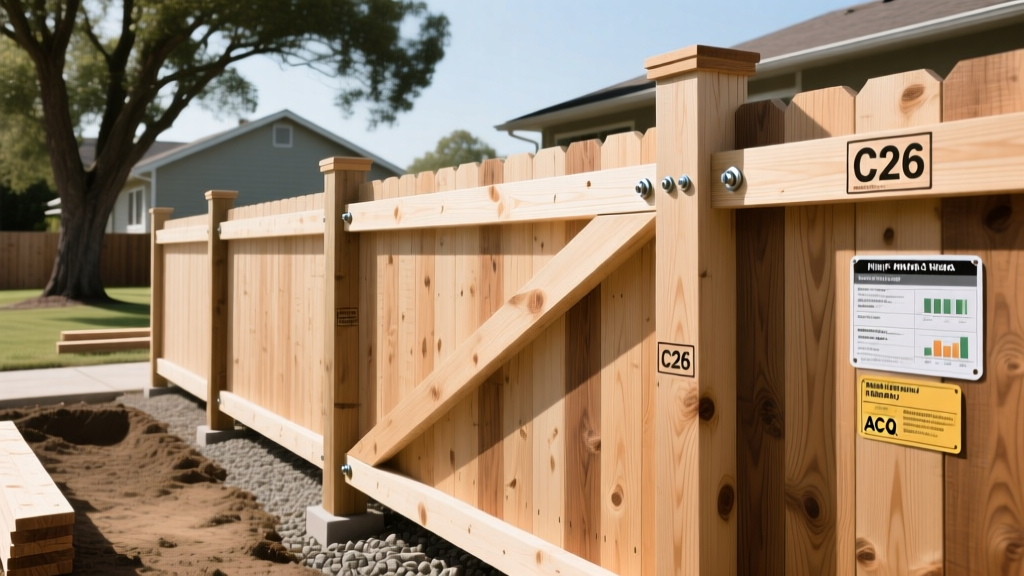
The Engineering Behind Aesthetic Wood Fence Ideas
Most online galleries showcasing wood fence ideas focus entirely on aesthetics—stain colors, lattice patterns, and landscaping integration. However, a fence is a structural cantilever system subjected to severe lateral wind loads, soil moisture, and biological decay. Evaluating wood fence ideas from a performance and specification perspective ensures the design survives extreme weather without premature fastener failure or post rotation.
Matching Wood Fence Ideas to AWPA Use Categories
The American Wood Protection Association (AWPA) classifies treated lumber into Use Categories (UC) based on exposure to moisture and biological hazards. Selecting the wrong UC for a specific fence component is the leading cause of structural failure within the first five years.
| Fence Component | AWPA Category | Exposure Condition | Required Treatment / Species |
|---|---|---|---|
| Posts (In-Ground) | UC4A | Ground contact, critical structural | 0.40 pcf MCA/ACQ or naturally resistant heartwood (e.g., Ipe) |
| Bottom Rails | UC3B | Above ground, exposed to weather | 0.25 pcf MCA or Western Red Cedar |
| Pickets / Slats | UC3A or UC3B | Above ground, rapid water runoff | 0.15 pcf MCA or Cedar/Cypress |
| Post Caps / Trim | UC2 | Protected from direct rain pooling | Untreated clear cedar or primed pine |
Design-Specific Structural Specifications
Different wood fence ideas impose unique mechanical stresses on the lumber and hardware. Here is how to specify materials for the two most common high-performance designs.
1. Horizontal Slat Fences (Modern Privacy)
Horizontal fences act as continuous beams spanning between posts. The primary failure mode is mid-span deflection (sagging) caused by the dead load of the wood and lateral wind pressure.
- Span Limits: For 1x6 Western Red Cedar (Modulus of Elasticity ~1,100,000 psi), maximum post spacing must not exceed 6 feet on-center to maintain a deflection limit of L/180.
- Dimensional Specs: Use 5/4x6 (actual 1" x 5.5") rather than nominal 1x6 (actual 0.75" x 5.5") to increase the moment of inertia and reduce sagging by nearly 40%.
- Fastening: Face-screw with 3-inch Type 305 stainless steel trim-head screws. Ring-shank nails will back out over time due to the horizontal wood grain expansion and contraction cycle.
2. Board-on-Board Privacy Fences (Traditional Heavy)
Board-on-board designs overlap pickets by 1 to 1.5 inches, creating a solid wind barrier. This design catches 100% of the wind load, transferring massive shear forces to the post-to-rail connections.
- Rail Specifications: Minimum 2x4 SPF #2 (Spruce-Pine-Fir) installed flat-wise. For 8-foot spans, upgrade to 2x6 or install a mid-rail to prevent rail twisting under torsional wind loads.
- Pickets: 1x6 boards require three fasteners per rail intersection. Using only two fasteners allows the board to pivot and warp.
- Weight Load: A 6-foot tall board-on-board fence weighs approximately 4.5 lbs per square foot. An 8-foot section carries over 215 lbs of dead load before wind pressure is calculated.
Lumber Grade Specifications for Fence Components
Buying 'fence grade' lumber without checking the stamp leads to high waste rates and structural weak points. The Western Red Cedar Lumber Association (WRCLA) and softwood grading rules dictate specific limits on knots, wane, and slope of grain.
- Posts (4x4 or 6x6): Specify #1 Structural or Select Structural. Avoid #2 grade for posts, as large edge knots drastically reduce the bending strength (Fb) required to resist wind overturning.
- Rails (2x4): #2 SPF is the industry standard. It allows for tight, sound knots but restricts slope of grain to 1 in 12, ensuring the rail won't snap under lateral load.
- Pickets (1x6 Cedar): #1 Grade (or 'Select Tight Knot'). Avoid 'Utility' or '#3' grades, which permit wane (bark edges) and large loose knots that will fall out, compromising fastener holding power.
Wind Load Ratings and Post Embedment Depths
The American Society of Civil Engineers (ASCE) outlines wind load calculations that directly dictate how deep your fence posts must be set. A fence post functions as a cantilever beam embedded in soil. The soil's passive resistance must counteract the wind's overturning moment.
The 1/3 to 2/3 Rule: For a standard 6-foot tall fence in normal wind zones (90-100 mph), a minimum of 36 inches of embedment in compacted soil or concrete is required. In high-wind coastal zones (115+ mph), embedment must increase to 42-48 inches, or posts must be anchored to continuous concrete footings using galvanized post bases.
Concrete Collar vs. Direct Burial: Encasing a pressure-treated post in a concrete collar traps water at the wood-concrete interface, accelerating rot even in UC4A lumber. The high-performance specification is to set the post in 6 inches of crushed gravel for drainage, backfill with native soil tamped in 4-inch lifts, and slope the topsoil away from the post. If concrete is required for lateral stability, use a sonotube that stops 2 inches below grade, sloped away from the wood.
Fastener and Hardware Corrosion Specifications
Modern pressure-treated lumber uses copper-based preservatives like MCA (Micronized Copper Azole) or ACQ (Alkaline Copper Quaternary). These chemicals are highly corrosive to standard steel and aluminum.
| Fastener Type | Specification Standard | Compatibility with Treated Wood | Estimated 2026 Cost Premium |
|---|---|---|---|
| Electro-Galvanized | ASTM A153 Class D | FAIL - Do not use with ACQ/MCA | Baseline |
| Hot-Dipped Galvanized (HDG) | ASTM A153 Class C (G185) | PASS - Minimum 1.0 oz/sq ft zinc | +15% over electro |
| Type 305 Stainless Steel | ASTM F1667 | PASS - Ideal for Cedar & Treated | +60% over HDG |
| Polymer-Coated Carbon Steel | ACQ Approved Listing | PASS - Must verify ACQ certification | +30% over HDG |
Real-World Cost and Lifespan Projections (2026 Data)
When evaluating wood fence ideas, lifecycle cost is a critical specification. A cheaper initial material often results in higher replacement costs due to biological degradation or wind failure.
- Pressure-Treated SPF (UC4A Posts, UC3B Rails): $22 - $32 per linear foot installed. Expected lifespan: 12-15 years. Failure mode: Rail warping and post rot at the grade line.
- Western Red Cedar (#1 Grade): $38 - $55 per linear foot installed. Expected lifespan: 18-25 years. Failure mode: Silvering/UV degradation (cosmetic) and bottom-rail moisture wicking.
- Tropical Hardwood (Ipe / Cumaru): $85 - $120 per linear foot installed. Expected lifespan: 40+ years. Failure mode: Hardware corrosion (wood outlasts standard fasteners).
By specifying the correct AWPA Use Category, adhering to ASCE 7 wind embedment depths, and selecting the appropriate lumber grade for each structural component, you transform aesthetic wood fence ideas into high-performance, long-lasting exterior structures.