How to Clean Bamboo Flooring: A Scenario-Matched Guide
Learn how to clean bamboo flooring by matching specific scenarios—from pet accidents to heavy scuffs—with the right pH-balanced solutions and tools.
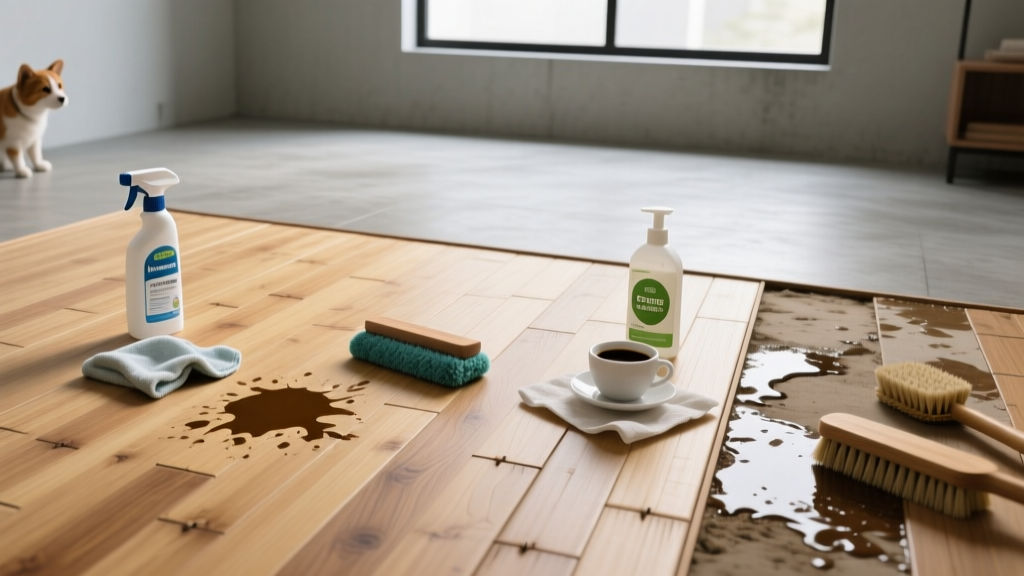
The Anatomy of a Bamboo Floor Finish
Understanding how to clean bamboo flooring requires a fundamental shift in perspective: you are not cleaning the bamboo grass itself; you are cleaning the factory-applied topcoat. Modern bamboo flooring—particularly strand-woven varieties compressed with phenolic resins and boasting a Janka hardness of 3,000 to 4,000 lbf—is typically sealed with 7 to 10 coats of UV-cured polyurethane infused with aluminum oxide (corundum) for scratch resistance.
While the bamboo core is highly durable, the polyurethane finish is vulnerable to chemical etching, micro-abrasions, and prolonged moisture exposure. Therefore, effective maintenance relies on matching specific household scenarios with the exact chemical pH and mechanical tool required to protect the urethane bonds. According to the NWFA maintenance guidelines, using the wrong pH balance is the leading cause of premature finish hazing and degradation in factory-sealed floors.
Scenario-Matching Matrix: The Core Framework
Use this decision matrix to select the correct application for your specific flooring challenge. Never use a heavy-duty solution for a daily maintenance scenario, as over-cleaning strips the sheen.
| Scenario | Threat to Finish | Approved Agent & Tool | Banned Agent |
|---|---|---|---|
| Daily Dust & Micro-Grit | Micro-scratching from dragged silica | Electrostatic dry microfiber pad | Stiff-bristle brooms, beater-bar vacuums |
| Light Liquid Spills | Water pooling in micro-bevels | pH-neutral spray (6.5-7.5) + damp cloth | Wet mops, steam mops, soaking |
| Pet Urine & Acidic Spills | Uric acid etching, tannin blackening | Enzymatic hard-floor cleaner | Ammonia, bleach, vinegar |
| Scuffs & Sticky Residue | Abrasive scrubbing dulling the gloss | Diluted isopropyl alcohol (1:10 ratio) | Steel wool, magic erasers, degreasers |
| Heavy Grime Buildup | Residue trapping more dirt | Bona Hardwood Floor Cleaner + damp mop | Murphy's Oil Soap, wax-based polishes |
Scenario 1: Daily Micro-Grit and Dust Control
The most insidious threat to bamboo flooring is not large debris, but microscopic silica grit. When walked on, this grit acts like sandpaper against the aluminum oxide finish, eventually creating a cloudy, dull appearance known as 'traffic path hazing'.
The Right Tool: Electrostatic Microfiber
Use a dry, electrostatic microfiber dust mop (such as the O-Cedar Dual-Action Micro Flip Mop). The synthetic fibers generate a static charge that lifts and traps dust rather than pushing it around. Sweep in the direction of the bamboo grain to pull grit out of the micro-bevel seams.
Tools to Ban
- Stiff-bristle brooms: These flick micro-grit into the air, which settles back onto the floor minutes later.
- Vacuum beater-bars: The rotating bristles on standard upright vacuums can leave micro-dents in horizontal or vertical bamboo (which has a lower Janka rating of ~1,380 lbf compared to strand-woven). If vacuuming, use the 'hard floor' setting which disables the rotating brush.
Scenario 2: High-Risk Moisture and Pet Accidents
Bamboo is a grass with high silica and starch content. When moisture breaches the polyurethane topcoat and reaches the bamboo core, it triggers a tannin reaction, resulting in permanent black stains that cannot be sanded out of pre-finished planks without ruining the wear layer.
Managing Pet Urine and Acidic Spills
Pet urine contains uric acid, which aggressively eats through polyurethane. You must neutralize the acid without introducing excess moisture.
- Blot, Don't Wipe: Use a dry paper towel to absorb the liquid. Wiping spreads the acid across a larger surface area of the finish.
- Apply an Enzymatic Cleaner: Use a product specifically formulated for sealed hard floors, such as Nature's Miracle Hard Floor Cleaner (approx. $10.99). Enzymes break down the uric acid crystals without requiring heavy scrubbing.
- Dry Immediately: Follow up with a dry microfiber cloth. Never allow liquid to sit in the tongue-and-groove seams for more than 2 minutes.
Warning: The 'Natural' Vinegar Trap
Internet forums frequently recommend a mixture of white vinegar and water for cleaning bamboo. This is highly destructive. White vinegar contains acetic acid and has a pH of roughly 2.5. Bamboo finishes require a pH-neutral environment (6.5 to 7.5). Repeated use of vinegar chemically breaks down the urethane bonds, causing irreversible 'chalking' or hazing. Furthermore, vinegar leaves a sticky residue that attracts more dirt. Always opt for EPA Safer Choice certified pH-neutral cleaners designed specifically for polyurethane-sealed floors.
Scenario 3: Scuffs, Stains, and Adhesive Residue
When dealing with physical marks on the surface of the finish, the goal is to dissolve the mark without abrading the surrounding gloss.
The Isopropyl Alcohol Method
For rubber scuffs from shoes or sticky residue from dropped food:
- Mix 1 part 70% isopropyl alcohol with 10 parts distilled water.
- Lightly mist the solution directly onto a microfiber cloth (never spray directly onto the floor to prevent pooling).
- Gently rub the scuff mark in a circular motion. The alcohol acts as a mild solvent to break down the rubber or adhesive without softening the UV-cured polyurethane.
Never use melamine foam (Magic Erasers) on bamboo flooring. Melamine foam is essentially micro-sandpaper and will instantly dull the gloss level of the finish, leaving a permanent matte spot.
Scenario 4: Deep Grime and Residue Stripping
If a previous homeowner or cleaning service used oil-based soaps (like Murphy's Oil Soap) or wax-based polishes, your bamboo floor likely has a hazy, sticky buildup that repels water and traps dirt. Standard pH-neutral cleaners will not cut through this lipid layer.
The Stripping Protocol
- Identify the Buildup: Sprinkle a few drops of water on the hazy area. If the water beads up but the area underneath remains cloudy, you have a wax/oil residue.
- Use a Polyurethane-Safe Stripper: Apply a commercial hard floor residue remover (such as Bona Hardwood Floor Cleaner or a dedicated polyurethane prep solution) to a damp mop.
- Agitate and Extract: Work in small 3x3 foot sections. Mop the solution in, let it sit for exactly 60 seconds to emulsify the oils, and immediately dry it with a clean, dry terry cloth towel. Do not let the emulsified oils dry back onto the floor.
When Cleaning Fails: Assessing Finish Degradation
Sometimes, what appears to be 'dirt' is actually a failing finish. If your bamboo floor looks perpetually dull even after a deep clean, the aluminum oxide topcoat may be worn through to the bare polyurethane or the bamboo itself.
The Water-Drop Test
Perform this diagnostic test in the highest-traffic area of your home (usually in front of the sofa or kitchen sink):
- Pass (Intact Finish): Place 1 tablespoon of water on the floor. If it beads up tightly and the floor underneath remains unchanged after 5 minutes, your finish is intact. The dullness is likely just surface grime.
- Fail (Compromised Finish): If the water spreads out and the bamboo darkens within 3 minutes, the finish has been breached. Moisture is penetrating the grass fibers.
Restoration Options for 2026
If the floor fails the water-drop test, no amount of cleaning will restore the shine. You must mechanically address the finish.
Screen and Recoat: A professional flooring contractor will use a floor buffer with a 120-grit screen to lightly abrade the existing polyurethane (without cutting into the bamboo), then apply a fresh coat of commercial-grade water-based polyurethane. In 2026, expect to pay between $3.00 and $4.50 per square foot for this service. This is significantly cheaper than a full sand-and-refinish, which is often impossible on engineered bamboo or thin-top layer solid bamboo.
Summary of Environmental Controls
Cleaning is only half the battle. Bamboo is highly reactive to ambient humidity fluctuations, which can cause edge-cupping or gapping regardless of how clean the surface is. Maintain your home's relative humidity (RH) between 35% and 55% year-round. In winter, use a console humidifier (like the Essick Air 696 400) to prevent the bamboo from drying out and shrinking, which opens the seams to dirt and moisture infiltration. In summer, use dehumidification to prevent the grass fibers from expanding and crushing against each other at the edges.