Landscape Timber Taxonomy: Selecting the Right Wood for Soil Contact
Compare landscape timber types for retaining walls and garden beds. Learn material taxonomy, ground-contact grades, and safety for edible soils.
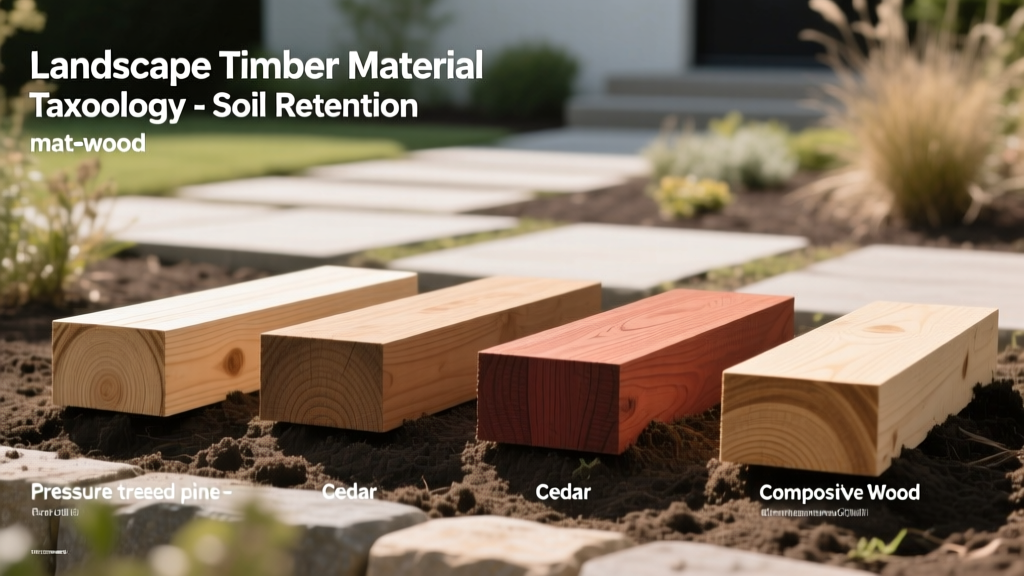
The Landscape Timber Material Taxonomy
In the lumber industry, the term 'landscape timber' is frequently misapplied to any wood placed outdoors. True landscape timbers occupy a specific niche in the material taxonomy: they are milled, peeled, or squared wood products engineered specifically for earth-to-wood contact, lateral soil retention, and outdoor structural loading. Selecting the correct material requires understanding the intersection of wood species, preservative chemistry, and structural geometry.
Core Material Categories
- Peeled Roundwood (Standard Landscape Timbers): Typically Southern Yellow Pine (SYP) or Douglas Fir. These are mechanically peeled to remove the bark and sapwood, leaving a rounded profile with two flat, parallel milled sides (usually measuring 3.5 inches by 5 inches). The flat sides allow for stable stacking.
- Squared Structural Timbers (6x6 and 8x8): Fully milled, square-edge timbers used for heavy-duty retaining walls, step systems, and high-load corners. These offer maximum surface contact for fastening and superior structural rigidity.
- Naturally Decay-Resistant Heartwood: Western Red Cedar and Coastal Redwood. Only the heartwood (the dark, inner core of the tree) contains the natural extractives (thujaplicins in cedar) that resist fungal decay and insect attack. Sapwood cedar is virtually useless in soil contact.
- Recycled Railroad Ties: Historically used, but heavily restricted. These are creosote-treated hardwoods (usually oak) that off-gas volatile organic compounds (VOCs) and leach toxic polycyclic aromatic hydrocarbons (PAHs) into the soil.
Never use reclaimed creosote-soaked railroad ties for residential landscaping, particularly near edible gardens or water features. The EPA strictly regulates creosote as a restricted-use pesticide due to its carcinogenic properties and severe environmental leaching risks.
Decoding AWPA Ground Contact Ratings
The most critical factor in landscape timber selection is the American Wood Protection Association (AWPA) Use Category. Retailers often sell 'pressure-treated' wood that is only rated for above-ground use, which will rot within 3 to 5 years if buried in soil. For landscape applications, you must verify the end-tag for specific ground-contact ratings.
The UC4 Series: Your Selection Baseline
According to the American Wood Protection Association (AWPA), ground-contact timbers fall into three distinct sub-categories:
- UC4A (Ground Contact, General Use): Suitable for fence posts, basic garden bed borders, and timbers where the wood touches the soil but does not support critical structural loads. Retention levels of preservative are moderate.
- UC4B (Heavy-Duty Ground Contact): Required for retaining walls over 24 inches high, permanent wood foundations, and timbers placed in poorly drained soils or high-decay environments (like the US Southeast). This wood has a higher chemical retention rate.
- UC4C (Permanent Wood Foundation): The highest grade, used for structural basement walls and critical load-bearing columns embedded in concrete or soil.
Material Comparison & Cost Matrix (2026 Market Data)
| Material Type | AWPA Rating | Expected Soil Lifespan | Avg Cost / Linear Ft | Best Application |
|---|---|---|---|---|
| SYP Peeled (MCA-C Treated) | UC4A | 15 - 20 Years | $3.50 - $5.50 | Garden borders, low beds |
| SYP 6x6 (CA-C Treated) | UC4B | 25 - 40 Years | $8.00 - $12.00 | Retaining walls, steps |
| Western Red Cedar (Heart) | N/A (Natural) | 10 - 15 Years | $14.00 - $22.00 | Edible gardens, aesthetic beds |
| Coastal Redwood (Heart) | N/A (Natural) | 15 - 25 Years | $18.00 - $28.00 | Premium raised beds, terracing |
Selection Framework: Matching Timber to Application
Scenario A: Retaining Walls and Terracing
Retaining walls are structural elements that must withstand immense hydrostatic pressure and lateral earth loads. Peeled roundwood is entirely inappropriate for walls exceeding 18 inches in height due to its irregular geometry and lower moment of inertia.
- Material Choice: 6x6 or 8x8 UC4B-rated pressure-treated Southern Yellow Pine.
- Fastening: Use 10-inch or 12-inch hot-dipped galvanized steel spikes (never electroplated, which will rust and shear in 3 years). Drive two spikes per timber, spaced 12 inches from each end.
- Anchoring: The base course must be pinned to the earth using #4 (1/2-inch diameter) or #5 (5/8-inch diameter) steel rebar, driven at least 24 inches into the subgrade through pre-drilled holes in the timber.
Scenario B: Raised Beds for Edible Crops
The safety of pressure-treated wood in vegetable gardens remains a highly debated topic. Modern preservatives like MCA (Micro-conized copper azole) and CA-C (Copper azole) do not contain arsenic or chromium, unlike the legacy CCA (Chromated Copper Arsenate) treatments banned for residential use in 2003. Research from the USDA Forest Products Laboratory indicates that copper leaching from modern treatments is minimal and binds tightly to soil organic matter, remaining largely unavailable to plant roots.
Best Practice for Organic Growers: If you require strict organic certification or want absolute zero-risk assurance, use untreated Western Red Cedar heartwood, or line the interior walls of your pressure-treated beds with a continuous sheet of 6-mil polyethylene plastic to create a physical barrier between the soil and the wood.
Engineering Failure Modes in Timber Landscaping
Understanding why landscape timber structures fail is just as important as selecting the right wood. The USDA Forest Products Laboratory notes that biological decay is rarely the primary cause of early structural failure in modern treated wood; mechanical and hydrological failures are far more common.
1. Hydrostatic Pressure Blowout
When soil behind a retaining wall becomes saturated, water pressure builds exponentially. A standard 6x6 timber wall will bow and eventually snap its galvanized spikes if water is not managed. The Fix: You must install a 4-inch perforated PVC drain pipe wrapped in landscape fabric at the base of the wall, backfilled with 3/4-inch crushed angular gravel (never round pea gravel, which does not interlock and fails to provide adequate drainage void space).
2. Frost Heave Displacement
In climates with freeze-thaw cycles, moisture in the soil freezes and expands, pushing the base course of the timber wall upward. The Fix: Excavate a trench 6 to 8 inches below the local frost line and fill it with compacted crushed stone to create a free-draining, non-frost-susceptible base pad before laying the first timber.
3. Deadman Anchor Failure
For walls taller than 24 inches, vertical spikes alone cannot resist the overturning moment of the soil. The Fix: Install 'deadman' anchors every 6 to 8 linear feet. This involves attaching a perpendicular timber to the wall face via steel cables or specialized timber-lock screws, burying the deadman timber in the compacted backfill soil to leverage the weight of the earth itself against the wall's outward push.