Types of Pine Wood: Installation Best Practices for Builders
Master installation best practices for different types of pine wood. Learn acclimation, fastening, and finishing rules for SYP, Eastern White, and Ponderosa.

Understanding the Core Characteristics of Pine Species
Pine is one of the most widely used softwoods in construction, but treating all pine species as interchangeable is a critical error that leads to structural failures, finish defects, and dimensional instability. The term 'pine' encompasses dozens of species with vastly different densities, resin contents, and shrinkage rates. When evaluating the various types of pine wood for a project, installers must adapt their acclimation timelines, fastener selections, and joint management strategies to the specific botanical and mechanical properties of the lumber.
According to data from the Wood Database, the Janka hardness of pine ranges from 380 lbf (Eastern White Pine) to over 1,200 lbf (Longleaf Southern Yellow Pine). This 300% variance in density dictates everything from pilot hole diameters to the pneumatic pressure required for flooring cleats. Below is a comprehensive, species-specific installation guide designed for professional contractors and advanced DIYers.
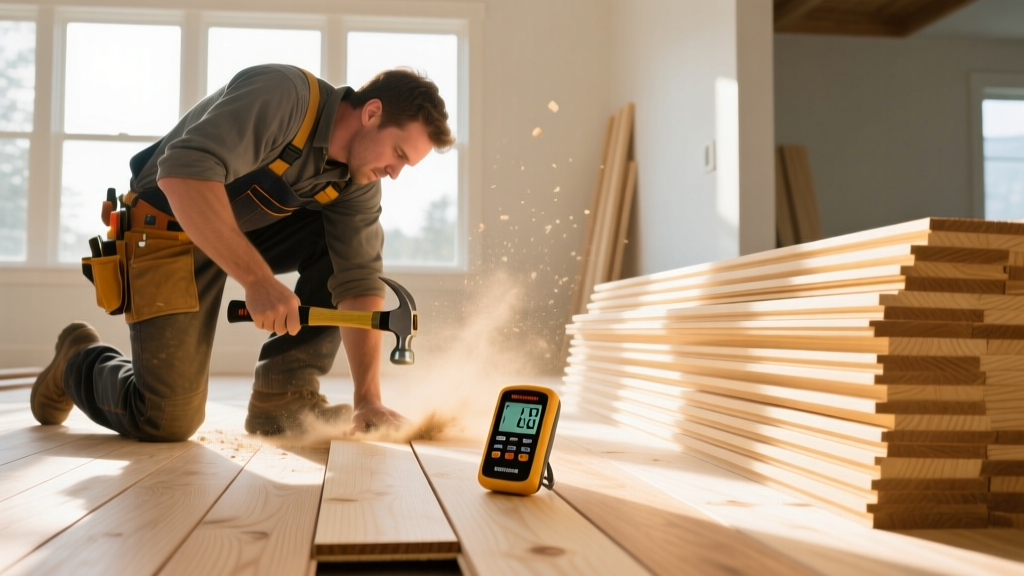
Regardless of the pine species, the National Wood Flooring Association (NWFA) mandates that solid wood flooring must be acclimated until its moisture content (MC) is within 2% of the subfloor's MC. For 3-inch wide boards, the tolerance is 2%; for boards 4 inches or wider, the tolerance tightens to 1.5%. Always use a pin-type moisture meter (like the Wagner Meters MMC220) for accurate deep-tissue readings in pine.
Southern Yellow Pine (SYP): Structural & Flooring Installation
Southern Yellow Pine is actually a grouping of four principal species (Loblolly, Shortleaf, Longleaf, and Slash pine). It is the densest, strongest, and most resinous of the commercial pines, making it the premier choice for structural framing and heavy-duty flooring.
Framing and Structural Fastening
Because SYP has a high specific gravity (0.55 to 0.59), it holds fasteners exceptionally well but is highly susceptible to splitting if not handled correctly. When framing with SYP, the American Wood Council (AWC) recommends using hot-dipped galvanized or polymer-coated structural screws rather than standard smooth-shank nails in high-wind or seismic zones. For ledger boards and joist hangers, use 3-inch Simpson Strong-Tie SDWS structural wood screws. Pre-drilling is generally not required for framing nails, but if driving 16d (3.5-inch) common nails near the end grain of SYP, blunt the nail tip with a hammer to shear the wood fibers rather than wedging them apart, which prevents end-splitting.
Flooring Acclimation and Nail Schedules
SYP flooring is prized for its durability and dramatic grain patterns. However, its high resin content and density mean it reacts aggressively to moisture fluctuations.
- Acclimation: Unbundle SYP flooring and cross-stack it with 1-inch spacers in the installation room for a minimum of 7 to 14 days. The room must be maintained at 60-80°F and 30-50% relative humidity.
- Fastening: Use 16-gauge or 15-gauge pneumatic flooring cleats, 1.5 to 2 inches in length. Blind-nail at a 45-degree angle through the tongue. Set the compressor to 70-90 PSI; higher pressures will blow out the tongue on dense SYP.
- Top-Nailing: If top-nailing the first and last rows, pre-drill with a 3/32-inch bit and use 6d or 8d cut nails or spiral-shank flooring nails, countersinking them and filling with a color-matched wood filler.
Eastern White Pine: Trim, Millwork, and Interior Detailing
Eastern White Pine (EWP) is a low-density softwood (Janka hardness: 380 lbf) characterized by its pale color, minimal resin, and exceptional workability. It is the industry standard for interior trim, crown molding, and custom millwork. Its primary installation vulnerability is its high tangential shrinkage rate (7.2%), which can cause joints to open visibly during winter heating seasons.
Joint Management and Coping vs. Mitering
Because EWP shrinks and expands significantly across the grain, relying solely on miter joints for inside corners is a guarantee of future callbacks. As the wood dries in winter, miter joints will inevitably open at the heel.
- Inside Corners: Always cope inside corners for EWP baseboards and crown molding. A coped joint allows the wood to shrink longitudinally without exposing a gap at the profile intersection.
- Outside Corners: Use miter joints reinforced with 23-gauge micro-pins and high-quality PVA wood glue (like Titebond II). Do not rely on brad nails alone, as EWP's low density offers poor withdrawal resistance for thin fasteners.
- Scarf Joints: For long runs requiring scarf joints, cut the mating pieces at a 30-degree angle (not 45 degrees) to increase the glue surface area and hide seasonal shrinkage gaps.
While EWP has less sap than SYP, the knots can still bleed resin through water-based primers. Always seal EWP knots with a pigmented shellac primer (such as Zinsser B-I-N) before applying topcoats. Additionally, to prevent 'picture framing'—where unpainted wood is exposed when the board shrinks after installation—prime and apply the first topcoat to all edges and the back of the trim before nailing it to the wall.
Ponderosa and Sugar Pine: Interior Paneling Techniques
Ponderosa Pine and Sugar Pine are frequently milled into tongue-and-groove (T&G) paneling for ceilings and accent walls. Sugar Pine is particularly notable for its large, uniform cells and minimal shrinkage, making it highly stable once acclimated. However, both species are brittle at the edges and prone to splintering during installation.
Step-by-Step Blind Nailing Flow for Paneling
- End-Match Pre-Drilling: Ponderosa and Sugar Pine T&G boards will split if nailed blindly near the ends. You must pre-drill a 3/32-inch pilot hole through the tongue within 1 inch of any board end before driving the fastener.
- Fastener Selection: Use 18-gauge, 1.5-inch brad nails or specialized T&G paneling nails with small, concave heads. Avoid 16-gauge finish nails, as the thicker shank will fracture the delicate pine tongue.
- Face-Nailing the First Course: The first course must be face-nailed to the wall studs. Position the board with the groove facing the starting wall. Face-nail 1/2 inch from the edge (where the casing or trim will cover it) and blind-nail the tongue.
- Seating the Joints: Never strike the tongue of Sugar or Ponderosa pine directly with a steel hammer or rubber mallet. Use a 6-inch scrap piece of the paneling as a tapping block to distribute the impact force and prevent crushing the tongue profile.
Acclimation Timelines and Moisture Tolerances
Proper acclimation is the single most critical factor in preventing cupping, crowning, and joint failure in pine installations. The table below outlines the target moisture content and acclimation parameters for the most common types of pine wood used in interior applications.
| Pine Species | Primary Application | Target MC (%) | Minimum Acclimation Time |
|---|---|---|---|
| Southern Yellow Pine (SYP) | Flooring, Structural Framing | 6% - 9% | 7 - 14 Days |
| Eastern White Pine | Trim, Millwork, Cabinetry | 6% - 8% | 3 - 7 Days |
| Ponderosa Pine | T&G Paneling, Doors | 7% - 9% | 5 - 10 Days |
| Sugar Pine | Ceiling Paneling, Pattern Stock | 7% - 9% | 5 - 10 Days |
Fastener Selection Matrix by Pine Species
Matching the fastener to the density and application of the pine species prevents structural pull-out and cosmetic surface damage. Refer to the NWFA technical resources for comprehensive flooring fastener schedules.
| Species | Application | Recommended Fastener | Gauge / Size |
|---|---|---|---|
| SYP | Solid Strip Flooring | Pneumatic Flooring Cleat | 16-gauge, 1.5' or 2' |
| SYP | Structural Framing | Hot-Dipped Galvanized Common Nail | 16d (3.5') |
| Eastern White | Baseboard / Casing Trim | Finish Nail (Glue-Coated) | 15-gauge, 2' or 2.5' |
| Ponderosa / Sugar | T&G Ceiling Paneling | Brad Nail or Paneling Nail | 18-gauge, 1.25' or 1.5' |
Frequently Asked Questions
Why is my pine floor cupping after installation?
Cupping in pine flooring occurs when the bottom of the board has a higher moisture content than the top, causing the edges to curl upward. This is almost always caused by inadequate acclimation or installing the floor over a damp subfloor (like a concrete slab without a proper vapor retarder). To fix this, identify and eliminate the moisture source, then run commercial dehumidifiers in the space. Do not sand a cupped pine floor until the moisture gradient has fully equalized, or the floor will crown when it finally dries.
Can I use standard drywall screws to frame with Southern Yellow Pine?
Never use standard black phosphate drywall screws for structural framing or load-bearing connections in SYP or any other lumber. Drywall screws are brittle, lack shear strength, and are highly susceptible to corrosion. The zinc phosphate coating offers virtually no weather or moisture resistance. Always use fasteners rated for structural timber, such as hot-dipped galvanized nails or polymer-coated structural wood screws that meet ICC-ES AC233 standards.
How do I prevent Eastern White Pine trim from denting during installation?
Eastern White Pine is exceptionally soft. To prevent hammer marks and compressor dings, use a 'no-mar' pad on your pneumatic nail gun's nose piece. If using hand tools, use a magnetic nail set to drive the nail below the surface rather than striking the wood directly with the hammer face. For high-traffic areas like baseboards, consider upgrading to a harder wood species like Poplar or MDF, or specify a high-build polyurethane topcoat if using EWP.
Written by
Elena RodriguezElena Rodriguez is a civil engineer and technical writer specializing in concrete technology, masonry systems, and ASTM/ACI compliance. She earned her B.S. in Civil Engineering from Texas A&M University and spent a decade at a materials testing laboratory, performing over 2,000 concrete compressive strength tests and masonry prism evaluations. Elena is an ACI-certified Field Testing Technician (Grade I) and a member of ASTM Committee C12 on Natural Building Stone. She currently consults on forensic engineering cases involving concrete failures and moisture intrusion. Based in San Antonio, TX, Elena is a proud member of the Society of Women Engineers (SWE) and coaches her daughter's FIRST Robotics team.
More from Elena Rodriguez
View all
Walls & Panels
Cost Analysis: Light Gauge Steel Framing Advantages and Disadvantages
Evaluate light gauge steel framing advantages and disadvantages through a strict cost analysis lens, comparing material, labor, and lifecycle expenses.
Aug 4, 2026

Walls & Panels
Gypsum Board Types: Exact Specifications, Thickness & Dimensions
Compare standard, Type X, and moisture-resistant gypsum board types. Get exact specifications, thicknesses, dimensions, and ASTM standards for your project.
Aug 4, 2026

Fire Resistance
Best Fire-Resistant Outdoor Decking Materials: 2026 Buyer Guide
Discover the best fire-resistant outdoor decking materials for 2026. Compare Class A PVC, aluminum, and hardwood options for WUI compliance and safety.
Aug 4, 2026