Types of Wooden Fences: A Material and Style Selection Framework
Compare types of wooden fences using our structural selection framework. Evaluate cedar, pine, and hardwood costs, rot resistance, and privacy styles.

The 4-Axis Wooden Fence Selection Matrix
Selecting from the various types of wooden fences requires moving beyond basic aesthetics. Contractors and property owners must evaluate materials across four structural and environmental axes: biological degradation resistance, wind load profile, capital cost, and dimensional stability. A fence that performs exceptionally in a dry, mild climate may suffer catastrophic failure modes in regions with high soil moisture or severe freeze-thaw cycles. This framework dissects wood species, architectural styles, and hardware specifications to provide a definitive selection matrix for residential and commercial perimeter structures.
Material Matrix: Wood Species Evaluated
The longevity of a wood fence is dictated by the species' natural extractive content (which deters fungi and insects) or its chemical treatment profile. When sourcing materials, current 2026 market pricing reflects both lumber availability and the premium for old-growth or heartwood-specific milling.
| Wood Species | Decay Resistance | Janka Hardness | Avg. Installed Cost (per LF) | Expected Lifespan |
|---|---|---|---|---|
| Pressure-Treated SYP (Southern Yellow Pine) | High (Chemical) | 870 lbf | $28 - $42 | 20 - 25 years |
| Western Red Cedar (Heartwood) | High (Natural) | 350 lbf | $45 - $70 | 25 - 30 years |
| California Redwood | Very High (Natural) | 420 lbf | $60 - $95 | 30+ years |
| Ipe (Brazilian Walnut) | Exceptional | 3,680 lbf | $120 - $180 | 50+ years |
| Spruce / Fir (Economy) | Low | 500 lbf | $18 - $25 | 7 - 12 years |
For pressure-treated pine, it is critical to verify the American Wood Protection Association (AWPA) Use Category tags on the end of the lumber. Posts buried in concrete or soil must be rated UC4B (Ground Contact) or UC4C (Heavy-Duty Ground Contact). Above-ground rails and pickets can utilize UC4A. Using UC4A pine for subterranean post applications will result in structural rot within 5 to 7 years.
When ordering Western Red Cedar, explicitly specify "100% Heartwood" or "Clear Heart" grades. The sapwood (the outer rings of the log) lacks the natural thujaplicins that provide rot and insect resistance. Sapwood cedar will decay at the same rate as untreated pine when exposed to ground moisture.
Natural durability ratings for cedar and redwood are extensively documented by the USDA Forest Products Laboratory, which classifies old-growth heartwood of both species as "Resistant to Very Resistant" to decay fungi. However, second-growth lumber with high sapwood ratios will underperform these baseline expectations.
Architectural Styles and Structural Implications
The physical configuration of the fence dictates its wind load resistance and privacy level. According to structural design guidelines published by the American Wood Council (AWC), solid fences act as sails, requiring deeper post footings and stronger rail-to-post connections than permeable designs.
- Board-on-Board (Total Privacy): Features overlapping 1x6 pickets on the same side of the rail. This creates a solid visual barrier but catches maximum wind load. Requires 4x6 posts or 6x6 posts in high-wind zones, set a minimum of 36 inches deep in concrete.
- Shadowbox (Semi-Private): Pickets alternate on opposite sides of the rails with a 1-inch gap. This design allows roughly 15-20% wind permeability, significantly reducing lateral shear stress on the posts while maintaining privacy from oblique angles.
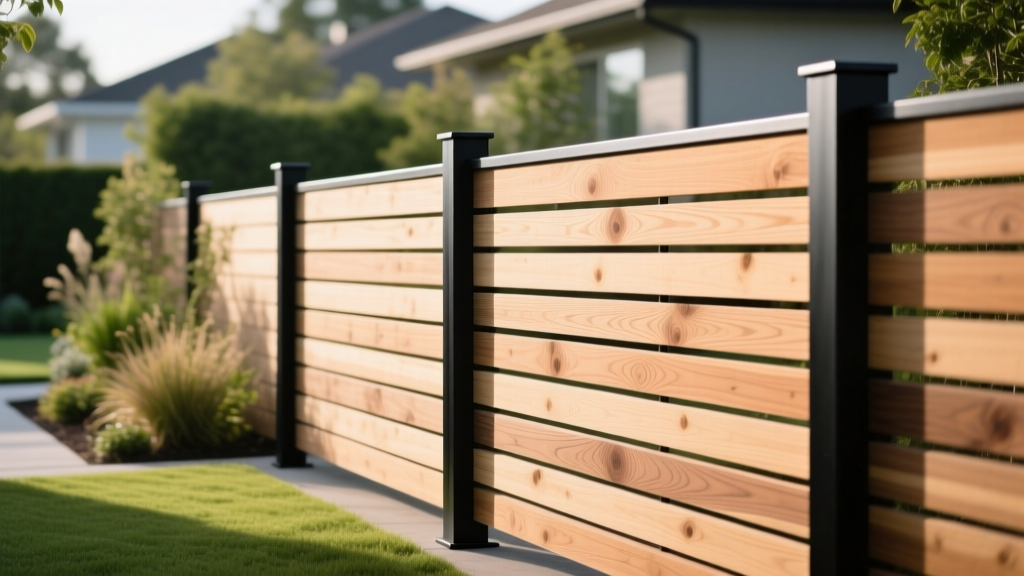
- Horizontal Slat (Modern): Highly susceptible to wood cupping and racking. To prevent the horizontal boards from bowing and pulling fasteners, span between steel or wood posts must not exceed 6 feet. Using hidden fastener systems or structural screws (e.g., Simpson Strong-Tie) is mandatory to resist the lateral expansion forces of the wood grain.
- Stockade (Traditional): Pickets placed tightly side-by-side with pointed tops. Shrinkage during the first summer will open 1/4-inch gaps between pickets. This style is highly forgiving of uneven terrain but offers poor wind permeability.
Climate-Specific Failure Modes and Mitigation
Post Base Rot and Frost Heave
The most common failure point in any wooden fence is the post-to-ground interface. Encasing a wooden post entirely in concrete creates a "cup" that traps surface water, accelerating rot. The correct mitigation framework involves digging the hole 6 inches deeper than the frost line, adding a 6-inch gravel base for drainage, setting the post, and pouring concrete to just above grade. The concrete collar must be troweled into a slope pointing away from the wood to shed water. Alternatively, utilizing galvanized steel post anchors (like Oz-Post or Simpson E-Z Base) elevates the wood entirely above the soil grade, eliminating ground-contact rot.
Tannin Bleed and Fastener Corrosion
Cedar and redwood contain high levels of tannic acid. When exposed to moisture, these tannins leach out and react with standard zinc-plated or electro-galvanized fasteners, causing severe black streaking and rapid fastener corrosion. Rule: Never use electro-galvanized nails or screws on cedar or redwood. You must specify Hot-Dipped Galvanized (HDG) fasteners, or ideally, Type 304 or Type 316 Stainless Steel fasteners. For tropical hardwoods like Ipe, the extreme density (3,680 lbf Janka) requires pre-drilling all pilot holes and utilizing specialized hardened-steel exterior screws to prevent shear failure during installation.
The Final Selection Framework
Use this sequential decision tree to finalize your material and style specifications based on site conditions:
- Assess Soil and Climate: If the site has heavy clay soil with poor drainage or experiences severe freeze-thaw cycles, eliminate untreated wood and standard pine. Default to UC4B Pressure-Treated Pine with steel post anchors, or upgrade to Redwood/Ipe with deep gravel drainage beds.
- Calculate Wind Load: For properties on coastal ridges or open plains with sustained winds over 70 mph, eliminate solid Board-on-Board and Stockade styles. Select Shadowbox or split-rail designs to allow wind permeability and reduce footing depth requirements.
- Determine Maintenance Tolerance: If the client requires zero maintenance and accepts a silver-gray patina, select Cedar or Ipe and omit UV-blocking sealants. If the client demands rich, original wood color retention, specify Redwood or Cedar and mandate a penetrating oil-based sealer (e.g., TWP or Armstrong Clark) reapplied every 24 to 36 months.
- Verify HOA and Municipal Setbacks: Before finalizing the style, cross-reference the chosen height and opacity with local zoning. Many municipalities restrict solid fences to 6 feet in backyards and mandate 50% open-permeability (like split-rail or spaced picket) for 4-foot front-yard enclosures.
By systematically filtering site conditions through this framework, builders and homeowners can eliminate premature failure modes, optimize capital expenditure, and ensure the selected wooden fence type performs structurally for its maximum rated lifespan.
Written by
Marcus ChenMarcus Chen is a licensed structural engineer (PE) and building materials analyst with over 12 years of experience across residential, commercial, and industrial construction. He holds a Master of Science in Civil Engineering from UC Berkeley and spent six years at Thornton Tomasetti before transitioning to independent consulting and technical writing. Marcus specializes in material selection for seismic-prone regions, concrete reinforcement strategies, and lifecycle cost analysis. His work has been cited by the American Concrete Institute (ACI) and the Structural Engineers Association of California (SEAOC). When he is not on a job site or at his desk, you will find him hiking the Sierra Nevada or restoring a 1920s craftsman bungalow in Oakland, CA.
More from Marcus Chen
View all
Construction Cost
How Much Did the Eiffel Tower Cost to Build?
How much did the Eiffel Tower cost to build in 1889? We adjust for inflation and compare its budget to modern skyscraper construction.
Aug 4, 2026

Fire Resistance
What Is a Fire Resistant Material? Testing & Certification Guide
Discover what is a fire resistant material through ASTM and UL testing. Learn how fire ratings, certifications, and assemblies work in construction.
Aug 4, 2026

Construction Cost
How Much Did the Burj Khalifa Cost to Build?
How much did the Burj Khalifa cost to build? We break down the $1.5B project and extract 5 money-saving strategies for your next build.
Jul 30, 2026