C16 vs C24 vs TR26 Timber Grades: 2026 Structural Comparison
Compare UK structural timber grades C16, C24, TR26, GL24h & GL28h—strength classes, span tables, load capacity. Get expert 2026 guidance now!
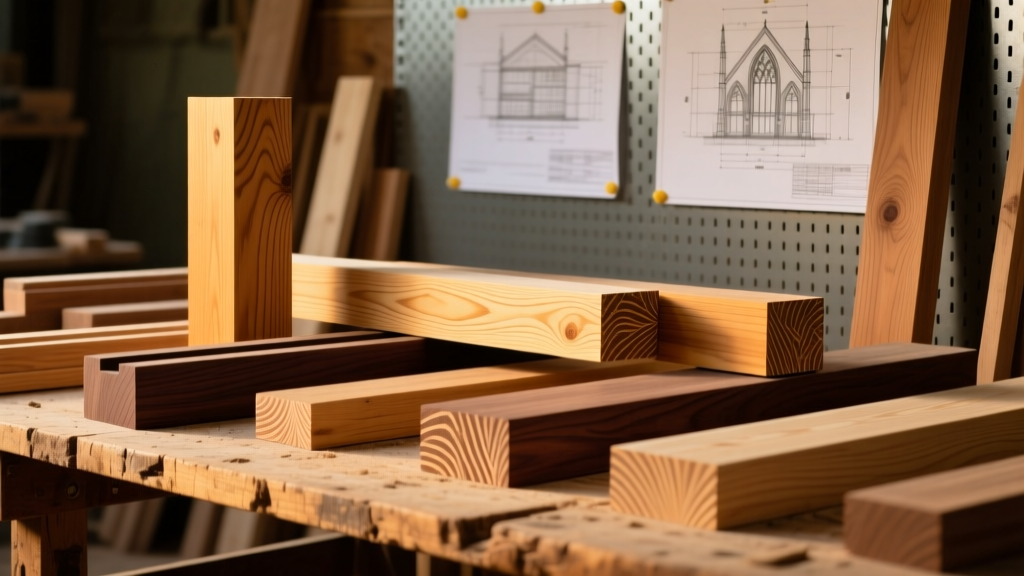
Introduction to Structural Timber Grades
Choosing the correct structural timber grade is one of the most critical decisions in any building project. Whether you are constructing a domestic floor, a commercial roof truss, or a glulam portal frame, understanding the differences between strength classes ensures compliance with UK Building Regulations, optimises material costs, and guarantees long-term structural safety.
In the United Kingdom and across Europe, structural timber is classified according to EN 14081 (for solid sawn timber) and EN 1194/EN 14080 (for glued laminated timber). These standards assign strength classes based on measurable mechanical properties such as bending strength, modulus of elasticity, and density. The most commonly specified grades in UK construction are C16, C24, TR26, GL24h, and GL28h.
This guide provides a detailed structural timber grades comparison, covering solid softwood grades, engineered timber products, grading methods, span tables, typical applications, and cost implications. By the end, you will be equipped to specify the right timber grade for any load-bearing application.
Understanding Timber Strength Classes
Timber strength classes are designated by a letter-and-number code. For solid softwood, the prefix C denotes coniferous (softwood) timber, while D denotes deciduous (hardwood). For glued laminated timber (glulam), the prefix GL is used. The number that follows represents the characteristic bending strength in megapascals (MPa).
For example:
- C16 = softwood with a characteristic bending strength of 16 MPa
- C24 = softwood with a characteristic bending strength of 24 MPa
- TR26 = truss timber graded to 26 MPa (specific to roof truss industry)
- GL24h = glulam with 24 MPa bending strength, homogeneous layup
- GL28h = glulam with 28 MPa bending strength, homogeneous layup
Higher numbers indicate greater load-bearing capacity. However, strength class alone does not tell the full story; designers must also consider stiffness (modulus of elasticity), density, moisture content, and service class conditions.
Key Mechanical Properties Compared
The table below summarises the principal mechanical properties for each grade, taken from EN 338:2016 and manufacturer technical data sheets.
| Property | C16 | C24 | TR26 | GL24h | GL28h |
|---|---|---|---|---|---|
| Characteristic bending strength (fm,k) | 16 MPa | 24 MPa | 26 MPa | 24 MPa | 28 MPa |
| Characteristic tensile strength parallel to grain (ft,0,k) | 10 MPa | 14.5 MPa | 15.6 MPa | 16.5 MPa | 19.5 MPa |
| Characteristic compression strength parallel to grain (fc,0,k) | 17 MPa | 21 MPa | 24 MPa | 24 MPa | 26.5 MPa |
| Mean modulus of elasticity (E0,mean) | 8,000 MPa | 11,000 MPa | 11,700 MPa | 11,600 MPa | 12,600 MPa |
| Characteristic density (ρk) | 310 kg/m³ | 350 kg/m³ | 370 kg/m³ | 380 kg/m³ | 410 kg/m³ |
| Service Class | 1 & 2 | 1 & 2 | 1 & 2 | 1, 2 & 3 | 1, 2 & 3 |
As the table demonstrates, each incremental step up in grade delivers meaningful improvements in both strength and stiffness. The jump from C16 to C24 represents a 50% increase in bending strength, while GL28h offers a further 17% improvement over GL24h.
C16 Timber: The Economy Choice
Properties and Applications
C16 is the baseline structural softwood grade in the UK. It is typically sourced from fast-grown Sitka spruce plantations in Scotland, Wales, and Ireland. Because of its lower density and higher knot content, C16 is suited to applications where spans are relatively short and loads are moderate.
Common uses include:
- Internal stud walls and partitions (non-load-bearing or lightly loaded)
- Ground floor joists at 400 mm centres with spans up to 3.0 m
- Upper floor joists in light-duty residential applications
- Ceiling binders and purlins in small-span situations
Limitations
C16 is generally not recommended for roof rafters in exposed locations, long-span floor joists, or any application where high stiffness is required to limit deflection. Its lower modulus of elasticity means that deflection criteria (typically span/360 for floors) often govern the design before strength limits are reached.
C24 Timber: The Industry Standard
Properties and Applications
C24 is the most widely specified structural timber grade in UK housebuilding and light commercial construction. It is predominantly imported from Scandinavia (Sweden, Finland, Norway) and the Baltic states, where slower growth rates produce denser, stronger wood with fewer knots.
Typical applications for C24 include:
- Roof rafters at 600 mm centres with spans up to 4.8 m
- Floor joists at 400 mm centres spanning up to 4.5 m
- Load-bearing wall studs in two- and three-storey timber frame construction
- Lintels and trimmers in domestic openings
- Timber frame panels manufactured off-site
Why C24 Dominates
The widespread availability of C24 from multiple supply chains means that it offers an excellent balance of performance and cost. Most timber merchants stock C24 as standard, and structural engineers routinely specify it for residential projects. The 50% strength advantage over C16 translates directly into longer allowable spans or reduced section sizes, both of which save money in the overall build.
TR26: Purpose-Graded for Roof Trusses
Origin and Specification
TR26 is a grade developed specifically for the prefabricated roof truss industry in the UK. It was introduced by the Trussed Rafter Association (TRA) to provide a reliable, machine-graded timber suitable for the precision demands of truss manufacturing. TR26 timber must meet a minimum bending strength of 26 MPa and is typically machine stress graded (MSG) to ensure consistent quality.
Applications
TR26 is used almost exclusively in:
- Fink and monopitch roof trusses
- Attic trusses (room-in-the-roof)
- Posi-joists and metal-web joists
- Spandrel panels and hip sets
Because truss manufacturers operate under strict factory production controls (FPC) certified to BS EN 14250, they require timber with predictable and consistent properties. TR26 delivers this reliability, reducing reject rates and ensuring that every truss meets its design load.
Glulam Grades: GL24h and GL28h
What Is Glulam?
Glued laminated timber (glulam) is an engineered wood product made by bonding together multiple laminations of structural timber with durable adhesives. The laminations are typically 33–45 mm thick and are finger-jointed to achieve long lengths. Glulam can be manufactured in straight, curved, or tapered profiles, making it ideal for architecturally expressive structures.
GL24h vs GL28h
The suffix h denotes a homogeneous layup, meaning all laminations are of the same strength class. In contrast, a c suffix (combined) indicates that higher-grade laminations are placed in the outer zones where bending stresses are greatest.
| Feature | GL24h | GL28h |
|---|---|---|
| Bending strength | 24 MPa | 28 MPa |
| Modulus of elasticity | 11,600 MPa | 12,600 MPa |
| Typical lamination grade | C24 throughout | C30 throughout |
| Maximum practical depth | Up to 1,200 mm | Up to 1,200 mm |
| Service class | 1, 2 & 3 | 1, 2 & 3 |
| Common applications | Beams, columns, portals | Long-span beams, arches |
Applications of Glulam
Glulam is specified where solid timber sections are insufficient or where architectural exposure of the timber is desired:
- Portal frames for commercial and agricultural buildings
- Long-span beams in schools, sports halls, and swimming pools
- Curved arches and barrel vaults
- Exposed columns and feature beams in residential projects
- Bridge decks and footbridges
Visual Grading vs Machine Grading
Visual Strength Grading
Visual grading is performed by trained assessors who inspect each piece of timber for defects that reduce strength. The grader examines:
- Knots – size, position, and frequency
- Slope of grain – deviation of fibres from the longitudinal axis
- Wane – bark or missing wood on edges
- Fissures and shakes – splits along the grain
- Rate of growth – indicated by ring width
Visual grading is governed by BS 4978 (for softwood) and BS 5756 (for hardwood). It is labour-intensive and subjective, but it remains useful for small batches, heritage restoration, and situations where machine graders are unavailable.
Machine Stress Grading (MSG)
Machine grading uses automated equipment to measure the stiffness of each piece of timber by applying a known load and measuring deflection. The machine then assigns a grade based on the measured modulus of elasticity. Machine grading offers several advantages:
- Consistency – removes human variability
- Speed – modern graders process over 120 linear metres per minute
- Accuracy – direct measurement of stiffness correlates well with strength
- Traceability – each piece is marked with grade, species, and mill identifier
Most C24 and TR26 timber sold in the UK is machine graded. C16 may be visually or machine graded depending on the source.
Span Tables: Practical Guidance
The following simplified span tables are based on Eurocode 5 (EN 1995-1-1) calculations for Service Class 1 conditions (internal, heated environments). They assume a maximum deflection limit of span/360 under total load and are provided for illustrative purposes only. All structural designs must be verified by a qualified engineer.
Floor Joists – Domestic Loading (1.5 kN/m² imposed + 0.5 kN/m² dead)
| Section Size (mm) | C16 Max Span @ 400 ctrs | C24 Max Span @ 400 ctrs | C16 Max Span @ 600 ctrs | C24 Max Span @ 600 ctrs |
|---|---|---|---|---|
| 47 × 150 | 2.78 m | 3.46 m | 2.48 m | 3.08 m |
| 47 × 175 | 3.28 m | 4.05 m | 2.92 m | 3.62 m |
| 47 × 200 | 3.74 m | 4.62 m | 3.34 m | 4.14 m |
| 47 × 225 | 4.20 m | 5.19 m | 3.76 m | 4.64 m |
Roof Rafters – Pitched Roof (0.75 kN/m² total load, 30° pitch)
| Section Size (mm) | C16 Max Span @ 600 ctrs | C24 Max Span @ 600 ctrs |
|---|---|---|
| 47 × 125 | 2.60 m | 3.12 m |
| 47 × 150 | 3.16 m | 3.80 m |
| 47 × 175 | 3.72 m | 4.48 m |
| 47 × 200 | 4.26 m | 5.12 m |
These tables illustrate clearly why C24 is preferred for most structural applications: the same section size delivers approximately 20% longer spans, reducing the number of supporting walls or beams required.
Building Regulations and Compliance
Approved Document A (Structure)
In England and Wales, structural timber must comply with Approved Document A, which references Eurocode 5 for the design of timber structures. Key requirements include:
- All structural timber must be strength graded to EN 14081 (solid) or EN 14080 (glulam)
- Timber must bear the CE or UKCA mark, showing declared performance values
- Moisture content at time of installation must not exceed 20% for internal use (Service Class 1 & 2)
- Preservative treatment must be applied where timber is at risk of insect or fungal attack
- Fire performance must be demonstrated, typically through charring rate calculations to EN 1995-1-2
National Annexes and Service Classes
The UK National Annex to Eurocode 5 modifies certain partial safety factors and combination factors. Designers must also assign a Service Class to each member:
- Service Class 1 – moisture content ≤ 12% (heated interiors)
- Service Class 2 – moisture content ≤ 20% (unheated but sheltered)
- Service Class 3 – moisture content > 20% (external, exposed)
Higher service classes require larger modification factors (kmod), effectively reducing the allowable stress. Glulam grades GL24h and GL28h can be used in all three service classes when manufactured with appropriate adhesives (typically resorcinol or melamine-urea-formaldehyde).
Cost Comparison
Material costs vary by region, supplier, and market conditions. The figures below represent typical UK merchant prices as of mid-2025, exclusive of VAT.
| Grade | Typical Price per m³ | Relative Cost Index |
|---|---|---|
| C16 | £380 – £440 | 1.00 |
| C24 | £480 – £560 | 1.25 |
| TR26 | £520 – £600 | 1.35 |
| GL24h | £1,100 – £1,400 | 2.90 |
| GL28h | £1,300 – £1,650 | 3.40 |
While glulam is significantly more expensive per cubic metre than solid timber, it delivers value through:
- Longer spans – reducing the need for intermediate supports and steel beams
- Architectural expression – exposed glulam eliminates the cost of secondary finishes
- Dimensional stability – minimal shrinkage and warping reduces call-backs
- Prefabrication – large sections can be CNC-cut off-site, speeding construction
For domestic floor joists and roof rafters, C24 remains the most cost-effective choice in the vast majority of cases. Upgrading from C16 to C24 typically adds only 3–5% to the total structural timber budget while delivering substantially better performance.
Sustainability and Environmental Considerations
All structural timber grades discussed in this guide are sourced from sustainably managed forests, certified under schemes such as FSC (Forest Stewardship Council) or PEFC (Programme for the Endorsement of Forest Certification). Specifying certified timber earns credits under BREEAM and the Code for Sustainable Homes.
Timber also offers the lowest embodied carbon of any structural material. A cubic metre of spruce sequesters approximately 0.9 tonnes of CO₂, and the energy required to process it into structural sections is a fraction of that needed for steel or concrete. Glulam, despite the energy used in adhesive production and pressing, still achieves a carbon-negative balance when sourced from certified forests.
For projects targeting Passivhaus, BREEAM Outstanding, or net-zero carbon, specifying timber grades that maximise structural efficiency (and therefore minimise material volume) is a sound environmental strategy.
Specifying the Right Grade: A Decision Framework
Use the following decision guide to select the appropriate timber grade for your project:
- Short-span internal partitions and ceiling joists → C16 is adequate and economical.
- Domestic floor joists, roof rafters, and wall studs → C24 is the default specification for most UK housebuilders.
- Prefabricated roof trusses → TR26 is the industry standard; specify it on all truss contracts.
- Long-span beams, portal frames, exposed structures → GL24h for standard applications; GL28h where maximum span or minimum depth is critical.
- External or high-moisture environments → Specify glulam (GL24h or GL28h) with Service Class 3 adhesives and appropriate preservative treatment.
Summary Comparison Table
| Grade | Type | Bending Strength | Stiffness (E mean) | Best For | Relative Cost |
|---|---|---|---|---|---|
| C16 | Solid softwood | 16 MPa | 8,000 MPa | Short spans, partitions | £ |
| C24 | Solid softwood | 24 MPa | 11,000 MPa | Floors, roofs, wall frames | ££ |
| TR26 | Machine graded | 26 MPa | 11,700 MPa | Roof trusses, joists | ££ |
| GL24h | Glulam | 24 MPa | 11,600 MPa | Beams, portals, columns | £££ |
| GL28h | Glulam | 28 MPa | 12,600 MPa | Long spans, arches | ££££ |
Conclusion
A thorough structural timber grades comparison reveals that the UK market offers a well-differentiated range of products to suit every application and budget. C16 serves as the economical baseline for light-duty work, C24 is the versatile workhorse for mainstream construction, TR26 delivers the consistency demanded by truss manufacturers, and GL24h/GL28h glulam enables ambitious architectural and engineering designs.
By understanding the mechanical properties, grading methods, span capabilities, and cost profiles of each grade, specifiers can make informed decisions that balance structural performance, regulatory compliance, and project economics. Always consult a structural engineer for final design verification, and ensure that all timber carries the appropriate CE or UKCA marking for your jurisdiction.
Whether you are a self-builder selecting joists for a home extension or a consultant engineer designing a glulam portal frame, the right grade choice underpins the safety, durability, and value of every timber structure.