What Type of Wood Was the Ark Made Of? A Timber Comparison
Discover what type of wood the ark was made of. We compare gopher wood candidates like cypress, teak, and cedar for historic shipbuilding traits.

The "Gopher Wood" Mystery: Translating Genesis 6:14
The biblical account of Noah's Ark specifies a highly enigmatic building material: "gopher wood" (Genesis 6:14). In Hebrew, the term is gopher (גֹּפֶר), a hapax legomenon—a word that appears only once in the entire Hebrew Bible. Because it lacks a direct linguistic parallel, botanists, theologians, and naval architects have debated its true identity for centuries. To answer the question of what type of wood the ark was made of, we must evaluate the candidate species not merely through historical availability in the ancient Near East, but through the rigorous lens of marine timber engineering.
Constructing a wooden vessel 300 cubits long (approximately 510 feet) pushes the absolute limits of timber shipbuilding. For context, the largest wooden sailing ship ever built, the Wyoming (1909), was 450 feet long and suffered from severe hogging and sagging in heavy seas, requiring iron cross-bracing to keep the hull from tearing apart. Therefore, the "gopher" timber had to possess exceptional tensile strength, natural rot resistance, and the ability to yield long, straight beams. Below, we compare the four leading botanical candidates.
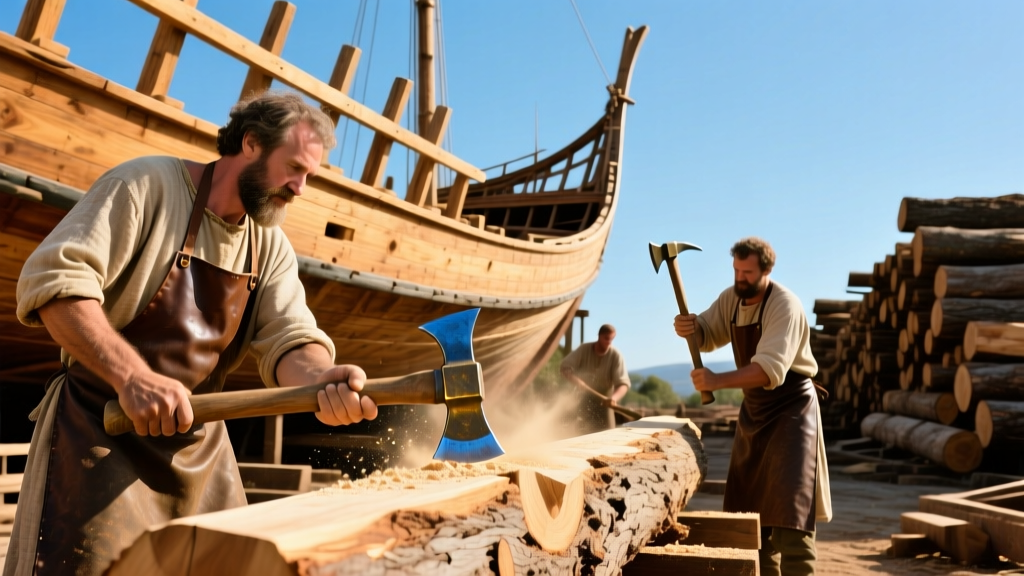
Top Candidate Species for Ark Construction
1. Mediterranean Cypress (Cupressus sempervirens)
Mediterranean Cypress is the most widely accepted candidate among biblical scholars and naval historians. The Hebrew word gopher shares a phonetic and etymological root with kopher (pitch/resin), and cypress is renowned for its highly resinous, pitch-rich heartwood. Ancient Egyptian and Greek shipwrights heavily favored cypress for building merchant vessels and warships due to its natural resistance to marine borers and decay.
- Pros: High natural resin content provides inherent waterproofing and rot resistance; grows tall and straight, yielding long timbers; excellent dimensional stability when exposed to moisture cycles.
- Cons: Relatively low Janka hardness (430 lbf) makes it susceptible to impact damage from floating debris; lower modulus of rupture compared to dense hardwoods.
According to The Wood Database, Mediterranean Cypress features a specific gravity of 0.42, making it lightweight enough to maintain buoyancy while providing sufficient structural integrity for a barge-like hull.
2. Teak (Tectona grandis)
Teak is universally considered the gold standard for marine timber. It contains high levels of silica and natural oils that make it virtually impervious to water rot, fungal decay, and Teredo navalis (shipworms). While teak is native to the Indian subcontinent and Southeast Asia, extensive ancient trade routes could have theoretically supplied it to the Mesopotamian region.
- Pros: Unmatched marine durability; Janka hardness of 1,070 lbf provides high impact resistance; natural oils eliminate the need for extensive external pitch coatings.
- Cons: High silica content rapidly dulls bronze and iron cutting tools, making ancient harvesting and shaping exceedingly difficult; heavy specific gravity (0.56) reduces overall cargo buoyancy.
3. Lebanese Cedar (Cedrus libani)
Cedar of Lebanon was the premier prestige timber of the ancient Near East, famously used by King Solomon to build the First Temple and by the Phoenicians to construct their legendary fleet. It is lightweight, straight-grained, and highly workable.
- Pros: Excellent strength-to-weight ratio; highly workable with ancient tools; pleasant aroma and natural resistance to dry rot and insects.
- Cons: Brittle under dynamic wave-loading; prone to splitting when driven with wooden treenails (pegs); historically reserved for royalty, making it unlikely for a massive, utilitarian survival barge.
4. Acacia (Acacia nilotica)
Acacia is incredibly dense, durable, and abundant in the Middle East and Egypt. It was used for the Tabernacle furniture and Egyptian chariots. However, its growth habit makes it a poor candidate for a 510-foot ship.
- Pros: Extreme hardness (2,300+ lbf); virtually immune to rot and insect degradation.
- Cons: Grows in twisted, short, and irregular forms. Finding beams long enough to span the Ark's massive 85-foot width would be botanically impossible.
Structural & Marine Comparison Matrix
To determine which wood best suits a 510-foot wooden hull, we must look at the engineering data. The following matrix compares the critical structural properties of the candidate species.
| Timber Species | Janka Hardness (lbf) | Specific Gravity (Basic) | Modulus of Rupture (psi) | Rot Resistance | Max Natural Beam Length |
|---|---|---|---|---|---|
| Mediterranean Cypress | 430 | 0.42 | 9,400 | Very High (Resinous) | 60 - 80 ft |
| Teak | 1,070 | 0.56 | 14,100 | Exceptional (Oily) | 40 - 60 ft |
| Lebanese Cedar | 420 | 0.39 | 10,600 | High | 60 - 90 ft |
| Acacia (Nilotica) | 2,300 | 0.72 | 16,500 | Exceptional | 15 - 25 ft |
Pitch and Waterproofing: The "Kopher" Factor
Genesis 6:14 commands: "Make yourself an ark of gopher wood; make rooms in the ark, and cover it inside and out with pitch." The Hebrew word for pitch is kopher (כֹּפֶר). The linguistic similarity between gopher and kopher has led many Hebrew scholars to suggest that "gopher wood" may not refer to a specific tree species at all, but rather to a grade or process of wood preparation.
If gopher translates to "pitch-wood" or "resinous wood," this heavily reinforces the case for Mediterranean Cypress or a highly resinous Pine species. The process of "pitching" the vessel inside and out was not merely for waterproofing; it was a vital structural adhesive. In ancient wooden shipbuilding, hot pine pitch mixed with animal fat or beeswax was driven into the caulking seams between the timber planks. As the wood absorbed moisture and swelled, the pitch acted as a flexible gasket, preventing the hull from weeping under hydrostatic pressure.
Modern Shipbuilding Verdict: Which Wood Wins?
If a modern timber engineer were tasked with replicating the Ark using only ancient Near Eastern materials, Mediterranean Cypress is the undisputed choice for the primary hull planking and framing. While Teak offers superior hardness and Lebanese Cedar offers superior length, Cypress strikes the exact engineering balance required for a massive survival barge:
- Weight-to-Buoyancy Ratio: Its low specific gravity (0.42) ensures the massive structure remains buoyant even when loaded with thousands of tons of cargo, feed, and water.
- Flexural Yield: Cypress can endure the dynamic hogging (bending upward) and sagging (bending downward) caused by 100-foot ocean swells without suffering catastrophic tensile failure.
- Resin Synergy: The natural resins in the wood bond chemically with the kopher (pitch) coating, creating a monolithic, waterproof barrier that prevents the internal wood from rotting during a year-long voyage in a hyper-humid environment.
Frequently Asked Questions About Ark Timber
Could the Ark have been made of multiple wood species?
Yes. Ancient shipwrights routinely mixed timbers based on structural needs. The Ark likely utilized Cypress for the massive hull planking and framing, Cedar for the upper deck beams and masts (if any were used for ventilation sails), and harder woods like Oak or Acacia for critical joinery, treenails (wooden pegs), and high-wear decking areas.
How did ancient builders join 510 feet of wood without iron nails?
Iron nails were not strictly necessary for ancient shipbuilding. The Greeks and Egyptians used mortise-and-tenon joints, where a protruding wooden tenon on one plank fits into a carved slot (mortise) on the adjacent plank, locked in place by driven wooden pegs (treenails). As the wood absorbs water and swells, the joints lock together with immense friction, creating a watertight seal stronger than early iron fasteners, which would rapidly rust and fail in saltwater.
Does "gopher wood" exist today under a different name?
Most botanical and linguistic consensus points to the Cypress family (Cupressaceae). If gopher is a transliteration of an ancient Sumerian or Akkadian trade word for "pitch-tree," it maps directly to the resinous conifers native to the mountainous regions of the ancient Near East, which are still harvested today for marine and exterior construction.
Written by
Priya KapoorPriya Kapoor is a real estate market analyst and construction economics researcher with expertise in housing affordability, development feasibility, and infrastructure investment. She holds a Master of Regional Planning from Cornell University and previously worked as a senior analyst at CBRE's Investment Properties group, where she modeled returns for $4B in mixed-use development pipelines. Priya now runs an independent research practice advising developers, municipalities, and REITs on construction cost forecasting and market timing. She publishes the quarterly "BuildMat Market Pulse" report tracking material price indices across 12 commodity categories. Based in Austin, TX, Priya serves on the board of Habitat for Humanity Austin and is a marathon runner.
More from Priya Kapoor
View all
Construction Cost
Cost to Build a 1600 Sq Ft Home in 2026: Full Breakdown
Accurate 2026 cost to build a 1600 sq ft home—material, labor, and regional pricing breakdowns included. Plan your budget with real-time estimates.
Aug 11, 2026

Wood & Lumber
Name the Types of Wood for Pressure Treatment and Preservation
Learn how to name the types of wood best suited for pressure treatment. Compare species treatability, chemical retention levels, and 2026 preservation costs.
Aug 4, 2026

Stone & Masonry
Stone Veneer Suppliers Lindenhurst: 2026 Cost Analysis
Analyze 2026 stone veneer costs in Lindenhurst, NY. Compare local supplier pricing, delivery fees, and Suffolk County installation labor rates.
Aug 4, 2026