Selecting Types of Hand Wood Saws: A Woodworker's Framework
Master the selection of hand wood saws with our pro framework. Compare rip, crosscut, and Japanese pull saws for precise woodworking and framing.

The Anatomy of a Hand Saw Cut
Selecting the correct saw is not about brand loyalty; it is an exercise in applied geometry and metallurgy. Every hand saw is engineered to manage three variables: kerf width, tooth set, and cutting angle. Understanding these variables is the prerequisite to mastering the different types of hand wood saws available on the market today.
Manufacturers often use TPI (Teeth Per Inch) and PPI (Points Per Inch) interchangeably, but they are not the same. PPI counts the points (the tips of the teeth), while TPI counts the gullets (the valleys between teeth). A saw with 14 PPI has 13 TPI. When calculating chip clearance for deep rip cuts, always calculate based on TPI, as the gullet volume dictates how much sawdust the saw can evacuate before binding.
The 'set' of a saw refers to the lateral bend of the teeth. Alternate set (teeth bent left and right) creates a kerf wider than the blade plate, preventing friction and binding. However, excessive set wastes material and requires more physical energy. For fine joinery in dry hardwoods, minimal set (or no set, relying on blade taper) is preferred, whereas framing in wet dimensional lumber requires aggressive set to accommodate wood swelling.
The Core Types of Hand Wood Saws Explained
The taxonomy of hand saws is broadly split by stroke mechanics (push vs. pull) and cut orientation (rip vs. crosscut). Here is how the primary categories function in a modern workshop.
Western Push Saws (Crosscut & Rip)
Traditional Western saws cut on the push stroke, requiring a thicker blade plate to prevent buckling under compressive load.
- Crosscut Saws: Feature teeth filed with a 'fleam' angle (typically 15 to 20 degrees), acting like tiny knives to sever wood fibers perpendicular to the grain. Ideal for sizing boards and cutting tenons to length.
- Rip Saws: Feature chisel-shaped teeth filed straight across (0-degree fleam). They act like a series of tiny hand planes, scooping out material parallel to the grain. Essential for resawing and cutting dovetail pins.
Japanese Pull Saws (Ryoba, Dozuki, Mawashibiki)
Because the blade is under tension during the pull stroke, Japanese saws can be manufactured with exceptionally thin steel (often SK-5 high-carbon steel). This results in a significantly narrower kerf and less physical effort per stroke.
- Ryoba: A double-edged saw with crosscut teeth on one side and rip teeth on the other. The ultimate general-purpose carpentry saw.
- Dozuki: The Japanese equivalent of a backsaw. It features a stiffening spine (usually brass or steel) to keep the ultra-thin blade rigid for precision joinery.
- Mawashibiki: A keyhole saw with a narrow, tapered blade for cutting curves and interior cutouts.
Specialty & Joinery Saws
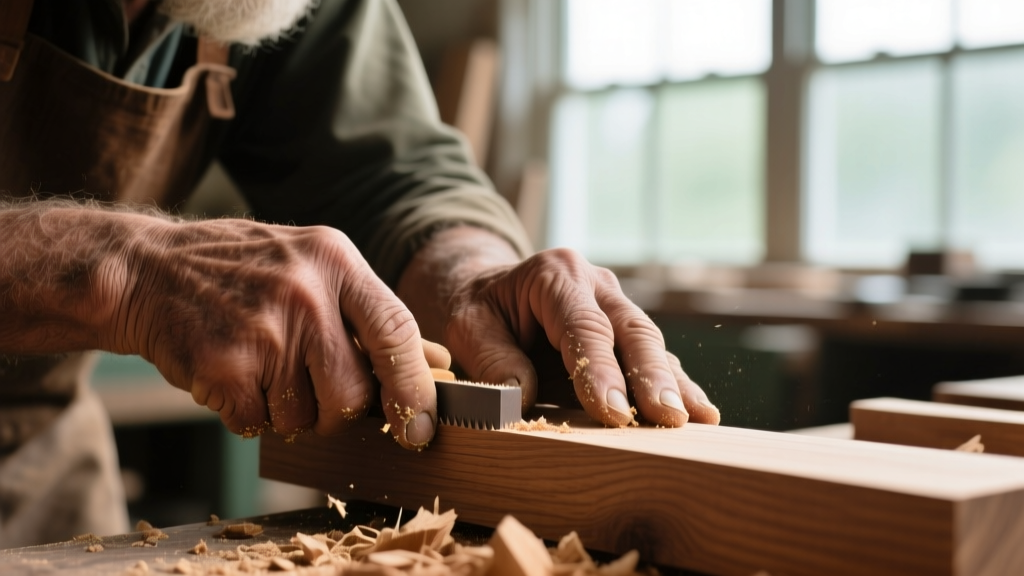
According to tool experts at Popular Woodworking, specialty saws bridge the gap between rough dimensioning and final assembly. Backsaws (Western tenon and carcass saws) utilize a rigid spine for dead-straight cuts in furniture making. Flush-cut saws feature zero-set teeth with a flexible blade, allowing you to trim dowels and plugs perfectly level with the workpiece surface without scratching the surrounding wood.
The 4-Step Selection Framework
When faced with a specific cutting task, run the material and the desired outcome through this four-step decision matrix to select the optimal tool.
- Identify Grain Orientation: Are you cutting across the fibers (crosscut) or parallel to them (rip)? Using a crosscut saw to rip hard maple will result in agonizingly slow progress and rapid edge dulling. Conversely, using a rip saw to crosscut plywood will cause catastrophic tear-out on the bottom veneer.
- Apply the 3-Tooth Rule: Match the TPI to your stock thickness. At least three teeth must be engaged in the material at all times. If you are cutting 1/4" stock, you need a minimum of 12 TPI. If cutting a 2x4 (1.5" thick), a 5 to 8 TPI saw is optimal. Too few teeth causes snagging and chattering; too many teeth clogs the gullets and slows the cut.
- Determine Kerf Tolerance: For structural framing or rough carpentry, kerf width is irrelevant—prioritize speed and aggressive set. For dovetails or mortise-and-tenon joinery, a thin-kerf pull saw or a finely set Western backsaw is mandatory to maintain tight tolerances (under 0.020").
- Evaluate Stroke Ergonomics: Pull saws excel in delicate, unsupported cuts (like cutting a dowel flush) because the tension keeps the blade straight without requiring downward force. Push saws excel when you can clamp the workpiece securely and use your body weight to drive the cut.
2026 Market Pricing & Brand Matrix
The hand saw market has bifurcated into disposable, impulse-hardened consumer saws and premium, resharpenable professional tools. Below is a snapshot of current benchmark models and their specific applications.
| Brand & Model | Saw Type | TPI | Kerf | Est. Price | Primary Use Case |
|---|---|---|---|---|---|
| Silky Gomboy 270 | Ryoba (Pull) | 6.5 / 13 | 0.051" | $62 | General carpentry, site work, pruning |
| Gyokucho Razorsaw #372 | Dozuki (Pull) | 22 | 0.020" | $48 | Fine dovetails, small tenons, model making |
| Veritas Carcass Saw | Backsaw (Push) | 14 | 0.024" | $119 | Precision Western joinery, furniture making |
| Stanley FatMax Xtreme 15" | Crosscut (Push) | 9 | 0.045" | $29 | Rough framing, dimensional lumber, demo |
| Shinwa Flush Cut | Veneer (Pull) | 28 | 0.010" | $19 | Trimming dowels, plugs, and flush cuts |
Edge Retention: Sharpening vs. Replacement
A critical factor in selecting types of hand wood saws is understanding the metallurgy of the teeth. Most modern consumer saws (including many Japanese pull saws and Western hardware store saws) feature impulse-hardened teeth. This process uses high-frequency electrical current to instantly heat and quench the tooth tips, achieving a Rockwell hardness of up to 68 HRC.
While impulse-hardened teeth stay sharp 3 to 5 times longer than untreated steel, they are completely brittle and cannot be sharpened with standard mill or triangular files. The file will simply slide off or shatter the tooth. Once an impulse-hardened saw goes dull, the blade must be replaced. For production environments or occasional DIYers, this is cost-effective. For traditional woodworkers, investing in unhardened high-carbon steel (like the Veritas or premium Disston models) allows for infinite resharpening and custom tooth geometry.
Guidelines from Fine Woodworking emphasize that learning to sharpen a Western handsaw requires only a few specialized files (a taper file for crosscut, a double-cut mill file for rip) and a saw set tool to maintain the lateral bend of the teeth. A properly tuned, unhardened rip saw will cut through hard maple faster and smoother than a brand-new, out-of-the-box hardware store saw.
Troubleshooting Common Sawing Failures
Even with the correct saw type, poor technique or environmental factors can ruin a cut. Use this diagnostic matrix to correct issues on the fly.
- Symptom: Saw binds tightly in the kerf mid-cut.
Cause: Insufficient tooth set for the moisture content of the wood, or internal tension in the board pinching the blade.
Fix: Rub paraffin wax or candle wax on the blade plate to reduce friction. If cutting a board with internal tension, insert a small wooden wedge into the kerf behind the saw to keep it open. - Symptom: Severe tear-out on the exit side of a crosscut.
Cause: The teeth are acting as chisels on the unsupported bottom fibers, or the saw is dull.
Fix: Score the cut line deeply with a marking knife before sawing. Alternatively, clamp a sacrificial backer board tightly against the exit side to support the fibers. - Symptom: The saw tracks off the layout line despite starting perfectly.
Cause: Uneven set (more teeth bent to one side than the other) or twisting the wrist during the stroke.
Fix: Check the set with a dial caliper. If the saw is perfectly set, the error is biomechanical—focus on aligning your shoulder, elbow, and wrist in a single plane parallel to the cut line.
"A hand saw is not a blunt instrument; it is a precision array of micro-chisels. Treating a 22-TPI Dozuki with the same brute force you apply to a 9-TPI framing saw will instantly buckle the plate and snap the teeth. Let the geometry of the tool do the work; your arm merely provides the transit."
By applying this framework—matching the tooth geometry to the grain direction, respecting the 3-tooth rule for stock thickness, and choosing the appropriate stroke mechanics for your workholding setup—you will eliminate the frustration of binding, tear-out, and inaccurate joinery, elevating the quality of every wood project you undertake.
Written by
Sarah WhitfieldSarah Whitfield is a chartered quantity surveyor (MRICS) and construction cost analyst with 15 years of experience in material pricing, procurement strategy, and project budgeting. She earned her degree in Construction Management from the University of Reading (UK) and has worked on projects ranging from $2M custom homes to $180M mixed-use developments across North America and Europe. Sarah currently leads cost estimating for BuildMat Insight, maintaining a proprietary database of 4,000+ material price points updated quarterly. She is a frequent contributor to RSMeans cost data panels and has presented at the International Cost Engineering Council (ICEC) congress. Based in Denver, CO, Sarah is an avid trail runner and volunteer mentor for Women in Construction.
More from Sarah Whitfield
View all
Wood & Lumber
What Are the Different Types of Wood? A Builder's Guide
Compare structural softwoods, finish hardwoods, and engineered lumber. Analyze Janka ratings, MOE values, and 2026 pricing for construction.
Aug 4, 2026

Walls & Panels
Steel Framing vs Wood Framing: Corrosion and Moisture Defense
Compare steel framing vs wood framing for moisture resistance. Learn about galvanized coatings, condensation risks, and corrosion protection strategies.
Jul 21, 2026

Stone & Masonry
How to Cut Stone Veneer: Wet Saw vs Grinder Comparison
Compare the best tools for cutting stone veneer. We review wet saws, angle grinders, and chop saws to help you achieve clean, chip-free cuts.
Jul 21, 2026