Cost Per Sq Ft to Build a House in Arizona: 2026 Budget Guide
Analyze the 2026 cost per sq ft to build a house in Arizona. Breakdowns for Phoenix, Tucson, and Flagstaff, plus hidden desert construction costs.
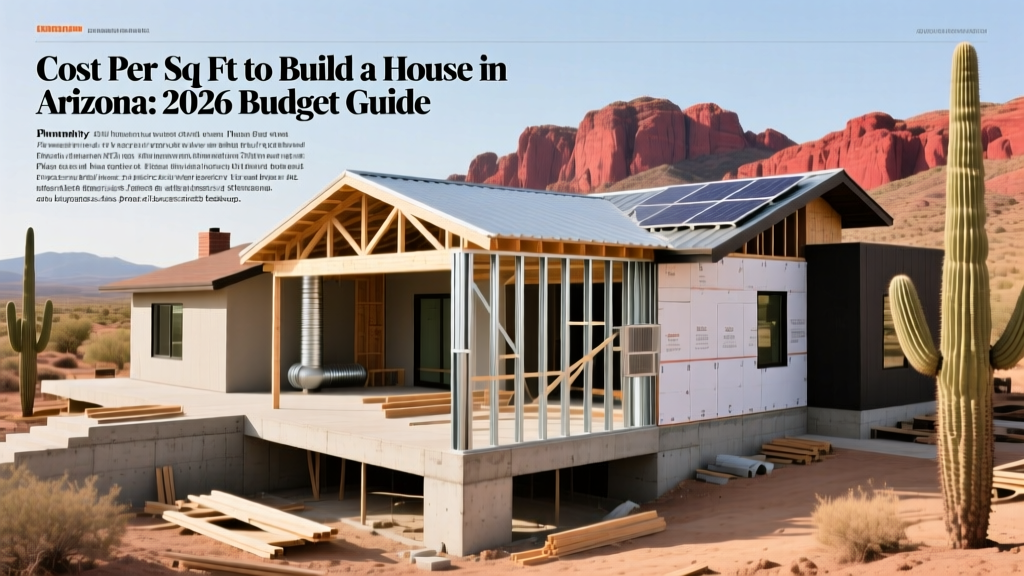
The Real Cost Per Sq Ft to Build a House in Arizona (2026 Data)
Building in the Sonoran Desert or the high country of the Colorado Plateau requires entirely different structural engineering, material selections, and site prep strategies. The baseline cost per sq ft to build a house in Arizona ranges from $155 to $450+ in 2026, but raw averages obscure the localized expenses that routinely derail budgets. According to data tracked by the U.S. Census Bureau New Residential Construction reports and regional builder surveys, Arizona's construction costs are heavily dictated by micro-climates, geotechnical anomalies, and municipal utility impact fees.
2026 Arizona Construction Cost Baselines
- Production / Tract Homes: $155 – $185 per sq. ft.
- Semi-Custom Builds: $200 – $260 per sq. ft.
- High-End Custom Luxury: $300 – $450+ per sq. ft.
Note: These figures represent vertical construction costs and exclude land acquisition, site development, and architectural/engineering fees.
Regional Variations: Phoenix vs. Tucson vs. Flagstaff
Arizona is not a monolith. A 2,500 sq. ft. home in Scottsdale will have a drastically different cost profile than the exact same footprint in Flagstaff or Tucson. The National Association of Home Builders (NAHB) notes that labor availability and topographical challenges are the primary drivers of regional variance.
| Region | Semi-Custom Cost / Sq Ft | Primary Cost Drivers |
|---|---|---|
| Phoenix Metro (East Valley) | $210 - $265 | Expansive clay soils, post-tension slabs, high HVAC tonnage requirements. |
| Phoenix Metro (West Valley) | $195 - $245 | Caliche rock excavation, extreme heat mitigation for labor, SRP/APS hookup fees. |
| Tucson / Southern AZ | $190 - $240 | Monsoon wind-load engineering, slightly lower labor rates, water conservation mandates. |
| Flagstaff / Prescott | $250 - $320 | 48-inch frost depth foundations, heavy snow load trusses, steep slope grading, wildfire WUI codes. |
Hidden Arizona Cost Drivers That Break Budgets
National cost estimators frequently fail in Arizona because they do not account for subsurface geology and extreme thermal loads. Budget planning must include line items for the following localized challenges.
1. The Caliche and Expansive Soil Tax
In the West Valley (Buckeye, Goodyear, Surprise), builders frequently encounter caliche—a concrete-like crust of calcium carbonate. Standard trenching equipment cannot penetrate it; excavation requires D8 dozers with ripper bars or pneumatic hammers, adding $3,500 to $7,000 per lot just for site prep. Conversely, the East Valley (Gilbert, Queen Creek, Chandler) sits on expansive clays that swell significantly when wet. To prevent catastrophic foundation failure, engineers mandate post-tension (PT) slabs. PT slabs use steel tendons tensioned to 33,000 PSI after the concrete cures, compressing the slab to resist cracking. Expect to pay $1.50 to $2.50 extra per square foot of slab area for a PT foundation compared to conventional rebar.
2. Thermal Envelope and HVAC Sizing
Arizona summers demand aggressive thermal boundaries. Standard fiberglass batt insulation is insufficient for modern energy codes and utility rate plans. In 2026, custom builders are standardizing on closed-cell or open-cell spray foam applied directly to the underside of the roof deck (creating an unvented, semi-conditioned attic). This keeps HVAC ducts within the thermal envelope, preventing the 20-30% energy losses common in vented attics where ambient temperatures routinely exceed 150°F.
Furthermore, ENERGY STAR Heating and Cooling Guidelines and local utility rebates heavily incentivize 18+ SEER2 systems. For a 3,000 sq. ft. home in Maricopa County, budget for dual-zone, high-efficiency heat pumps (e.g., Carrier Infinity or Trane XV series) costing $22,000 to $35,000 installed, significantly higher than the national average.
3. Roofing Weight and Truss Engineering
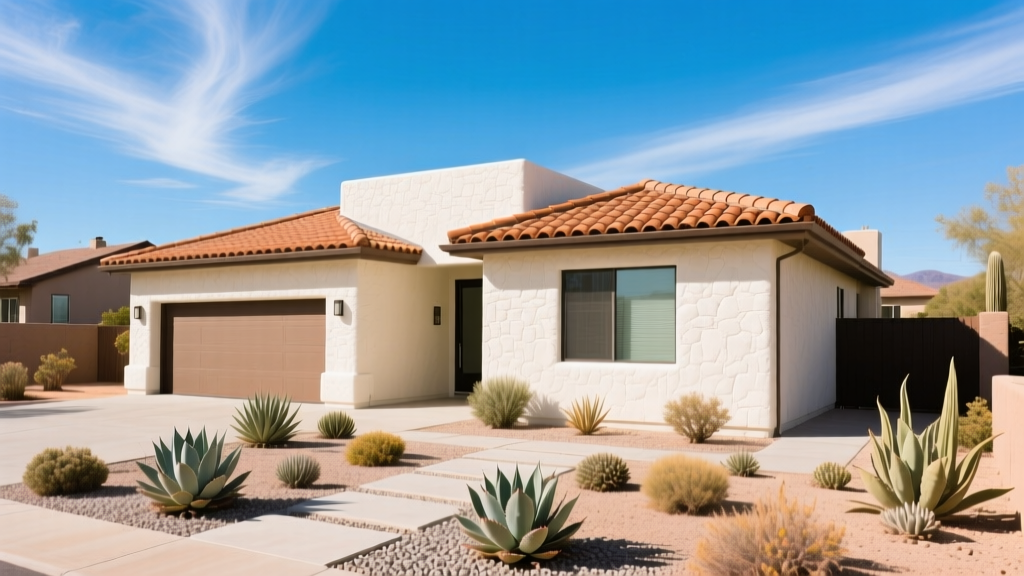
Concrete and clay roof tiles (e.g., Eagle Roofing or Boral) are the standard for fire resistance and longevity in Arizona. However, they weigh between 900 and 1,100 lbs per square (100 sq. ft.). This dead load requires engineered roof trusses with heavier lumber grades (2x6 top chords) and tighter spacing (12" or 16" on-center rather than 24"). This structural upgrade adds $2.50 to $4.00 per square foot of roof area compared to architectural asphalt shingles.
Foundation Decision Matrix for Arizona Soils
Choosing the wrong foundation system for your specific parcel is the most expensive mistake in Arizona residential construction. Use this matrix during the budgeting phase:
Post-Tension Slab
Best For: East Valley expansive clays, large open-concept floorplans.
Pros: Highly resistant to differential settlement; uses less steel than conventional slabs.
Cons: Cannot drill into the slab post-pour for plumbing modifications; requires specialized licensed contractor.
Conventional Rebar Slab
Best For: Stable soils (parts of North Scottsdale, bedrock parcels).
Pros: Cheaper upfront; easy to core-drill for post-construction plumbing or gas lines.
Cons: High risk of severe cracking if soil moisture fluctuates; requires deep grade beams.
Stem Wall with Crawl Space
Best For: Flagstaff, Prescott, and sloped desert lots.
Pros: Accommodates frost-depth requirements (48"); allows easy access to plumbing/electrical.
Cons: High labor and excavation costs; requires extensive waterproofing and vapor barriers.
Pier and Grade Beam
Best For: Extreme slopes, hillside lots in Paradise Valley or Tucson foothills.
Pros: Minimizes site grading and retaining wall requirements; preserves natural drainage.
Cons: Most expensive option; requires deep caissons drilled into bedrock.
Step-by-Step Budget Allocation Framework
When planning your capital stack for a custom build in Arizona, allocate your vertical construction budget using this desert-specific framework. Note the heavier weighting toward site prep and MEP (Mechanical, Electrical, Plumbing) compared to national averages.
- Site Prep, Grading & Foundation (14% - 18%): Higher than the national 10% average due to caliche ripping, engineered fill imports, and post-tension engineering.
- Framing & Exterior Envelope (20% - 24%): Includes upgraded trusses for tile roofs, structural insulated panels (SIPs), or advanced framing techniques.
- MEP Rough-in & Trim (15% - 18%): Driven by high-tonnage HVAC, tankless water recirculation loops, and whole-house water filtration (essential for AZ hard water).
- Insulation & Thermal Sealing (6% - 8%): Spray foam rooflines, radiant barrier sheathing (e.g., LP TechShield), and airtight drywall approaches.
- Interior Finishes (25% - 30%): Flooring (porcelain tile and polished concrete dominate over hardwood due to humidity fluctuations), cabinetry, and trim.
- Exterior Living & Hardscape (5% - 8%): Covered patios with integrated misting systems, outdoor kitchens, and desert landscaping.
Permitting, Impact Fees, and Xeriscaping Mandates
Before breaking ground, municipalities will assess development impact fees. In Maricopa County, water and sewer capacity charges, school district fees, and park dedication fees can total between $12,000 and $22,000 per single-family lot. Unincorporated Pinal County may have lower impact fees but will require you to budget $15,000 to $30,000 for a private septic system and well drilling if municipal infrastructure is unavailable.
Finally, budget planning must account for xeriscaping mandates. Municipalities like Scottsdale, Gilbert, and Mesa enforce strict water conservation codes, often limiting turf grass to less than 10% of the landscaped area. Budget $8 to $14 per square foot of landscaped area for crushed granite, river rock, boulders, and low-water-use plants (Lantana, Agave, Palo Verde trees), alongside smart drip-irrigation controllers that tie into local municipal water restriction schedules.
Frequently Asked Questions
Do I need a radiant barrier in my Arizona home?
Yes. While spray foam on the roofline is the gold standard, if you are building on a tighter budget and using a vented attic with blown-in cellulose or fiberglass, a radiant barrier sheathing (like LP TechShield) is mandatory for blocking up to 97% of radiant heat transfer. It adds roughly $0.50 to $0.75 per sq. ft. of roof area but drastically reduces afternoon cooling loads.
What window specifications are required for the Sonoran Desert?
Standard vinyl windows will degrade and transfer too much heat. Specify fiberglass or aluminum-clad wood frames with Low-E3 or Low-E4 glass coatings. For south and west-facing elevations, the Solar Heat Gain Coefficient (SHGC) must be 0.23 or lower to prevent solar radiation from overwhelming your HVAC system. Brands like Milgard (Trinsic series) or Andersen (Silver Line) offer desert-specific glazing packages.
How do monsoon winds affect framing costs?
Southern Arizona experiences severe monsoon microbursts with wind speeds exceeding 100 mph. Roof tie-downs (hurricane clips), continuous load path engineering, and reinforced masonry or shear walls are required by code in Pima and Maricopa counties. Ensure your structural engineer specifies Simpson Strong-Tie connectors at every truss-to-wall junction, adding roughly $1,500 to $2,500 in hardware and labor to the framing budget.
Written by
Marcus ChenMarcus Chen is a licensed structural engineer (PE) and building materials analyst with over 12 years of experience across residential, commercial, and industrial construction. He holds a Master of Science in Civil Engineering from UC Berkeley and spent six years at Thornton Tomasetti before transitioning to independent consulting and technical writing. Marcus specializes in material selection for seismic-prone regions, concrete reinforcement strategies, and lifecycle cost analysis. His work has been cited by the American Concrete Institute (ACI) and the Structural Engineers Association of California (SEAOC). When he is not on a job site or at his desk, you will find him hiking the Sierra Nevada or restoring a 1920s craftsman bungalow in Oakland, CA.
More from Marcus Chen
View all
Construction Cost
How Much Did the Eiffel Tower Cost to Build?
How much did the Eiffel Tower cost to build in 1889? We adjust for inflation and compare its budget to modern skyscraper construction.
Aug 4, 2026
Fire Resistance
What Is a Fire Resistant Material? Testing & Certification Guide
Discover what is a fire resistant material through ASTM and UL testing. Learn how fire ratings, certifications, and assemblies work in construction.
Aug 4, 2026
Construction Cost
How Much Did the Burj Khalifa Cost to Build?
How much did the Burj Khalifa cost to build? We break down the $1.5B project and extract 5 money-saving strategies for your next build.
Jul 30, 2026