How to Finance the Cost to Build a Storage Unit Facility
Learn how to finance the cost to build a storage unit facility. Compare SBA, conventional, and hard money loans with 2026 rates and lender requirements.
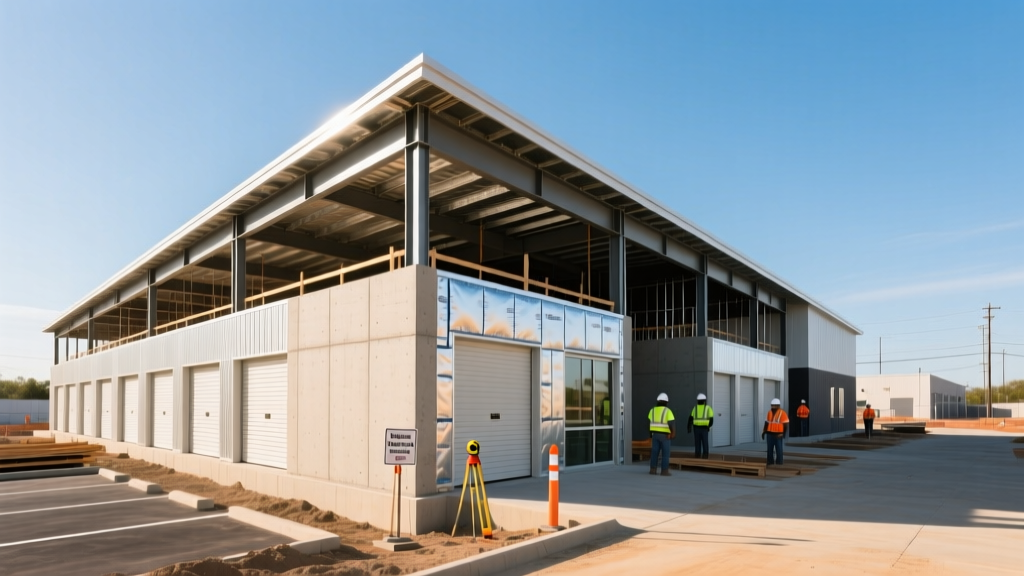
The True Cost to Build a Storage Unit Facility: 2026 Baselines
Securing capital for ground-up self-storage development requires a precise understanding of both hard construction costs and the debt structures available in the current macroeconomic environment. The total cost to build a storage unit facility is rarely a single line item; it is a composite of land acquisition, site work, vertical construction, and soft costs. In 2026, developers are navigating stabilized but elevated interest rates, making the selection of the right capital stack critical to project viability.
According to industry data tracked by Yardi Matrix, the national average for self-storage development costs varies wildly based on the product type and regional labor markets. Below are the current baseline costs per rentable square foot (RSF):
- Single-Story, Non-Climate Controlled: $35 to $55 per RSF. These traditional steel-building models remain the most cost-effective but face increasing zoning resistance in urban infill markets.
- Single-Story, Climate Controlled: $60 to $85 per RSF. Requires insulated metal panels (IMPs), HVAC zoning, and enhanced vapor barriers.
- Multi-Story, Urban Infill (Elevators & Climate Control): $110 to $160+ per RSF. Driven by expensive concrete/steel framing, fire suppression systems, and high-capacity freight elevators.
Matching Your Capital Stack to the Project Phase
Financing the cost to build a storage unit facility is rarely a one-and-done transaction. Most developers utilize a phased capital stack, starting with high-cost land acquisition debt, moving into a construction loan, and eventually refinancing into a stabilized commercial mortgage or CMBS loan once the facility reaches 85% to 90% occupancy.
| Loan Type | Max LTC / LTV | Typical 2026 Pricing | Term & Amortization | Best Use Case |
|---|---|---|---|---|
| SBA 504 | 90% LTC | Fixed (CDC portion ~6.5%) | 10/20/25-yr terms, 25-yr amort | Owner-operators building their flagship facility. |
| SBA 7(a) | 85% LTC | Prime + 2.25% to 2.75% | 10-25 yr terms, fully amortizing | Smaller projects (<$5M) or buying existing businesses. |
| Conventional Construction-to-Perm | 65% - 75% LTC | SOFR + 250-350 bps | 12-24 mo construction, 25-30 yr perm | Experienced sponsors with strong balance sheets. |
| Hard Money / Private Debt | 50% - 65% LTC | 10% - 13% Interest Only | 12-24 months, balloon payment | Land acquisition, zoning entitlements, or distressed turnarounds. |
What Lenders Scrutinize: The 4 Pillars of Storage Underwriting
When you approach a commercial lender or a Certified Development Company (CDC) to finance your storage facility, they will stress-test your pro forma against specific metrics. Self-storage is an operationally intensive asset class, and lenders price their risk accordingly.
1. Debt Service Coverage Ratio (DSCR)
Lenders require a minimum stabilized DSCR of 1.25x to 1.35x. This means your projected Net Operating Income (NOI) at stabilization (usually month 24 to 36) must exceed your annual debt service by at least 25%. If your annual mortgage payment is $200,000, the facility must generate a minimum of $250,000 in stabilized NOI.
2. Absorption and Lease-Up Velocity
According to development insights from Inside Self-Storage, a standard 50,000-square-foot facility should absorb between 1,500 and 2,500 net rentable square feet per month during lease-up. Lenders will heavily discount your pro forma if you project unrealistic absorption rates (e.g., reaching 90% occupancy in 6 months in a market with 10% supply growth).
3. Sponsor Liquidity and Experience
For conventional construction loans, lenders typically require the sponsor to have post-closing liquidity equal to 10% to 20% of the total loan amount. If you are building a $5 million facility and borrowing $3.5 million, the bank wants to see $350,000 to $700,000 in verified liquid assets to cover interest carry and cost overruns.
4. The SBA "Passive Investment" Prohibition
Navigating the SBA 504 Loan for Ground-Up Construction
For owner-operators, the SBA 504 loan is arguably the most powerful tool to finance the cost to build a storage unit facility. As outlined by the U.S. Small Business Administration, the 504 program splits the capital stack into three distinct tranches, minimizing the developer's out-of-pocket equity requirement.
- First Mortgage (Bank): 50% of the total project cost. This is a conventional senior loan with a 10-year balloon or a 25-year amortization.
- Second Mortgage (CDC): 40% of the total project cost. This is backed by a 100% SBA guaranty and features a below-market, fixed interest rate that remains locked for 10, 20, or 25 years.
- Borrower Equity: 10% of the total project cost. (Note: This increases to 15% if the project is considered a "single-purpose property," though many modern storage facilities with flexible layouts can successfully argue against this classification).
The primary advantage of the 504 program is that it preserves developer capital. By only putting 10% down, a sponsor can deploy their remaining cash into marketing, working capital, or the development of a second facility.
The Construction Draw Process: Managing the Cash Flow
Securing the loan is only the first step. During the 9-to-14-month construction phase, you do not receive the loan proceeds in a lump sum. Funds are disbursed via a rigorous draw process managed by a third-party construction inspector.
- AIA G702/G703 Forms: Your general contractor must submit these standardized applications for payment by the 25th of each month, detailing the percentage of work completed for every line item.
- 10% Retainage: Lenders will automatically withhold 10% of every draw to ensure the contractor completes the punch list. This retainage is released only after the Certificate of Occupancy (CO) is issued and all mechanic's lien waivers are collected.
- Interest Carry: You must pay interest only on the funds actually disbursed. Ensure your pro forma includes an "Interest Reserve"—a dedicated bucket of loan funds set aside specifically to pay the monthly interest during construction so you aren't paying out of pocket before the facility generates revenue.
Common Financing Pitfalls and How to Avoid Them
Pitfall 1: Underestimating Site Work and Utility Tap Fees
Many first-time developers focus entirely on the cost of the pre-engineered metal building and concrete slab, ignoring the dirt. Site work—including grading, stormwater retention ponds, and utility connections—can consume 20% to 30% of the hard costs. Municipal water and sewer tap fees alone can range from $40,000 to over $150,000 depending on the jurisdiction. Always secure a preliminary utility capacity letter from the local municipality before purchasing the land.
Pitfall 2: Ignoring the Stabilization Period Carry Costs
A 50,000-square-foot facility will not be cash-flow positive on day one. It typically takes 18 to 36 months to reach stabilized occupancy. If your construction loan converts to a permanent mortgage upon issuance of the CO, you will immediately owe full principal and interest payments while the facility is only 40% occupied. To survive this, negotiate a 12-to-18-month "interest-only" period on the permanent mortgage post-construction, or ensure your initial equity injection includes a dedicated operating deficit reserve.
Pitfall 3: Failing to Hedge Floating Rate Exposure
Construction loans are almost exclusively floating-rate instruments tied to the Secured Overnight Financing Rate (SOFR). If SOFR spikes during your 14-month build, your interest carry costs will blow past your budget. In 2026, prudent developers purchase a SOFR interest rate cap at loan closing. A cap agreement guarantees that your interest rate will not exceed a specific strike price (e.g., 5.5%), protecting your pro forma from macroeconomic volatility.
Finalizing Your Capital Strategy
Financing the cost to build a storage unit facility requires aligning your project's physical scope with the right debt instrument. If you are an active operator building a flagship location, the SBA 504 program offers unmatched leverage and fixed-rate stability. If you are an institutional sponsor building a multi-story urban infill project, a conventional construction-to-perm loan with a mezzanine equity layer will provide the necessary speed and flexibility. By stress-testing your absorption rates, capitalizing your interest reserves, and strictly managing the draw process, you can transition your project from raw land to a stabilized, cash-flowing asset.
Written by
Marcus ChenMarcus Chen is a licensed structural engineer (PE) and building materials analyst with over 12 years of experience across residential, commercial, and industrial construction. He holds a Master of Science in Civil Engineering from UC Berkeley and spent six years at Thornton Tomasetti before transitioning to independent consulting and technical writing. Marcus specializes in material selection for seismic-prone regions, concrete reinforcement strategies, and lifecycle cost analysis. His work has been cited by the American Concrete Institute (ACI) and the Structural Engineers Association of California (SEAOC). When he is not on a job site or at his desk, you will find him hiking the Sierra Nevada or restoring a 1920s craftsman bungalow in Oakland, CA.
More from Marcus Chen
View all
Construction Cost
How Much Did the Eiffel Tower Cost to Build?
How much did the Eiffel Tower cost to build in 1889? We adjust for inflation and compare its budget to modern skyscraper construction.
Aug 4, 2026

Fire Resistance
What Is a Fire Resistant Material? Testing & Certification Guide
Discover what is a fire resistant material through ASTM and UL testing. Learn how fire ratings, certifications, and assemblies work in construction.
Aug 4, 2026

Construction Cost
How Much Did the Burj Khalifa Cost to Build?
How much did the Burj Khalifa cost to build? We break down the $1.5B project and extract 5 money-saving strategies for your next build.
Jul 30, 2026