Asphalt Concrete Types: Taxonomy and Paving Selection Guide
Explore the asphalt concrete taxonomy, from HMA to porous mixes. Learn how to select the right binder grade and aggregate for your paving project.
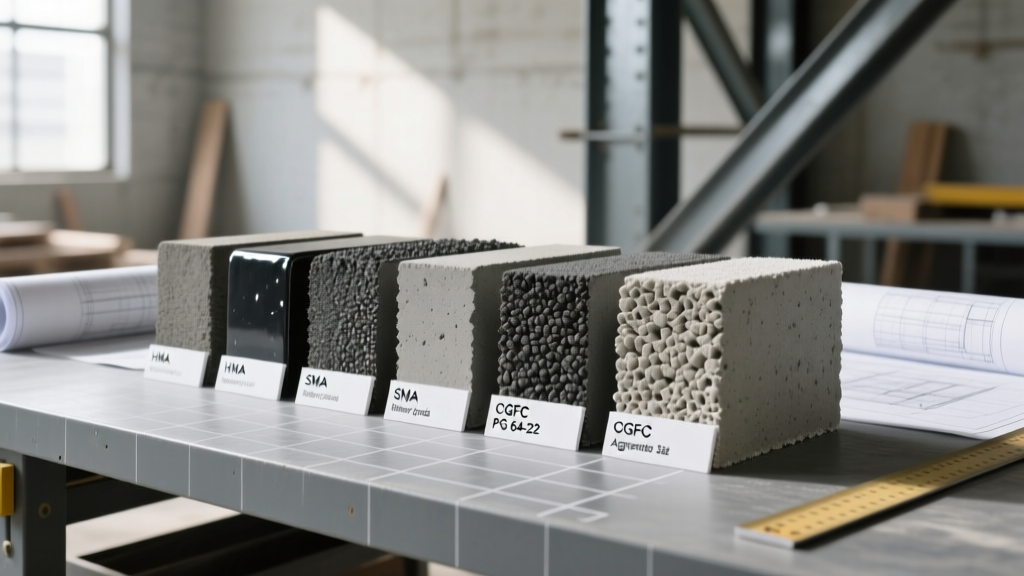
The Asphalt Concrete Taxonomy: Beyond 'Blacktop'
Asphalt concrete is a highly engineered composite material consisting of mineral aggregate bound together by bitumen (asphalt cement). While colloquially referred to as 'blacktop' or 'tarmac,' modern asphalt concrete is a complex, performance-driven material governed by strict rheological standards. Selecting the correct mix design is not a one-size-fits-all decision; it requires a deep understanding of traffic loads, climate extremes, and subgrade conditions. According to the Asphalt Institute, the distinction between mix types fundamentally alters the pavement's lifespan, noise profile, and maintenance cycle.
Primary Mix Classifications by Temperature and Composition
The taxonomy of asphalt concrete is primarily divided by production temperature and aggregate gradation. Each category serves a distinct structural or functional purpose in modern paving.
Hot Mix Asphalt (HMA)
HMA is the industry standard, produced and placed at temperatures between 300°F and 350°F (150°C - 175°C). The high heat reduces the viscosity of the bitumen, allowing for thorough aggregate coating and optimal compaction. HMA is further subdivided into dense-graded, open-graded, and gap-graded mixes. Dense-graded HMA is the workhorse for structural base and surface courses, offering high durability and low permeability.
Warm Mix Asphalt (WMA)
WMA technologies allow production and placement at temperatures 30°F to 100°F lower than traditional HMA. This is achieved through organic waxes, chemical surfactants, or zeolite additives that reduce binder viscosity without heat. WMA reduces plant fuel consumption by up to 20% and significantly lowers greenhouse gas emissions. It also extends the haul distance from the plant to the job site and improves worker comfort by reducing fumes.
Stone Matrix Asphalt (SMA)
SMA is a gap-graded mix designed to provide stone-on-stone interlock, offering exceptional rut resistance under heavy, channelized traffic. It contains a high coarse aggregate fraction (typically 70% or more passing the 4.75mm sieve) and a rich binder content (6.0% to 7.0%). Crucially, SMA requires the addition of cellulose or mineral fibers (usually 0.3% by weight of the total mix) to prevent binder drain-down during transport and placement.
Porous and Open-Graded Friction Courses (OGFC)
OGFC is a specialized surface layer with high interconnected void space (18% to 22%). It allows rainwater to drain through the pavement layer to the edges, virtually eliminating hydroplaning and reducing tire-pavement splash. It also reduces traffic noise by 2 to 4 decibels. However, OGFC is not a structural layer and must be placed over a dense, impermeable base.
Decoding the Performance Grade (PG) Binder System
The Superpave Performance Grading (PG) system, standardized under AASHTO M320, classifies asphalt binders based on their rheological performance at specific temperature extremes rather than arbitrary penetration or viscosity metrics. A binder designated as PG 64-22 is engineered to resist rutting at a maximum pavement temperature of 64°C and resist thermal cracking at a minimum pavement temperature of -22°C.
| PG Grade | Typical Climate Region | Primary Application |
|---|---|---|
| PG 52-28 | Northern US / Canada (Cold) | Low-volume rural roads |
| PG 64-22 | Mid-Atlantic / Midwest | Standard arterial roads, driveways |
| PG 70-22 | Southern US / High Heat | Interstates, heavy truck routes |
| PG 76-22 | Deep South / Extreme Heat | Port terminals, toll plazas, bus stops |
For high-stress areas like intersections and truck weigh stations, engineers often specify polymer-modified binders (PMB) to push the high-temperature grade to 76 or 82, significantly increasing the elastic recovery of the asphalt concrete.
Aggregate Selection and Gradation Profiles
Aggregates constitute roughly 95% of asphalt concrete by weight and 80% by volume. The structural integrity of the pavement relies heavily on aggregate interlock. The National Asphalt Pavement Association (NAPA) emphasizes that crushed, angular aggregates are mandatory for surface courses to ensure shear strength. Rounded particles (like uncrushed river gravel) lead to 'tender mixes' that shove and deform under roller compaction.
- Coarse-Graded Mixes: Nominal Maximum Aggregate Size (NMAS) of 19.0mm or larger. Excellent for base courses and rut resistance, but yields a rougher surface texture.
- Fine-Graded Mixes: NMAS of 12.5mm or 9.5mm. Provides a smoother ride quality and better skid resistance, making it ideal for surface overlays and residential driveways.
- Polished Stone Value (PSV): For high-speed highways, specify aggregates (like calcined bauxite or high-quality granite) with a PSV above 55 to prevent micro-texture loss and maintain wet-weather skid resistance.
Selection Matrix: Matching the Mix to the Application
Choosing the wrong asphalt concrete taxonomy for a specific application is a primary driver of premature pavement failure. Use the following matrix to align your project requirements with the correct material specifications.
| Application | Recommended Mix Type | Binder Grade | Target Lift Thickness |
|---|---|---|---|
| Residential Driveway | Fine-Graded Dense HMA | PG 64-22 | 2.0 - 2.5 inches |
| Commercial Parking Lot | Dense-Graded HMA / WMA | PG 64-22 or 70-22 | 3.0 - 4.0 inches (2 lifts) |
| Arterial Highway Surface | SMA or Coarse-Graded HMA | Polymer Modified PG 70-22 | 1.5 - 2.0 inches |
| High-Speed Interstate | OGFC over Dense HMA | Highly Modified PG 76-22 | 0.75 inch (OGFC only) |
Real-World Cost Variables and 2026 Pricing Benchmarks
Asphalt concrete pricing is highly volatile, tethered directly to the global crude oil market via the cost of liquid asphalt cement (binder). As of early 2026, material costs at the plant generally range from $130 to $175 per ton for standard dense-graded HMA, depending on regional aggregate availability and binder transport logistics.
Common Specification and Placement Failures to Avoid
Even with the perfect taxonomy selection, poor execution will compromise the pavement. The Federal Highway Administration (FHWA) identifies several critical failure modes related to mix selection and placement:
- Thermal Segregation: Occurs when temperature differentials exceed 25°F within the mat. Cooler spots fail to achieve proper density, leading to localized raveling and moisture infiltration. Use thermal imaging cameras during the breakdown rolling pass to identify cold spots.
- Inadequate Compaction: The target in-place density for dense-graded asphalt concrete is 92% to 96% of the Theoretical Maximum Specific Gravity (Gmm). Falling below 92% leaves interconnected air voids, accelerating oxidation and allowing water to strip the binder from the aggregate.
- Binder Stripping: Moisture damage occurs when the bond between the bitumen and aggregate fails. If using siliceous or acidic aggregates, a liquid anti-stripping agent (amine-based) or hydrated lime (1% to 1.5% by weight of aggregate) must be introduced at the plant to alter the aggregate surface chemistry.
By understanding the precise taxonomy of asphalt concrete and matching the binder grade, aggregate gradation, and mix type to the specific structural and environmental demands of your project, you can engineer a pavement system that maximizes lifecycle value and minimizes long-term maintenance interventions.