Cement Mix vs Concrete Mix: Which Material Do You Actually Need?
Discover the structural differences in cement mix vs concrete mix. Learn ASTM proportions, PSI strengths, and exact use cases for masonry and footings.

The Fundamental Chemistry: Binder vs. Composite
The terms "cement" and "concrete" are frequently used interchangeably by DIYers and even some general contractors, but in structural engineering and masonry, confusing a cement mix with a concrete mix leads to catastrophic application failures. To specify the correct material for your 2026 project, you must first understand the chemical hierarchy of these materials.
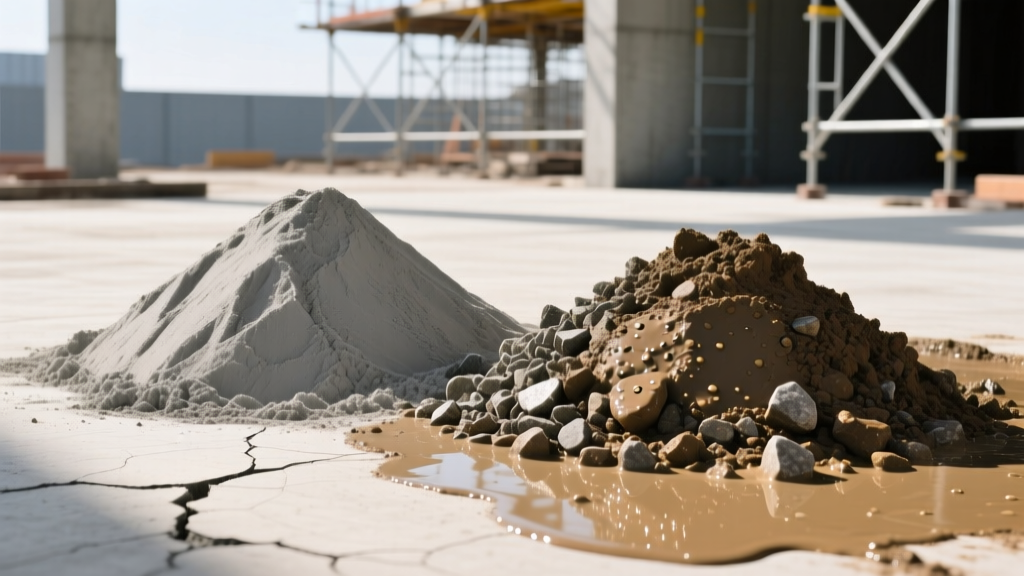
Cement is a finely ground calcined powder—most commonly Portland cement (ASTM C150)—that acts as the chemical binder. When mixed with water, it undergoes hydration, forming a rigid crystalline structure. Concrete, on the other hand, is a composite material. It consists of cement, water, fine aggregates (sand), and coarse aggregates (gravel or crushed stone). As the National Ready Mixed Concrete Association (NRMCA) defines it, cement is merely an ingredient of concrete, typically comprising only 10% to 15% of the total volume.
Cement Mix (Mortar): Composition and Masonry Applications
In practical construction terminology, a "cement mix" almost always refers to mortar or grout. Mortar is a blend of Portland cement, hydrated lime, fine masonry sand, and water. The absence of coarse gravel allows the mix to be highly workable, adhesive, and capable of holding heavy masonry units (brick, block, stone) together while accommodating slight structural movements.
Standard Mortar Proportions (ASTM C270)
Selecting the correct mortar type is critical. Using a mix that is too hard (high cement content) for soft masonry units will cause the bricks to crack under thermal expansion. Using a mix that is too soft will result in joint erosion and water infiltration.
| Mortar Type | Proportion (Cement:Lime:Sand) | Compressive Strength | Primary Application |
|---|---|---|---|
| Type M | 1 : 1/4 : 3 | 2,500 PSI | Below-grade foundations, retaining walls, heavy stone. |
| Type S | 1 : 1/2 : 4.5 | 1,800 PSI | At-grade exterior walls, brick veneers, patios. |
| Type N | 1 : 1 : 6 | 750 PSI | General above-grade masonry, soft brick, tuckpointing. |
| Type O | 1 : 2 : 9 | 350 PSI | Historic restoration, interior non-load-bearing walls. |
Concrete Mix: Aggregate Grading and Structural Integrity
Concrete relies on the mechanical interlock of coarse aggregates (typically 3/8-inch to 1-inch gravel) to achieve high compressive and tensile strength. According to the American Concrete Institute (ACI), the precise grading of these aggregates minimizes the volume of cement paste required, reducing shrinkage and lowering the overall cost of the mix while maximizing structural integrity.
The 1:2:3 Rule and Modern Admixtures
For standard structural applications (driveways, footings, slabs), the classic volumetric ratio is 1 part cement : 2 parts sand : 3 parts coarse gravel, mixed with roughly 0.45 to 0.50 parts water (water-cement ratio). However, modern concrete mix design rarely relies on raw proportions alone. Chemical admixtures are now standard:
- Air-Entraining Agents: Mandatory in freeze-thaw climates. These introduce microscopic air bubbles (typically 5-8% air content) that give expanding freezing water room to expand without spalling the concrete surface.
- Superplasticizers (HRWR): Allow for a drastic reduction in water content while maintaining high slump (workability), resulting in 4,000+ PSI mixes with minimal shrinkage cracking.
- Fly Ash / Slag Cement: Supplementary cementitious materials (SCMs) that replace 15-30% of Portland cement, reducing the carbon footprint and improving long-term durability against sulfate attack.
Direct Comparison Matrix: Cement Mix vs Concrete Mix
Use this decision matrix to verify you are specifying the correct material for your specific structural or aesthetic requirement.
| Feature | Cement Mix (Mortar) | Concrete Mix |
|---|---|---|
| Coarse Aggregate | None (Fine sand only) | Yes (3/8" to 1" gravel) |
| Compressive Strength | 350 - 2,500 PSI | 2,500 - 10,000+ PSI |
| Primary Function | Adhesion, bonding, joint filling | Load-bearing, structural mass |
| Workability | High (buttery, sticks to trowel) | Low to Medium (stiff, requires vibration/screeding) |
| Shrinkage Rate | Moderate (compensated by lime) | Low (aggregate restricts shrinkage) |
Troubleshooting Common Application Failures
Misapplying these materials is one of the most common and expensive errors in residential and light commercial construction. Here is how to identify and prevent the two most frequent failure modes:
Failure Mode 1: Using Mortar for Structural Footings
The Symptom: A mason uses a high-strength Type M mortar mix to pour a shallow footing for a retaining wall because they ran out of concrete mix.
The Result: Within two years, the footing exhibits severe spalling, map cracking, and eventual crushing under the structural load.
The Science: Mortar lacks the coarse aggregate skeleton required to distribute compressive loads. Without gravel, the hydrated cement paste takes the entire structural burden, leading to high shrinkage during curing and brittle failure under dead loads. Always use a minimum 2,500 PSI concrete mix with 3/4-inch aggregate for footings.
Failure Mode 2: Using Concrete for Bricklaying
The Symptom: A DIYer attempts to lay clay bricks using a bagged concrete mix, adding extra water to make it spreadable.
The Result: The mortar joints fail to adhere to the brick, and the gravel in the mix prevents a thin, uniform joint. Eventually, water penetrates the gaps, and the rigid concrete joints cause the softer clay bricks to crack during thermal expansion.
The Science: Concrete is designed to be rigid and lacks the lime content found in mortar. Lime provides the "fatness" (workability) and autogenous healing properties (re-sealing micro-cracks) necessary for masonry joints. Always use a Type N or Type S mortar for bricklaying.
2026 Sourcing and Cost Breakdown
Material costs fluctuate based on regional aggregate availability and fuel surcharges. Below are the average national pricing benchmarks for 2026 to help you estimate your project budget accurately:
- Bagged Portland Cement (94 lb / Type I/II): $16.00 – $22.00 per bag. (Used for custom site-mixed concrete or mortar).
- Bagged Mortar Mix (80 lb / Type S or N): $7.50 – $11.00 per bag. (Yields roughly 0.6 cubic feet).
- Bagged Concrete Mix (80 lb / 4000 PSI): $6.50 – $9.00 per bag. (Yields roughly 0.6 cubic feet).
- Ready-Mix Concrete Delivery: $145.00 – $175.00 per cubic yard (delivered). Note that short-load fees (typically $50-$75 per unused yard) apply for orders under 10 cubic yards.
Frequently Asked Questions
Can I add gravel to a bagged cement/mortar mix to make concrete?
Technically, yes, but it is not recommended for structural applications. Bagged mortar sand is graded specifically for fine masonry joints. Adding gravel to it will alter the water-cement ratio unpredictably. For structural slabs, buy pre-blended concrete mix or batch it from raw Portland cement, concrete sand, and 3/4-inch gravel.
Why does my concrete mix have small stones, but my cement mix does not?
The small stones (coarse aggregate) are the structural skeleton of concrete. They provide the bulk of the compressive strength and reduce the amount of expensive cement paste needed. Cement mixes (mortars) omit these stones intentionally so the mix can be troweled into thin, 3/8-inch joints between bricks or blocks.
Is Quikrete the same as cement?
No. Quikrete is a brand name that manufactures both concrete mixes and mortar mixes. Their standard "Concrete Mix" (No. 1101) contains Portland cement, sand, and gravel. Their "Mortar Mix" (No. 1102) contains Portland cement, lime, and masonry sand. Always read the specific product label to verify whether you are buying a composite concrete or a masonry cement mix.
Written by
James ThorntonJames Thornton is a construction industry veteran with 25 years of hands-on experience in wood framing, lumber grading, and residential building codes. He started as a framing carpenter in rural Oregon, earned his ICC Residential Building Inspector certification, and eventually became a senior plan reviewer for the City of Portland Bureau of Development Services. James holds a B.S. in Wood Science & Technology from Oregon State University and is a certified lumber grader through the West Coast Lumber Inspection Bureau (WCLIB). He has inspected over 3,000 residential construction sites and authored the city's internal guide on advanced framing techniques (2x6 at 24" O.C.). James lives in Bend, OR, where he builds custom timber-frame cabins and competes in lumberjack sports.
More from James Thornton
View all
Insulation
Best Home Insulation Materials: Complete 2026 Guide
Compare top home insulation materials for 2026. Find R-values, installed costs per square foot, and best uses for fiberglass, spray foam, and mineral wool.
Aug 4, 2026

Sustainable Building
Certify Your Green Building Material for LEED and WELL
Step-by-step guide to certifying a green building material for LEED v5 and WELL v2. Master EPDs, HPDs, and VOC limits for 2026 project specifications.
Aug 4, 2026

Stone & Masonry
Veneer Stacked Stone Panels: Interior Design & Style Showcase
Discover how veneer stacked stone panels transform interiors. Explore modern design profiles, material pairings, and technical installation specs.
Aug 4, 2026